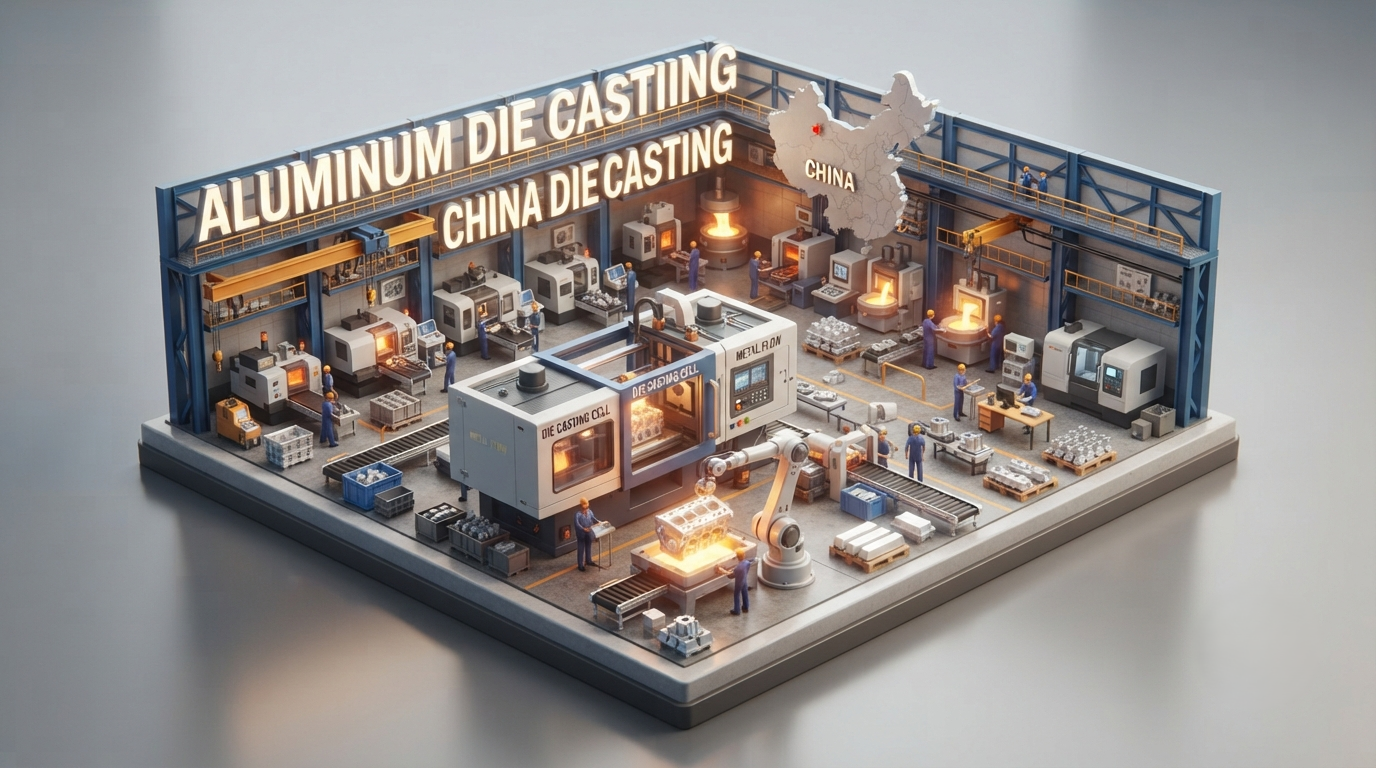
Modern manufacturers increasingly need metal components that combine strength, dimensional accuracy, low weight, and cost-efficient production. Aluminum die casting has become an important manufacturing method for meeting these requirements across automotive, electronics, machinery, lighting, telecommunications, and consumer-product applications.
Choosing an experienced Aluminum Die Casting Manufacturer is therefore more than simply finding a company capable of producing metal parts. The right manufacturing partner should understand tooling, alloy selection, casting parameters, machining, surface finishing, inspection, and scalable production.
At the same time, China Die Casting has developed into an important sourcing option for international businesses seeking integrated manufacturing capabilities and competitive large-volume production.
What Is Aluminum Die Casting?
Aluminum die casting is a manufacturing process in which molten aluminum alloy is injected under pressure into a precisely engineered steel die. After the metal cools and solidifies, the die opens and the finished casting is removed.
The process is particularly suitable for components requiring:
- Complex shapes and detailed features
- Thin-wall construction
- Consistent dimensions
- Good strength-to-weight performance
- Repeatability across large production volumes
- Integrated bosses, ribs and mounting features
- Compatibility with secondary machining and finishing
A capable Aluminum Die Casting Manufacturer can help optimise the component before tooling begins, potentially reducing unnecessary material, machining operations and production complexity.
Why Aluminum Is Widely Used for Die Casting
Aluminum combines several properties that make it attractive for engineered components. It is lightweight compared with many traditional metals while offering useful mechanical performance and corrosion resistance.
Lightweight Engineering
Reducing component weight is particularly important in vehicles, portable equipment, electronics and transportation systems. Aluminum allows designers to lower weight without automatically sacrificing structural functionality.
Thermal Performance
Aluminum’s thermal conductivity makes die-cast components suitable for heat sinks, LED housings, electronic enclosures and other products requiring effective heat management.
Design Flexibility
Die casting allows complicated geometries to be manufactured as a single component. Features that might otherwise require separate parts, welding or extensive machining can sometimes be incorporated directly into the casting design.
Surface Finishing Options
Depending on the alloy and application, aluminum castings may undergo powder coating, painting, polishing, plating or other suitable finishing processes.
Understanding China Die Casting Manufacturing
China Die Casting covers a broad manufacturing ecosystem ranging from specialised casting factories to suppliers offering tooling, CNC machining, finishing, assembly and inspection under coordinated production systems.
The advantage is not simply lower manufacturing cost. A well-selected supplier may provide an integrated process from design review through finished-component delivery.
A typical production workflow includes:
- Drawing and technical requirement review
- Design-for-manufacturing analysis
- Alloy selection
- Die and tooling engineering
- Prototype or sample validation
- Die casting
- Trimming and deburring
- CNC machining where required
- Surface treatment
- Dimensional and quality inspection
- Packaging and shipment
Buyers should assess these capabilities individually rather than assuming every supplier provides the same level of engineering or quality control.
Aluminum Die Casting Manufacturer vs Basic Casting Supplier
| Factor | Professional Manufacturer | Basic Casting Supplier |
| Design support | DFM and engineering assistance | Often limited |
| Tooling | Integrated tool development | May be outsourced |
| Machining | CNC finishing available | May require another vendor |
| Quality control | Structured inspection process | Varies considerably |
| Finishing | Multiple options may be available | Often limited |
| Scalability | Suitable for repeat production | Capacity may vary |
| Traceability | Production records may be maintained | Depends on supplier |
Price should therefore be considered alongside technical capability, consistency and total landed cost.
How to Select the Right Aluminum Die Casting Manufacturer
Supplier selection should begin with engineering requirements rather than quotation price alone.
Review Technical Capabilities
Confirm whether the manufacturer can handle the required component dimensions, casting weight, tolerances, production volume and alloy specifications.
Evaluate Tooling Experience
Tool design has a major influence on casting quality and production stability. Ask how the supplier approaches gating, venting, cooling, ejection and expected tool maintenance.
Examine Quality Management
Quality control may include dimensional inspection, material verification, visual checks, leak testing, X-ray inspection or other application-specific testing.
Request Documentation When Necessary
Depending on your industry, useful documentation may include inspection reports, material certificates, process records and relevant quality-management certifications.
Importance of Design for Manufacturability
A strong Aluminum Die Casting Manufacturer should review a component before the production die is finalised.
Design-for-manufacturability analysis can examine wall thickness, draft angles, ribs, bosses, fillets, undercuts, machining allowances and parting-line placement.
Small design improvements at this stage can have significant production benefits. For example, more consistent wall thickness can support better metal flow, while appropriate draft can make part ejection easier.
Good DFM collaboration can also reduce secondary machining and unnecessary material consumption.
Quality Control in China Die Casting
When sourcing through China Die Casting, buyers should define measurable acceptance criteria before mass production begins.
Important quality considerations include dimensional tolerances, surface requirements, porosity limits, mechanical properties, critical machining dimensions and functional testing requirements.
Communication is equally important. Engineering drawings should clearly identify critical-to-quality dimensions and special requirements.
For complex projects, first-article inspection before full production provides an opportunity to identify and correct problems before larger quantities are manufactured.
Industries Using Aluminum Die Cast Components
Aluminum die casting supports a wide range of applications, including:
- Automotive brackets, housings and structural components
- Electric vehicle components
- LED lighting housings
- Telecommunications equipment
- Electronic enclosures
- Industrial machinery parts
- Power-tool housings
- Pump and motor components
- Appliance parts
- Consumer-product components
The correct process depends on operating temperature, loads, environment, dimensional requirements and expected production quantity.
Reducing Total Manufacturing Cost
The lowest unit quotation does not necessarily produce the lowest overall project cost.
A reliable Aluminum Die Casting Manufacturer can help control total cost through better tooling, optimised component geometry, reduced scrap, appropriate automation and fewer secondary operations.
Buyers should consider tooling investment, machining, finishing, inspection, packaging, freight and potential quality-related costs when comparing suppliers.
This broader calculation provides a more realistic basis for evaluating China Die Casting sourcing options.
Frequently Asked Questions
1. What does an aluminum die casting manufacturer produce?
Manufacturers produce precision aluminum components using high-pressure die casting, often followed by machining, finishing and inspection.
2. Why choose aluminum for die casting?
Aluminum offers low weight, useful strength, corrosion resistance, thermal conductivity and considerable design flexibility.
3. Is China die casting suitable for high-volume production?
Yes. Many Chinese manufacturers are equipped for repeat and high-volume production, although actual capacity should always be verified.
4. Can die-cast aluminum parts be CNC machined?
Yes. Critical holes, threads, sealing surfaces and precision dimensions can be machined after casting.
5. What industries use aluminum die casting?
Common industries include automotive, electronics, lighting, telecommunications, industrial equipment and consumer products.
6. What should buyers check before choosing a manufacturer?
Review engineering capability, tooling experience, quality systems, equipment, inspection resources, capacity and communication.
7. Can complex shapes be die cast?
Yes. One of the main advantages of die casting is its ability to manufacture relatively complex geometries efficiently.
8. Does every casting require surface finishing?
No. Finishing depends on appearance, corrosion protection and functional requirements.
9. Why is tooling important in die casting?
Tooling affects metal flow, cooling, dimensional stability, surface quality, cycle efficiency and overall production consistency.
10. How can international buyers reduce sourcing risks?
Provide detailed drawings, specify acceptance criteria, approve samples, confirm inspection procedures and establish clear communication before mass production.