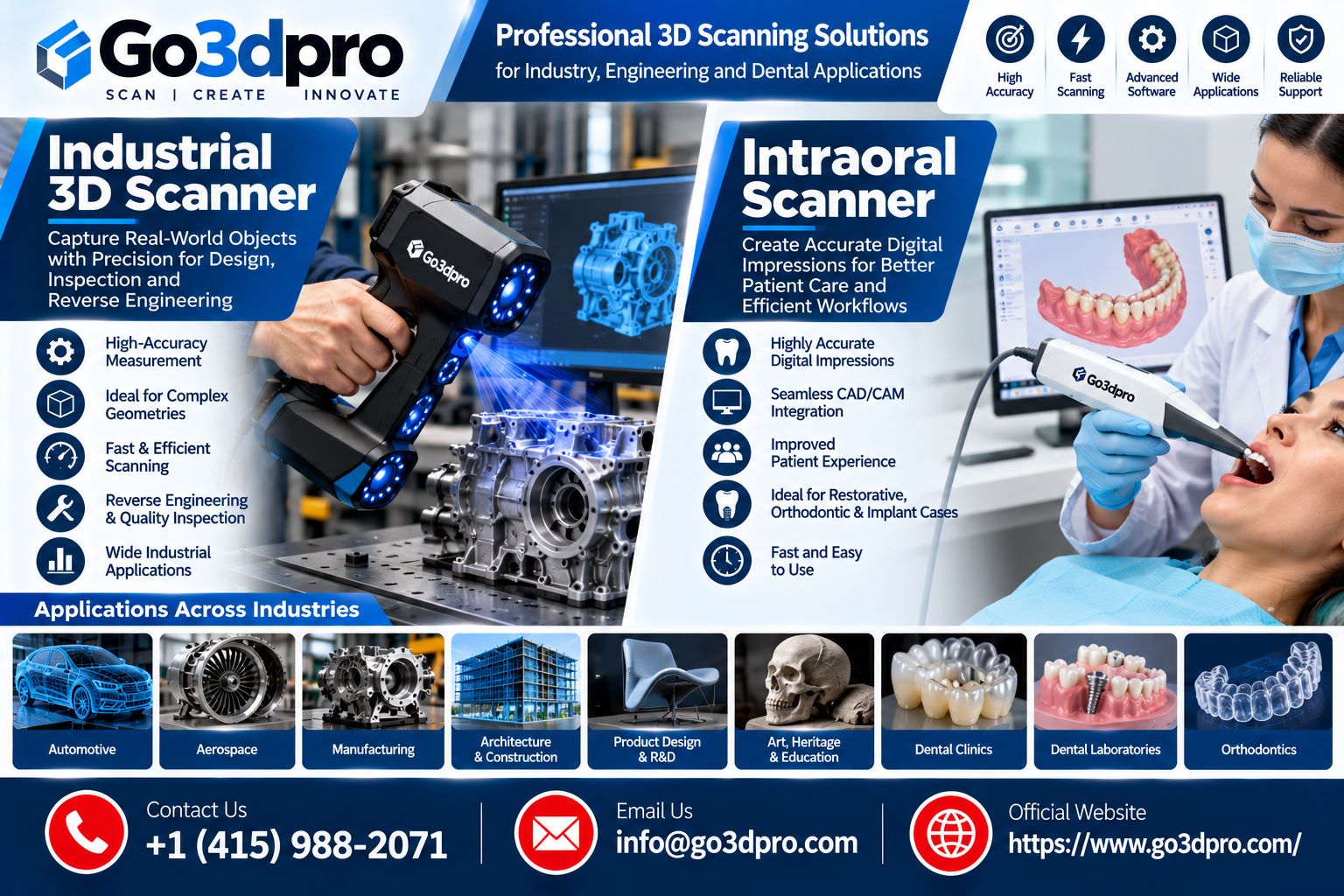
Three-dimensional scanning is changing how engineers, manufacturers, dental professionals, and designers capture physical objects and convert them into usable digital information.
From industrial quality inspection to digital dental impressions, scanning technology offers opportunities to improve measurement workflows, support precision, and simplify digital design processes.
Choosing the Best 3D Scanner requires evaluating accuracy, scanning technology, software compatibility, and application requirements.
Meanwhile, an intraoral scanner is designed specifically for capturing digital impressions of teeth and oral structures, supporting selected restorative and orthodontic workflows.
Understanding the differences between these technologies helps businesses and healthcare professionals make informed purchasing decisions.
What Is a 3D Scanner?
A 3D scanner is an electronic device that captures the shape and geometry of a physical object to create a three-dimensional digital representation.
Depending on the equipment, scanning may involve structured light, laser-based measurement, or other optical technologies.
Captured information can be processed into point clouds, polygon meshes, or compatible digital models.
Common applications include:
- Industrial product inspection.
- Reverse engineering.
- Automotive component analysis.
- Product design and prototyping.
- Engineering research.
- Cultural heritage documentation.
- Selected dental laboratory workflows.
What Makes the Best 3D Scanner?
The Best 3D Scanner is not necessarily the device with the highest advertised resolution or purchase price.
Its value depends on how effectively it meets the user’s requirements.
Measurement Accuracy
Accuracy indicates how closely captured measurements represent actual object dimensions.
Scanning Resolution
Resolution determines the level of surface detail a scanner can record. High resolution does not automatically mean high accuracy.
Scanning Speed
Faster capture may improve workflow efficiency, provided the equipment maintains suitable performance.
Portability
Handheld scanners are useful for capturing objects that cannot easily be transported.
Software Integration
Compatible software allows users to process, inspect, export, and work with scanned data.
Technical Support
Training, calibration guidance, software updates, and maintenance arrangements influence long-term usability.
What Is an Intraoral Scanner?
An intraoral scanner is a specialized dental imaging device that captures digital impressions directly inside a patient’s mouth.
It uses optical technology to record the geometry of teeth and surrounding oral structures.
The resulting digital data may support dental restorations, orthodontic planning, and communication with laboratories.
Common applications include:
Crowns and Bridges: Capturing suitable digital impressions for restorative design.
Orthodontics: Recording dental anatomy for selected treatment-planning workflows.
Dental Appliances: Supporting digital design of compatible dental devices.
Patient Communication: Displaying three-dimensional dental models during consultations.
Laboratory Collaboration: Transferring compatible digital files for fabrication processes.
Clinical accuracy depends on the scanner, operating technique, and specific procedure.
How Does Intraoral Scanning Work?
A dental professional moves the scanner’s imaging tip around the selected teeth and oral structures.
The device captures optical information, which software processes into a digital three-dimensional model.
The process generally includes:
- Patient Assessment: Confirming that digital scanning is appropriate.
- Preparation: Managing visibility, moisture, and access to the scanning area.
- Image Capture: Recording the required dental surfaces.
- Digital Processing: Combining captured information into a model.
- Quality Review: Checking for missing or distorted data.
- File Transfer: Exporting information into compatible dental software.
Best 3D Scanner vs Intraoral Scanner
Although both devices create digital three-dimensional representations, their applications differ.
| Feature | General 3D Scanner | Intraoral Scanner |
| Primary application | Industrial and object digitization | Dental digital impressions |
| Scanning targets | Components and physical objects | Teeth and oral structures |
| Important factors | Accuracy, object size, surface detail | Clinical accuracy, ergonomics, hygiene |
| Software integration | CAD and inspection systems | Dental CAD/CAM workflows |
| Typical users | Engineers and manufacturers | Dental professionals |
General-purpose scanners should not be used for intraoral clinical applications unless specifically authorized and suitable for that purpose.
Benefits of Digital Scanning in Modern Dentistry
Digital impressions offer several potential advantages over conventional impression techniques.
Improved Workflow Convenience
Digital information can be reviewed without handling conventional impression materials.
Faster Digital Communication
Compatible scans can be transmitted electronically to participating dental laboratories.
Patient Experience
Some patients may find digital scanning more comfortable than conventional impression procedures.
Digital Record Management
Three-dimensional models can support appropriate digital documentation and comparison.
CAD/CAM Compatibility
Digital scans can contribute to computer-aided design and manufacturing workflows.
However, conventional impressions remain appropriate in some clinical circumstances.
How to Choose the Right Intraoral Scanner
Dental professionals should evaluate equipment according to their specific clinical needs.
Important considerations include:
- Accuracy for the intended dental procedures.
- Scanning-tip size and ergonomics.
- Ease of use and operator training.
- Full-arch and localized scanning performance.
- Software compatibility and available file formats.
- Infection-control and sterilization requirements.
- Product authorization in the relevant market.
- Maintenance, updates, and technical support.
Requesting a practical demonstration can help dental teams understand how equipment performs in realistic clinical conditions.
Why Scanner Accuracy and Software Matter
The performance of a scanning system depends on both hardware and software.
Scanning errors may arise from reflective surfaces, movement, poor calibration, restricted access, or incomplete data capture.
Software processing can influence model alignment and final output quality.
For industrial applications, measurement validation is especially important when models are used for dimensional inspection.
For dental applications, clinicians must evaluate whether the captured geometry is sufficiently complete and accurate for the intended procedure.
Important Buying Considerations
Before selecting the Best 3D Scanner, purchasing teams should compare overall ownership costs.
These may include equipment, software subscriptions, training, maintenance, accessories, and support.
Dental buyers should also examine compatibility with existing laboratory systems and confirm applicable clinical requirements.
A supplier demonstration using representative objects or dental workflows can reveal practical limitations that product specifications alone may not show.
Frequently Asked Questions (FAQs)
1. What is the Best 3D Scanner?
The best device depends on measurement accuracy, object size, scanning environment, software compatibility, and budget.
2. What is an intraoral scanner?
It is a dental imaging device used to capture digital impressions of teeth and oral structures.
3. Are intraoral scanners accurate?
Suitable devices can provide accurate digital impressions, although results vary with equipment, technique, and clinical conditions.
4. Can 3D scanners be used for reverse engineering?
Yes. Appropriate scanners capture geometry that can support reverse engineering and CAD workflows.
5. Do intraoral scanners replace traditional impressions?
They can replace conventional impressions in many procedures, but not every clinical situation.
6. What file formats do 3D scanners support?
Common formats include STL, OBJ, PLY, and proprietary formats, depending on the equipment.
7. Are intraoral scanners comfortable for patients?
Many patients find them convenient, but comfort varies according to anatomy, scanning duration, and technique.
8. Can dental scans support orthodontic planning?
Yes. Compatible digital impressions can support selected orthodontic assessment and planning workflows.
9. What affects 3D scanner pricing?
Technology, accuracy, software, accessories, maintenance, training, and technical support influence costs.
10. How should buyers select a 3D scanner supplier?
Compare specifications, demonstrations, software compatibility, regulatory requirements, warranty terms, and available support.
Media Contact
Industry: 3D Scanning, Digital Manufacturing & Dental Technology
Service Enquiries: 3D Scanners, Intraoral Scanners, Digital Scanning Solutions & CAD/CAM Equipment
Contact Number: +1 (415) 988-2071
Email: info@go3dpro.com
Official Website: https://www.go3dpro.com/