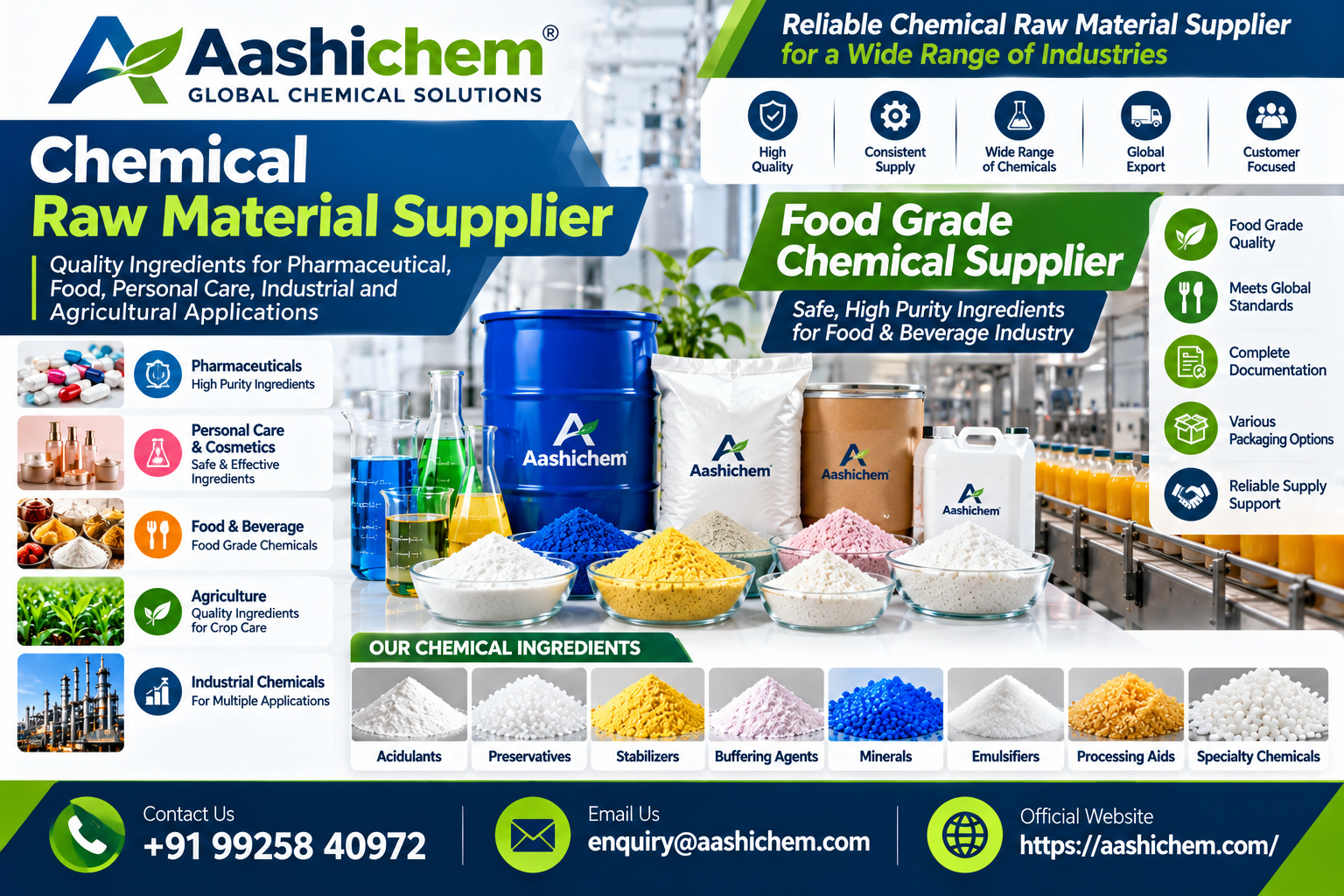
The demand for consistent raw material quality remains an important consideration for manufacturers working across food processing, cosmetics, pharmaceuticals, agriculture, and industrial production.
Selecting a reliable Chemical Raw Material Supplier helps businesses obtain ingredients that meet their technical specifications, production requirements, and purchasing expectations.
At the same time, choosing an experienced Food Grade Chemical Supplier is particularly important for food manufacturers, where ingredient purity, traceability, and compliance with applicable food safety regulations require careful attention.
As businesses strengthen their procurement practices, understanding chemical grades, supplier qualifications, quality documentation, and safe handling procedures can support more dependable manufacturing operations.
What Is a Chemical Raw Material Supplier?
A Chemical Raw Material Supplier is a business that manufactures, distributes, sources, or supplies chemical ingredients for commercial and industrial applications.
Depending on its capabilities, a supplier may provide different chemical grades, packaging options, and procurement quantities.
Common product categories include:
- Industrial chemical ingredients.
- Specialty chemical compounds.
- Food-processing ingredients.
- Cosmetic raw materials.
- Pharmaceutical intermediates.
- Textile-processing chemicals.
- Water-treatment chemicals.
- Plastic and polymer additives.
Each application requires appropriate material specifications.
Understanding the Role of a Food Grade Chemical Supplier
A Food Grade Chemical Supplier provides chemical ingredients intended for permitted applications in food manufacturing or processing.
Food-grade materials must meet relevant purity criteria, safety requirements, and applicable regulations.
These ingredients may serve different purposes depending on the formulation and permitted use.
Examples include:
Acidity Regulators: Help adjust acidity in suitable food formulations.
Preservatives: Certain authorized ingredients help control microbial spoilage under specified conditions.
Emulsifiers: Support the mixing and stability of compatible ingredients.
Antioxidants: Help protect selected products against oxidation.
Processing Aids: Assist particular manufacturing processes when legally permitted.
Importantly, a chemical described as food grade is not automatically approved for every food application or concentration.
Chemical Raw Material Supplier vs Food Grade Chemical Supplier
Although these supplier categories may overlap, their quality and regulatory requirements can differ.
| Feature | Chemical Raw Material Supplier | Food Grade Chemical Supplier |
| Primary market | Industrial and commercial manufacturing | Food manufacturing and processing |
| Product grades | Industrial and specialized grades | Grades meeting applicable food requirements |
| Quality focus | Composition and application suitability | Purity, contaminants, traceability and safety |
| Documentation | COA, SDS and specifications | COA, specifications and relevant food compliance records |
| Main buyers | Industrial manufacturers | Food processors and ingredient distributors |
A supplier serving both sectors must distinguish products clearly and maintain appropriate quality controls.
Why Chemical Quality Matters in Manufacturing
Consistent raw materials help manufacturers maintain predictable production processes.
Product Consistency
Defined purity and composition reduce unexpected formulation variations.
Manufacturing Efficiency
Suitable ingredients can help production teams maintain established processing conditions.
Regulatory Compliance
Materials must satisfy the legal requirements relevant to their intended uses and destination markets.
Supply Reliability
Clear procurement arrangements help buyers plan inventory and production schedules.
Traceability
Batch identification and supporting records assist with quality investigations when necessary.
Key Factors When Selecting a Chemical Raw Material Supplier
Industrial buyers should evaluate suppliers using clear technical and commercial criteria.
- Chemical Identity: Confirm the correct substance name and CAS number, where applicable.
- Purity Requirements: Review relevant specifications and impurity limits.
- Product Grade: Ensure the material is appropriate for its intended application.
- Quality Documentation: Request relevant technical records and batch information.
- Packaging: Confirm container suitability and labeling requirements.
- Order Quantities: Discuss minimum quantities and bulk supply arrangements.
- Delivery Reliability: Clarify shipment schedules and logistics conditions.
- Commercial Transparency: Establish pricing, payment terms, and acceptance criteria.
Sample evaluation can help determine whether the material performs as expected before commercial purchasing.
Important Requirements for Food Grade Chemicals
Businesses choosing a Food Grade Chemical Supplier should apply additional scrutiny to materials intended for food applications.
Food Safety Compliance
Ingredients must meet the regulations applicable to the intended food product and market.
Purity and Contaminants
Relevant specifications may address heavy metals, residual substances, or other contaminants.
Batch Traceability
Lot numbers and supply records support product identification and quality management.
Storage and Handling
Appropriate procedures help reduce contamination and preserve material quality.
Application Suitability
The ingredient’s permitted function, concentration, and conditions of use must be confirmed.
Requirements can differ between India and international destination markets.
Essential Chemical Quality Documents
Reliable procurement relies on proper documentation.
A Certificate of Analysis (COA) reports the results of specified tests for a material or batch.
A Safety Data Sheet (SDS) provides information on hazards, safe handling, storage, and emergency procedures.
A technical specification describes the material’s required characteristics.
For food-related ingredients, buyers may also need relevant compliance declarations, contaminant information, and traceability records.
Documentation should be reviewed for the specific product rather than assuming that one certificate covers an entire supplier’s portfolio.
Bulk Chemical Packaging and Transportation
Industrial chemicals may be supplied in bags, drums, containers, or other suitable packaging formats.
Packaging selection depends on chemical compatibility, physical form, quantity, and transport requirements.
Certain substances require specialized handling or dangerous-goods documentation.
Food-grade ingredients should be protected against contamination during storage, loading, and transportation.
The complete supply chain should follow applicable safety and regulatory procedures.
Common Chemical Procurement Challenges
Businesses may encounter inconsistent specifications, incomplete documentation, unexpected delivery delays, or incompatible packaging.
These issues can be reduced through written purchase requirements, sample approvals, quality agreements, and clear supplier communication.
Purchasing teams should consider total procurement costs rather than comparing unit prices alone.
A lower-priced material may not provide better value if it creates production interruptions or additional quality-control expenses.
Frequently Asked Questions (FAQs)
1. What does a Chemical Raw Material Supplier do?
It sources, manufactures, distributes, or supplies chemicals for industrial and commercial applications.
2. What is a Food Grade Chemical Supplier?
It supplies chemical ingredients intended to meet applicable requirements for permitted food-related uses.
3. Are food-grade and industrial-grade chemicals the same?
No. They may have different purity, contaminant, quality-control, and regulatory requirements.
4. Which industries require chemical raw materials?
Food processing, cosmetics, pharmaceuticals, textiles, agriculture, and industrial manufacturing are common examples.
5. What is a Certificate of Analysis?
A COA records specified quality-test results for a particular material or batch.
6. Why is batch traceability important?
It helps identify materials and investigate potential quality or supply problems.
7. Can food-grade chemicals be purchased in bulk?
Yes, subject to supplier availability, product specifications, and purchasing requirements.
8. What affects chemical raw material prices?
Grade, purity, quantity, packaging, transportation, and market conditions influence pricing.
9. Are all food-grade ingredients permitted in every country?
No. Permitted applications and regulatory requirements differ by jurisdiction.
10. How should manufacturers select a reliable chemical supplier?
Compare specifications, documentation, sample quality, regulatory suitability, delivery arrangements, and commercial terms.
Media Contact
Industry: Industrial Chemicals, Specialty Ingredients & Chemical Distribution
Service Enquiries: Chemical Raw Materials, Food-Grade Chemical Ingredients, Specialty Chemicals & Bulk Chemical Supply
Contact Number: +91 99258 40972
Email: enquiry@aashichem.com
Official Website: https://aashichem.com/