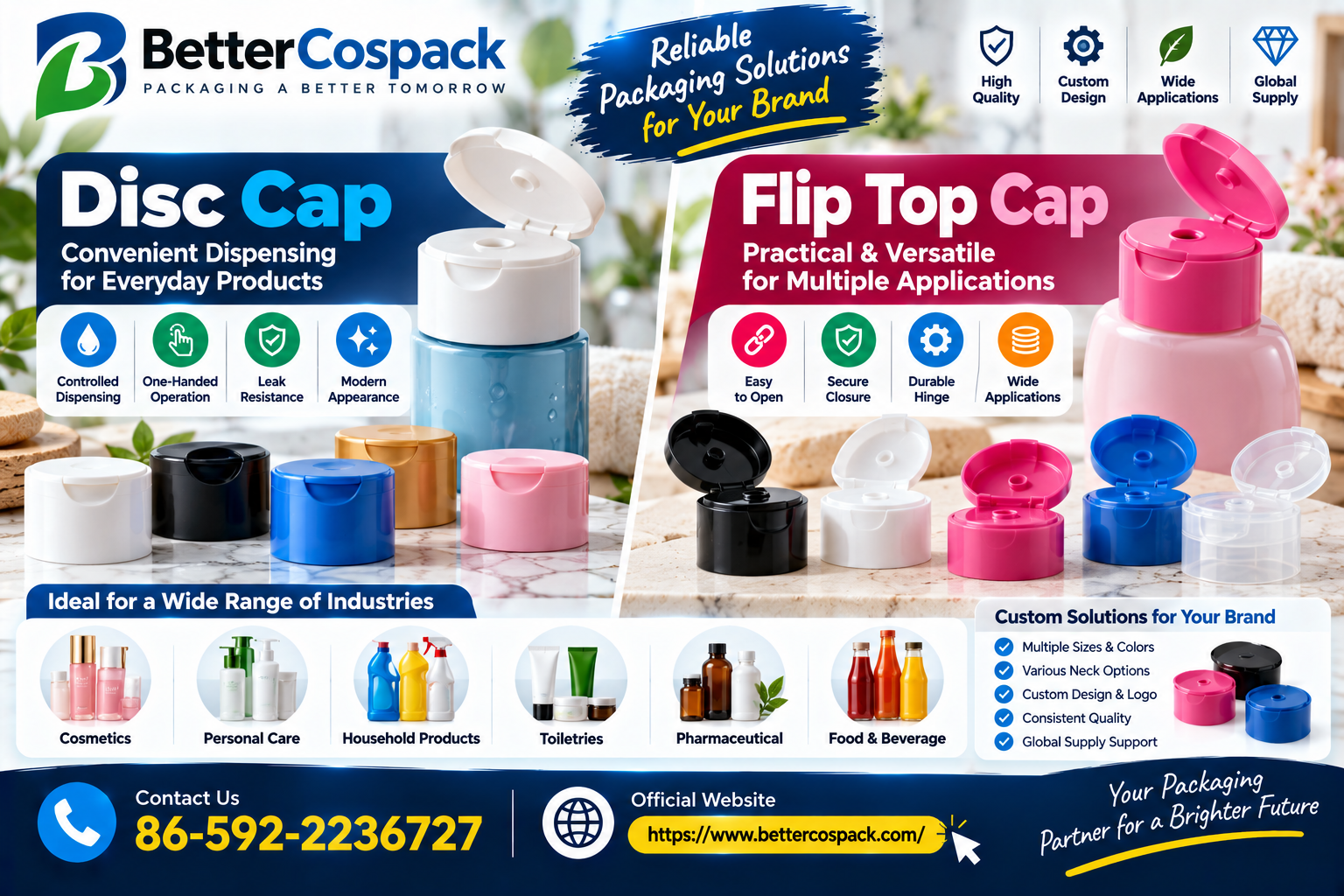
Packaging design is becoming increasingly important as consumer brands compete for convenience, product protection, shelf appeal, and ease of use. Among the most widely used dispensing closures are the disc cap and flip top cap, both of which are commonly found on bottles used for cosmetics, personal care, household products, toiletries, and selected food or wellness applications.
While both closure types are designed to improve dispensing convenience, their mechanisms and user experience differ. A disc cap typically opens through a press-to-open action, while a flip top cap uses a hinged lid that can be opened and closed repeatedly. For brands and packaging buyers, selecting the right closure requires attention to product viscosity, bottle neck design, dispensing control, leak resistance, aesthetics, and consumer expectations.
What Is a Disc Cap?
A disc cap is a dispensing closure commonly designed with a top disc that tilts when one side is pressed.
When opened, the opposite side rises to reveal the dispensing orifice. Pressing the raised side closes the cap again.
This simple mechanism makes it popular for products that need convenient one-handed dispensing.
Typical applications can include:
- Shampoo
- Conditioner
- Lotion
- Body wash
- Hair-care products
- Personal-care liquids
- Household products
The smooth top surface can also give bottles a clean and modern appearance.
Why Brands Choose Disc Cap Packaging
One major advantage of the disc cap is convenience.
Consumers can generally open and close the package quickly without completely removing the closure.
Other potential advantages include:
- Controlled dispensing
- Neat appearance
- One-handed operation
- Reusable opening mechanism
- Good compatibility with many bottle styles
- Reduced risk of losing a separate cap
For products frequently used in bathrooms or while travelling, convenience can strongly influence consumer preference.
Important Disc Cap Design Considerations
Not every disc closure is suitable for every formula.
Packaging designers should consider product characteristics carefully.
Dispensing Orifice
The opening size should match the viscosity of the product.
A very thick formulation may require a larger opening, while a thinner liquid may need a smaller orifice to provide better control.
Closure Fit
The disc cap must properly match the bottle neck and thread or snap system.
Poor compatibility can lead to leaking, loose fit, or filling-line problems.
Material Selection
Closure materials should be appropriate for the intended product, filling conditions, storage environment, and distribution requirements.
Consumer Handling
The press mechanism should operate smoothly without requiring excessive force.
What Is a Flip Top Cap?
A flip top cap is a dispensing closure with an attached hinged lid.
Consumers lift the lid to access the dispensing opening and push it closed after use.
The hinge keeps the top connected to the main closure, eliminating the need to remove and store a separate cap.
Common applications may include:
- Shampoo bottles
- Face wash
- Hand lotion
- Body lotion
- Shower gel
- Cosmetics
- Household cleaners
- Condiment-style packaging
The format is popular because it is simple, familiar, and convenient.
Why Flip Top Cap Packaging Remains Popular
A flip top cap offers a practical combination of accessibility and closure security.
Consumers generally understand the mechanism immediately, making it suitable for mass-market products.
Potential benefits include:
- Quick opening and closing
- Attached lid
- Controlled product dispensing
- Convenient repeated use
- Wide design flexibility
- Suitability for many bottle sizes
The external design can also be customized to complement different brand identities and bottle shapes.
Disc Cap vs Flip Top Cap
Both closure styles provide convenient dispensing, but their user experience differs.
| FeatureDisc CapFlip Top Cap | ||
| Opening method | Press-to-open disc | Hinged lid |
| Appearance | Smooth, compact top | Visible lid and hinge |
| One-handed use | Typically convenient | Typically convenient |
| Lid removal | Not required | Not required |
| Common applications | Personal care, lotion, shampoo | Cosmetics, toiletries, household products |
| Dispensing control | Depends on orifice design | Depends on orifice design |
| Branding flexibility | Clean, minimal look | Broad styling possibilities |
The best choice depends on the product, bottle, positioning, and consumer-use environment.
Product Viscosity Plays a Major Role
Viscosity is one of the most important factors when choosing a dispensing closure.
A thick lotion behaves differently from a watery cleanser.
If the dispensing opening is too small, thick products may be difficult to dispense. If it is too large, thinner liquids may flow too quickly.
Both disc cap and flip top cap designs should therefore be evaluated using the actual product formula whenever possible.
Prototype testing can help determine whether the user gets the right amount of product with reasonable pressure.
Leak Resistance Is Essential
Closures must protect the product during transportation, storage, retail handling, and consumer use.
Leak performance can depend on:
- Bottle-neck dimensions
- Closure tolerances
- Sealing surfaces
- Liner or sealing design
- Product viscosity
- Filling process
- Storage orientation
Packaging buyers should avoid evaluating a closure independently of the bottle.
A cap and bottle work as a complete packaging system.
Packaging Aesthetics Influence Brand Perception
The closure is highly visible and contributes directly to the overall appearance of the package.
A sleek disc cap can complement minimalist cosmetic or personal-care packaging.
A flip top cap can offer more visible shape and design opportunities for brands seeking a distinctive closure profile.
Manufacturers may offer options involving:
- Custom colours
- Surface finishes
- Different shapes
- Multiple diameters
- Logo or decorative treatment
- Matching bottle designs
Colour consistency can be particularly important for brands using closures across a product family.
Manufacturing Quality Matters
A dispensing closure may be opened hundreds of times during its useful life.
This means manufacturing consistency is important.
Quality control should evaluate factors such as:
- Dimensions
- Opening and closing action
- Hinge performance
- Surface finish
- Colour consistency
- Closure fit
- Dispensing function
- Sealing performance
For a flip top cap, hinge quality deserves special attention because repeated movement can place stress on the closure.
For a disc-style closure, the pressing and tilting mechanism should operate reliably.
Testing Before Mass Production
Brands should ideally test closures before committing to large production quantities.
Testing can include:
- Fit testing
- Leak testing
- Drop testing
- Dispensing trials
- Repeated opening and closing
- Transportation simulation
- Consumer-use evaluation
Testing the package with the actual formula can reveal issues that may not be visible when evaluating an empty bottle and cap separately.
Sustainability and Packaging Development
Sustainability is influencing closure design across the packaging industry.
Brands increasingly consider:
- Material reduction
- Lightweight designs
- Recyclability
- Compatibility with bottle materials
- Reduced component complexity
- Efficient transportation
However, sustainability should not compromise sealing performance or product protection.
A package that leaks, breaks, or causes product waste may create additional environmental impact.
Choosing a Packaging Supplier
A capable closure supplier should understand both manufacturing and application requirements.
When sourcing a disc cap or flip top cap, buyers should discuss:
- Closure diameter
- Bottle-neck compatibility
- Product viscosity
- Colour requirements
- Order quantity
- Surface finish
- Dispensing opening
- Customisation needs
- Packaging and shipping requirements
Providing detailed information at the beginning can reduce development delays.
Frequently Asked Questions
What is a disc cap?
A disc cap is a dispensing closure that usually opens when one side of a top disc is pressed, causing the opposite side to rise and reveal the dispensing opening.
What is a flip top cap?
A flip top cap is a closure with an attached hinged lid that opens to reveal a dispensing orifice and snaps closed after use.
What products use disc caps?
They are commonly used for shampoos, lotions, conditioners, body washes, and other personal-care or household products.
What products use flip top caps?
Flip-top closures are frequently used for cosmetics, toiletries, shampoos, lotions, cleansers, household products, and other bottled formulations.
Which closure is better for thick liquids?
Either type may work depending on the dispensing-orifice size and bottle design. Testing with the actual product is recommended.
Can disc caps be customized?
Depending on manufacturing capability, options may include custom colours, dimensions, finishes, and other design features.
Are flip top caps reusable?
They are typically designed for repeated opening and closing during the life of the packaged product.
How do I prevent closure leakage?
Use compatible bottle and cap dimensions, appropriate sealing design, and conduct leak testing with the actual formulation.
Is bottle-neck compatibility important?
Yes. Correct neck dimensions and closure specifications are critical for fit, sealing, and dispensing.
Should closures be tested before bulk ordering?
Yes. Samples and functional testing can help confirm compatibility before mass production.
Future Trends in Dispensing Closures
Packaging closures are becoming more consumer-focused, lightweight, visually refined, and compatible with sustainability goals.
Brands increasingly want closures that provide smooth dispensing while maintaining a distinctive appearance.
The disc cap is likely to remain attractive for clean, streamlined packaging designs, while the flip top cap will continue to be widely used for convenient everyday dispensing.
Future developments may increasingly focus on material efficiency, manufacturing consistency, improved sealing, and easier recycling.