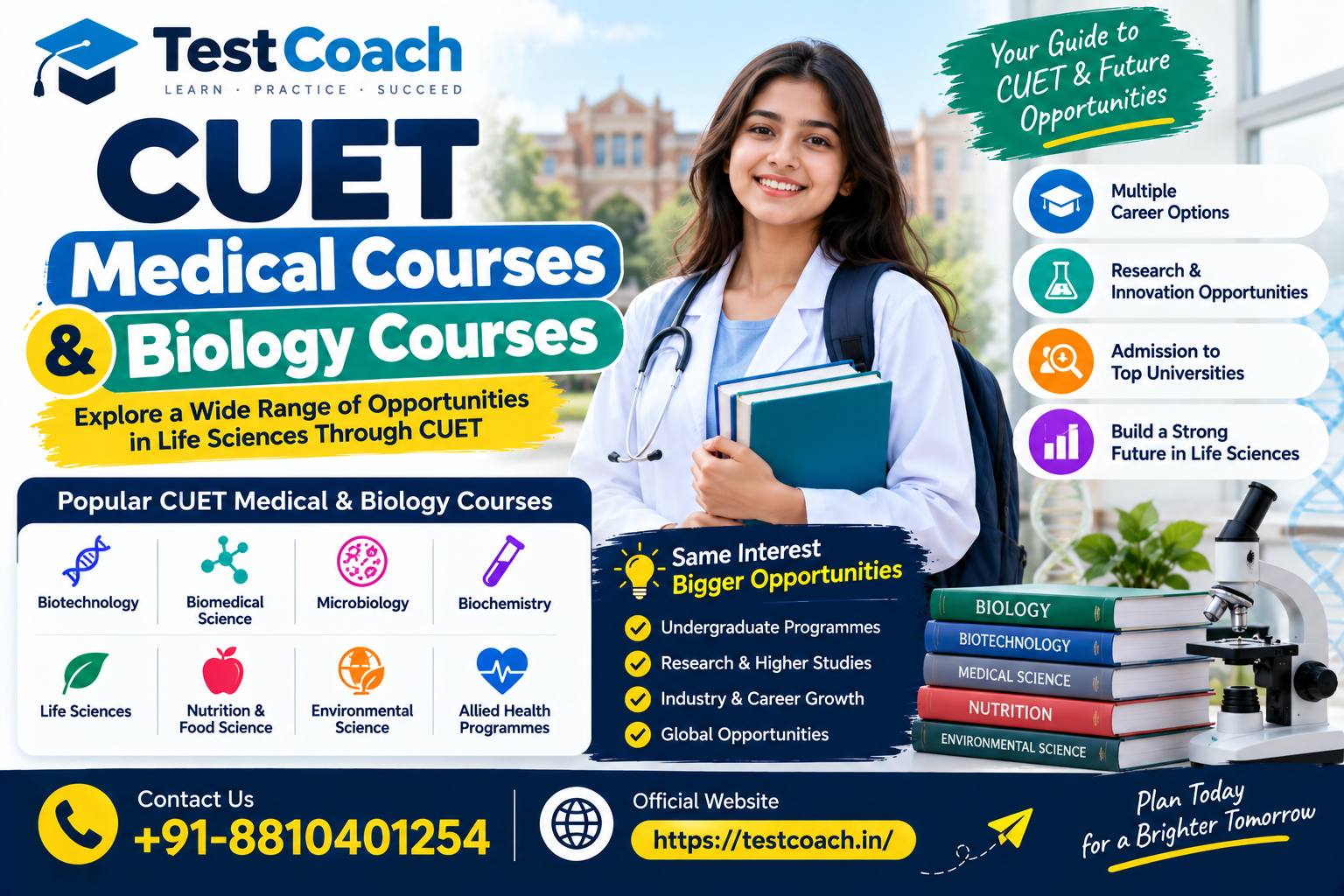
Students from a biology background are increasingly exploring undergraduate options beyond the traditional medical entrance route. Searches for CUET Medical Courses and CUET Biology Courses reflect a growing interest in life sciences, biomedical studies, biotechnology, microbiology, nutrition, environmental science, and other health-related academic pathways available through participating universities.
For students planning higher education after Class 12, CUET can open access to a wide range of science programmes, depending on the university and its eligibility rules. However, candidates should understand an important distinction: CUET-based programmes can include health and life-science courses, but professional medical degrees such as MBBS are generally governed by separate entrance and regulatory requirements. Students should therefore verify the latest programme-specific admission rules before applying.
What Are CUET Medical Courses?
The term CUET Medical Courses is commonly used by students searching for health-related or life-science programmes accessible through CUET.
Depending on the participating institution, students may find undergraduate courses related to areas such as:
- Biomedical science
- Life sciences
- Biotechnology
- Biochemistry
- Microbiology
- Nutrition and food science
- Environmental science
- Biological sciences
- Public-health-related disciplines
- Allied science programmes
The exact programmes available can vary significantly between universities and admission cycles.
Students should therefore check the official university programme list rather than assuming that every medical or health-related course accepts CUET scores.
Understanding CUET Biology Courses
CUET Biology Courses generally refer to undergraduate programmes where biology or related science subjects play an important role in eligibility or entrance subject selection.
These programmes may suit students who enjoyed biology in Classes 11 and 12 but want alternatives to conventional clinical medicine.
Life-science education can lead students toward research laboratories, higher studies, biotechnology companies, food and nutrition sectors, environmental organisations, academic careers, and several health-support industries.
The right course depends on a student’s interests, academic strengths, and long-term career plans.
CUET and Traditional Medical Admission Are Different
Students researching CUET Medical Courses should avoid confusing CUET with entrance processes for regulated professional medical degrees.
A programme related to biology, biotechnology, or biomedical science is not automatically equivalent to a medical qualification.
Before applying, students should determine:
- What qualification the programme awards.
- Whether the programme leads to a regulated profession.
- Which entrance examination is required.
- Which Class 12 subjects are compulsory.
- Whether additional university eligibility conditions apply.
This distinction can prevent students from selecting a course based only on its title.
Popular Areas Within CUET Biology Courses
Biology students can explore several academic areas.
Biotechnology
Biotechnology combines biological science with technology and laboratory applications. Students may study genetics, cell biology, molecular biology, and biotechnological processes.
It may appeal to learners interested in scientific research and applied biology.
Microbiology
Microbiology focuses on microorganisms and their interactions with humans, animals, plants, food, and the environment.
Students interested in laboratory science may consider microbiology as part of their search for CUET Biology Courses.
Biochemistry
Biochemistry studies the chemical processes occurring inside living organisms.
It connects biology and chemistry and can provide a foundation for research-oriented postgraduate study.
Biomedical Science
Biomedical science typically explores human biology, disease processes, laboratory investigation, and related scientific areas.
Students searching for CUET Medical Courses often consider biomedical programmes because of their connection with health science and laboratory research.
Life Sciences
Life-science programmes can provide broad exposure to biological subjects before students specialise at a higher level.
They may include topics from genetics, ecology, physiology, cell biology, and molecular science.
How to Select the Right CUET Course
Students should not select a programme only because it appears popular.
The best choice should reflect personal interests and future goals.
Before applying, candidates should compare:
- Course curriculum
- Eligibility criteria
- Subject requirements
- Laboratory exposure
- Higher-study opportunities
- Career direction
- University facilities
Subject Selection for CUET Biology Aspirants
Correct subject selection is important because universities may specify particular CUET subjects for particular programmes.
A biology student may be required to choose relevant domain subjects depending on the course and institution.
Students should first shortlist universities and programmes and then verify their required subject combinations.
Selecting CUET subjects first and checking eligibility later can create avoidable problems.
How to Prepare for Biology-Based CUET Subjects
Students preparing for CUET Biology Courses should begin with strong conceptual understanding.
A practical preparation plan can include:
- Revising important biology concepts
- Studying chapter-wise
- Practising objective questions
- Reviewing diagrams and terminology
- Taking timed mock tests
- Analysing incorrect answers
- Revising frequently
Students should understand concepts rather than rely entirely on memorisation.
Biology contains terminology and factual information, but application-based understanding can improve accuracy when questions are presented differently.
Why Mock Tests Matter
Mock tests help students become familiar with entrance-exam conditions.
They can reveal:
- Weak chapters
- Slow question-solving areas
- Careless mistakes
- Time-management problems
- Topics requiring revision
Students should analyse each mock test carefully.
Simply completing large numbers of tests without reviewing mistakes may not lead to significant improvement.
Career Possibilities After Biology-Based Degrees
The career direction after CUET Biology Courses depends heavily on the specific degree and further qualifications.
Possible areas can include:
- Scientific research
- Biotechnology
- Laboratory work
- Environmental science
- Food science
- Nutrition-related fields
- Academic research
- Life-science industries
- Higher education
Some roles may require postgraduate qualifications, professional certification, or specialised training.
Students should research the long-term pathway of a programme before admission.
Higher Studies Can Expand Career Options
Many life-science careers become more specialised at postgraduate level.
Students completing undergraduate biology-related programmes may later consider master’s degrees, research programmes, or other professional pathways aligned with their chosen field.
This is why the undergraduate programme should ideally provide strong fundamentals rather than focusing only on immediate job expectations.
Common Mistakes Students Should Avoid
Students exploring CUET Medical Courses sometimes make decisions based on assumptions.
Common mistakes include:
- Assuming every medical-related programme uses CUET
- Ignoring university-specific eligibility
- Selecting incorrect CUET subjects
- Choosing courses only because of their name
- Failing to research career pathways
- Depending on outdated admission information
Admission policies can change between academic sessions, so students should always verify current official information.
Frequently Asked Questions
What are CUET Medical Courses?
The term commonly refers to health-related, biomedical, biological, and life-science programmes offered by participating institutions through CUET-based admission.
Can I study MBBS through CUET?
Students should check current regulatory and official admission requirements. Professional medical degrees such as MBBS generally follow their own prescribed entrance process rather than standard CUET undergraduate admission.
What are CUET Biology Courses?
They are biology and life-science-related undergraduate programmes where CUET scores and relevant subject combinations may be used for admission by participating universities.
Which courses can biology students explore through CUET?
Depending on the institution, options may include biotechnology, microbiology, biochemistry, biomedical science, life sciences, nutrition, environmental science, and related programmes.
Is biology compulsory for every life-science course?
Requirements differ between universities and programmes. Students should verify the specific eligibility rules.
How should I choose CUET subjects?
First shortlist the university and programme, then choose CUET subjects based on the official eligibility requirements.
Can PCB students apply for CUET?
Students with a Physics, Chemistry, and Biology background may apply for relevant CUET programmes subject to individual university eligibility rules.
Is biotechnology a good option for biology students?
It can be suitable for students interested in laboratory science, genetics, molecular biology, research, and biological technology.
Are mock tests important for biology preparation?
Yes. Mock tests can improve speed, accuracy, time management, and awareness of weak areas.
Can CUET biology programmes lead to research careers?
Yes, several life-science degrees can provide a foundation for postgraduate education and research, although advanced research positions typically require further qualifications.
Future Scope of Biology and Life-Science Education
Biology education is becoming increasingly interdisciplinary.
Modern life sciences connect with technology, genetics, environmental challenges, nutrition, healthcare research, and data-driven science.
For students considering CUET Medical Courses, this means career planning should extend beyond conventional definitions of medicine.
Similarly, CUET Biology Courses can provide a foundation for specialised study in emerging biological and scientific fields.
Media Contact
Student & Media Enquiries
Contact: +91-8810401254
Official Website: https://testcoach.in/