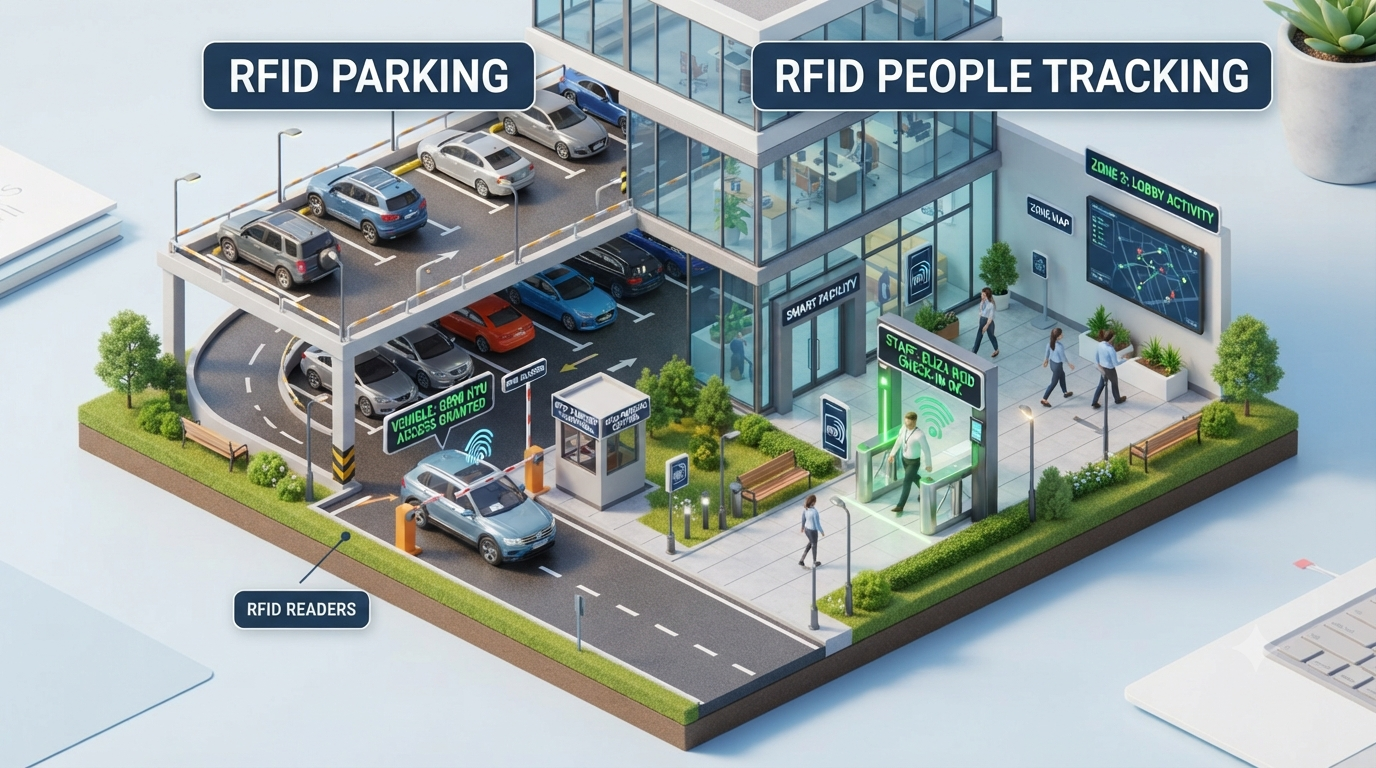
Modern organizations need faster access, better security, and clearer visibility across parking areas and facilities. Radio Frequency Identification, or RFID, helps meet these needs by automatically identifying vehicles and people through tags, readers, antennas, and connected software. Two increasingly valuable applications are RFID Parking and RFID People Tracking.
Both systems reduce manual work, improve record accuracy, and support smoother, more controlled movement.
Why RFID Matters for Modern Facilities
RFID uses radio waves to identify a tagged vehicle, person, or object. Unlike traditional barcode scanning, RFID normally does not require direct line of sight. This allows access events to be captured quickly and automatically.
A standard setup includes tags, readers, antennas, controllers, and software. When a tag enters the detection area, the system records the event or performs a configured action.
Choosing the Right RFID Technology
Passive RFID tags are cost-effective and receive power from the reader. Active tags include a battery and usually offer longer reading distances. The best option depends on required range, environment, accuracy, and application.
Short-Range and Long-Range Applications
Short-range RFID works well for doors and checkpoints, while long-range UHF solutions are commonly used where vehicles or people need to be detected from greater distances.
How RFID Parking Improves Vehicle Access
RFID Parking automates vehicle identification at parking entrances and exits. A windshield tag, RFID card, or UHF vehicle tag is linked to a registered vehicle. When the vehicle approaches a reader, the system verifies its authorization.
If approved, the boom barrier can open automatically while the system records details such as vehicle ID, entry time, exit time, parking zone, or account status.
Key benefits include:
- Faster vehicle entry and exit
- Reduced queues at security gates
- Automatic parking records
- Better control of authorized vehicles
- Less dependence on manual checking
- Integration with barriers, cameras, billing, and access systems
Commercial facilities can also support reserved, prepaid, employee, and visitor parking.
How RFID People Tracking Supports Safety and Efficiency
RFID People Tracking helps organizations identify registered individuals as they enter, leave, or move through controlled areas. Depending on the technology, it may provide checkpoint records or wider location visibility.
Typical uses include:
- Employee and visitor entry records
- Restricted-zone access
- Attendance automation
- Emergency muster support
- Personnel location within defined areas
- Workflow and occupancy analysis
- Automated activity reports
Factories, hospitals, campuses, offices, construction sites, and events can all benefit from controlled identification.
People tracking should be implemented transparently. Organizations should collect only necessary information, define retention periods, protect access to location data, and follow applicable privacy and employment requirements.
RFID Parking vs RFID People Tracking
| Feature | RFID Parking | RFID People Tracking |
| Main purpose | Vehicle access | Person identification |
| Common tags | Windshield or UHF tag | Badge, card, wristband |
| Typical range | Medium to long | Short to long |
| Main benefit | Faster parking flow | Better safety and visibility |
| Integration | Barriers, ANPR, billing | Attendance, access, alerts |
| Data | Vehicle entry/exit | Person entry/exit or movement |
Both systems can operate together. A company may recognize an employee’s car through RFID Parking and use the employee’s RFID badge to control building access.
Important Factors Before RFID Implementation
An effective RFID project begins with clear operational goals. Organizations should consider required read range, tag type, environmental conditions, reader placement, interference, network reliability, software features, integration needs, reporting, and future expansion.
Security must also be planned carefully. Administrators should decide who can view records, how information is protected, and how long data is retained. Collecting unnecessary location information can create privacy risks without adding operational value.
Benefits of an Integrated RFID Strategy
Combining RFID Parking and RFID People Tracking with centralized software improves facility management, access records, and emergency visibility.
RFID data can reveal peak arrival, occupancy, and movement patterns that support staffing, space planning, and traffic control.
Future of RFID-Based Access Systems
RFID is increasingly being connected with cloud dashboards, IoT devices, smart gates, mobile applications, video analytics, and building management platforms. APIs also allow RFID systems to exchange information with HR, security, attendance, and parking applications.
As these technologies develop, organizations can build more connected environments while keeping access policies and data governance under control.
Frequently Asked Questions
1. What is RFID Parking?
RFID Parking uses RFID tags and readers to identify vehicles and automate parking access and records.
2. What is RFID People Tracking?
RFID People Tracking uses RFID-enabled badges, cards, wristbands, or tags to identify registered individuals at designated locations.
3. Does RFID need direct line of sight?
Usually no. RFID communicates through radio waves, although performance depends on materials, range, frequency, and placement.
4. Can RFID open a parking barrier automatically?
Yes. An authorized vehicle tag can trigger a compatible boom barrier or gate controller.
5. Can RFID be used for attendance?
Yes. RFID can automatically record entry and exit and send data to attendance software.
6. What is passive RFID?
Passive RFID tags have no internal battery and receive energy from the RFID reader.
7. What is active RFID?
Active RFID tags contain a battery and generally provide longer detection ranges.
8. Is RFID suitable for large parking sites?
Yes. Long-range UHF systems can support corporate, industrial, residential, and commercial parking facilities.
9. Can RFID integrate with other software?
Yes. Many platforms connect with access control, HR, billing, security, attendance, and building-management systems.
10. Is RFID tracking secure?
It can be when supported by access controls, secure networks, appropriate authentication, limited retention, and responsible privacy practices.