Modern bulk material handling requires accuracy, cleanliness, speed, and consistency. Industries processing powders, granules, chemicals, minerals, food ingredients, fertilizers, and construction materials increasingly depend on automated equipment to maintain production efficiency. Two important systems in this process are the big bag filling machine and the powder sieving machine.
Although these machines perform different functions, they often work together within the same production line. A powder sieving machine prepares material by separating unwanted particles and controlling particle size, while a big bag filling machine accurately packs the processed product into large flexible containers for storage or transportation.
Understanding their functions, features, applications, and selection criteria can help manufacturers develop safer and more productive material-handling operations.
What Is a Big Bag Filling Machine?
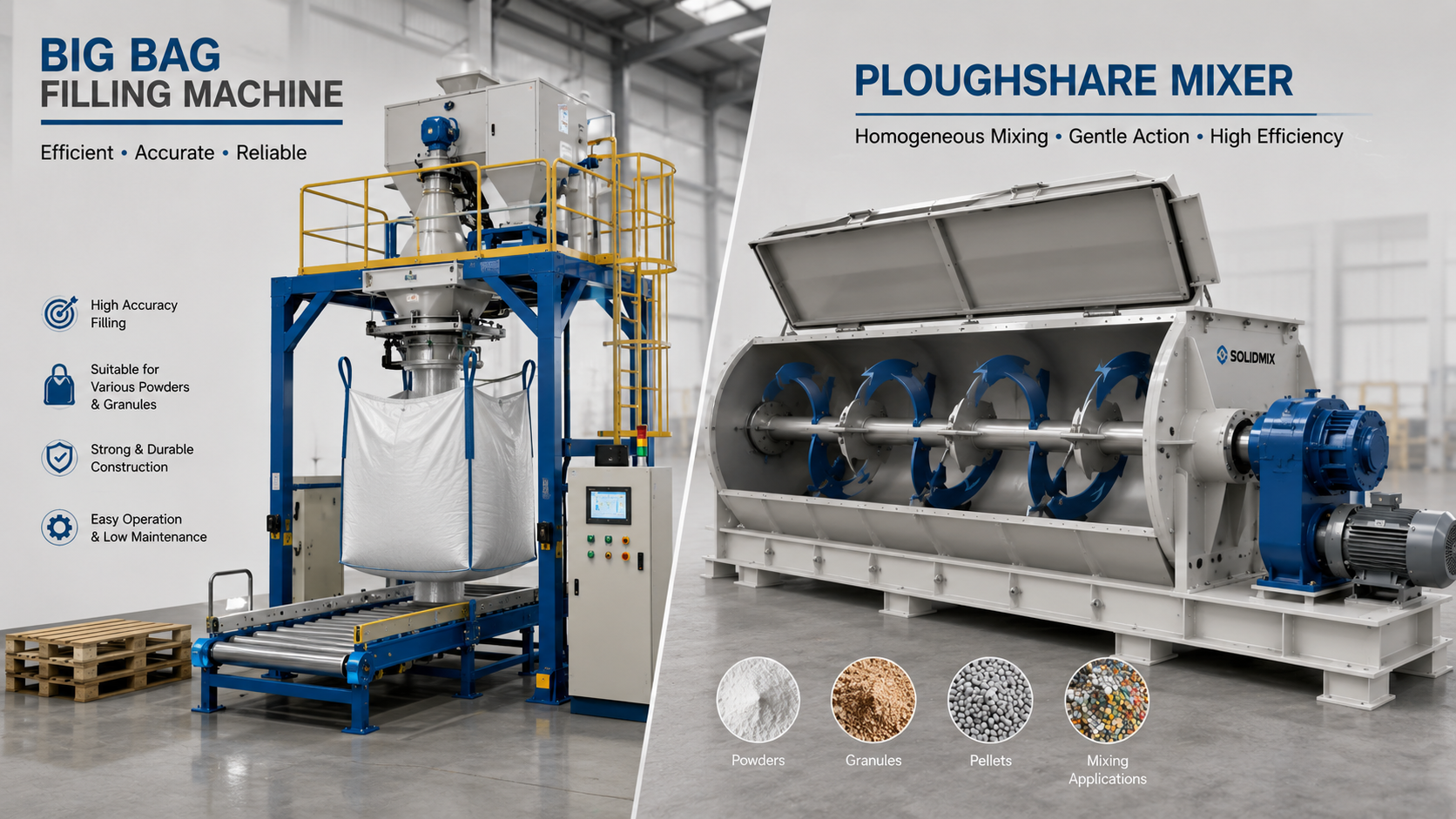
A big bag filling machine is industrial equipment designed to fill bulk materials into large bags commonly known as FIBC bags, jumbo bags, bulk bags, or one-ton bags.
Depending on the material and production requirement, these systems can handle powders, granules, flakes, pellets, minerals, chemicals, and other free-flowing or semi-free-flowing products.
A typical system may include:
- Bag supporting frames
- Filling spout
- Load cells
- Feeding equipment
- Dust collection connection
- Bag inflation system
- Automatic weighing controls
- Vibration or densification mechanisms
The objective is not simply to fill the bag. Modern equipment is designed to achieve repeatable filling weight while reducing product loss, dust generation, and manual handling.
How a Big Bag Filling Machine Works
The operating process generally begins when an empty bulk bag is positioned underneath the filling head. Its lifting loops are attached to supporting hooks, and the bag inlet is connected securely to the filling spout.
The machine then follows several stages:
- The empty bag is positioned and secured.
- The system determines the initial tare weight.
- Material begins flowing through the feeding mechanism.
- Load cells continuously measure the filling weight.
- Fast feeding changes to slower feeding near the target weight.
- Material may be vibrated or compacted inside the bag.
- Feeding stops after the programmed weight is achieved.
- The filled bag is released for palletizing or transportation.
Automatic weighing helps manufacturers maintain consistent package quantities and minimize overfilling.
What Is a Powder Sieving Machine?
A powder sieving machine is used to separate particles according to size while removing lumps, foreign materials, oversized particles, and other unwanted contamination.
Sieving is an essential quality-control stage in industries where uniform particle size directly influences processing, packaging, mixing, appearance, or final product performance.
Depending on the application, screening equipment may use circular vibration, rotary movement, centrifugal action, or linear vibration.
Common processing materials include:
- Flour and food powders
- Pharmaceutical ingredients
- Chemical powders
- Minerals
- Pigments
- Detergent powders
- Plastic powders
- Ceramic materials
- Spices
- Fertilizer ingredients
The correct sieve configuration depends on particle size, throughput, moisture level, material characteristics, and required separation accuracy.
How a Powder Sieving Machine Improves Product Quality
One major advantage of a powder sieving machine is its ability to create a more consistent final product.
During manufacturing, powders may contain agglomerated particles, foreign substances, irregular particles, or material outside the desired size range. Screening removes these inconsistencies before the material reaches later production stages.
Effective sieving can provide several benefits:
- More uniform particle distribution
- Reduced contamination risk
- Improved mixing consistency
- Better downstream equipment performance
- Fewer packaging problems
- Reduced product rejection
- Improved final product appearance
For industries with strict quality requirements, controlled screening can become an important part of the overall production strategy.
Big Bag Filling Machine vs Powder Sieving Machine
| Feature | Big Bag Filling Machine | Powder Sieving Machine |
| Main Function | Filling bulk bags | Particle separation |
| Process Stage | Packaging | Material preparation |
| Typical Materials | Powders and granules | Mainly powders and fine solids |
| Key Objective | Accurate bulk packaging | Consistent particle size |
| Automation | Manual to fully automatic | Manual-feed to automatic |
| Quality Benefit | Accurate filling weight | Removes oversized particles |
| Dust Control | Available | Available |
| Production Integration | Packaging lines | Processing and feeding lines |
These machines should not be viewed as alternatives. In many plants, they perform complementary roles.
Combining Sieving and Big Bag Filling
A particularly effective production arrangement places the powder sieving machine before the big bag filling machine.
Raw or processed powder first enters the screening system. Material meeting the required particle specification passes through the sieve, while oversized particles or contamination are separated.
Approved material then moves toward the filling station through equipment such as:
- Screw conveyors
- Vacuum conveyors
- Bucket elevators
- Pneumatic conveying systems
- Gravity-fed pipelines
The big bag filling machine receives the screened material and packs it according to the programmed target weight.
This integrated arrangement can reduce manual handling while creating a continuous workflow from quality control to final packaging.
Important Features to Consider
Selecting industrial equipment based only on purchase price may lead to poor productivity or unnecessary operating costs.
For a big bag filling machine, evaluate:
- Filling capacity
- Bag dimensions
- Maximum bag weight
- Weighing accuracy
- Feeding technology
- Dust containment
- Bag-support mechanism
- Automation level
- Construction material
- Maintenance accessibility
When selecting a powder sieving machine, consider:
- Required mesh size
- Powder characteristics
- Desired throughput
- Number of separation levels
- Screen cleaning method
- Machine vibration
- Contact material
- Dust-control requirements
- Ease of screen replacement
The machine should always be matched to the actual material rather than selected according to capacity alone.
Role of Automation in Modern Processing
Automation is transforming bulk-material processing because manufacturers increasingly need higher output without compromising consistency.
Modern systems may integrate PLC controls, digital weighing indicators, sensors, automated valves, variable-speed drives, alarms, production counters, and process monitoring.
Automating the connection between a powder sieving machine and bulk filling equipment can help reduce operator intervention and maintain stable material flow.
Automation can also improve traceability by recording filling weights, production quantities, batch information, and machine operating data.
Dust Control and Workplace Safety
Fine powder can create cleanliness, health, product-loss, and operating problems if it escapes during processing.
For this reason, both sieving and filling equipment should be designed with effective dust containment.
Useful features may include:
- Enclosed material transfer
- Sealed filling connections
- Dust extraction ports
- Flexible sleeves
- Closed screening chambers
- Proper ventilation
- Easy-clean contact surfaces
Actual safety requirements depend on the characteristics of the processed material. Powders with combustible or hazardous properties require appropriate engineering controls and application-specific safety evaluation.
Applications Across Different Industries
The combination of screening and bulk filling equipment is widely useful across multiple sectors.
Chemical manufacturers use these systems for powders, additives, pigments, and compounds. Food-processing companies may screen ingredients before bulk packaging. Mineral processors require reliable separation and heavy-duty filling equipment for products such as limestone and other powdered materials.
Similar systems are also found in:
- Fertilizer production
- Plastics manufacturing
- Construction materials
- Ceramics
- Pharmaceuticals
- Animal feed
- Agricultural processing
- Detergent production
Different industries may require specialized machine construction, hygiene standards, explosion protection, or corrosion-resistant materials.
Frequently Asked Questions
1. What is the purpose of a big bag filling machine?
A big bag filling machine fills powders, granules, and other bulk products into FIBC or jumbo bags accurately and efficiently.
2. What size bags can these machines fill?
Capacity varies according to equipment design and may include several common industrial FIBC sizes and filling weights.
3. What is the main purpose of powder sieving?
Sieving separates particles according to size and removes oversized material, lumps, or unwanted contamination.
4. Can a powder sieving machine handle fine powders?
Yes. The suitable machine and mesh configuration must be selected according to powder characteristics and required particle size.
5. Can both machines operate together?
Yes. A powder sieving machine can screen material before it enters a big bag filling machine.
6. Can filling systems provide automatic weighing?
Yes. Many systems use load cells and electronic controllers to achieve preset filling weights.
7. Are these machines suitable for food products?
They can be designed for food applications when suitable hygienic construction and appropriate contact materials are used.
8. How can dust be controlled during filling?
Sealed filling heads, extraction connections, enclosed conveyors, and dust collectors can help control airborne powder.
9. How do I select the correct sieve size?
The required mesh depends on desired particle size, product specifications, throughput, and material behavior.
10. What maintenance do these machines require?
Regular inspection should include screens, seals, weighing systems, motors, feeding mechanisms, connections, and product-contact components.