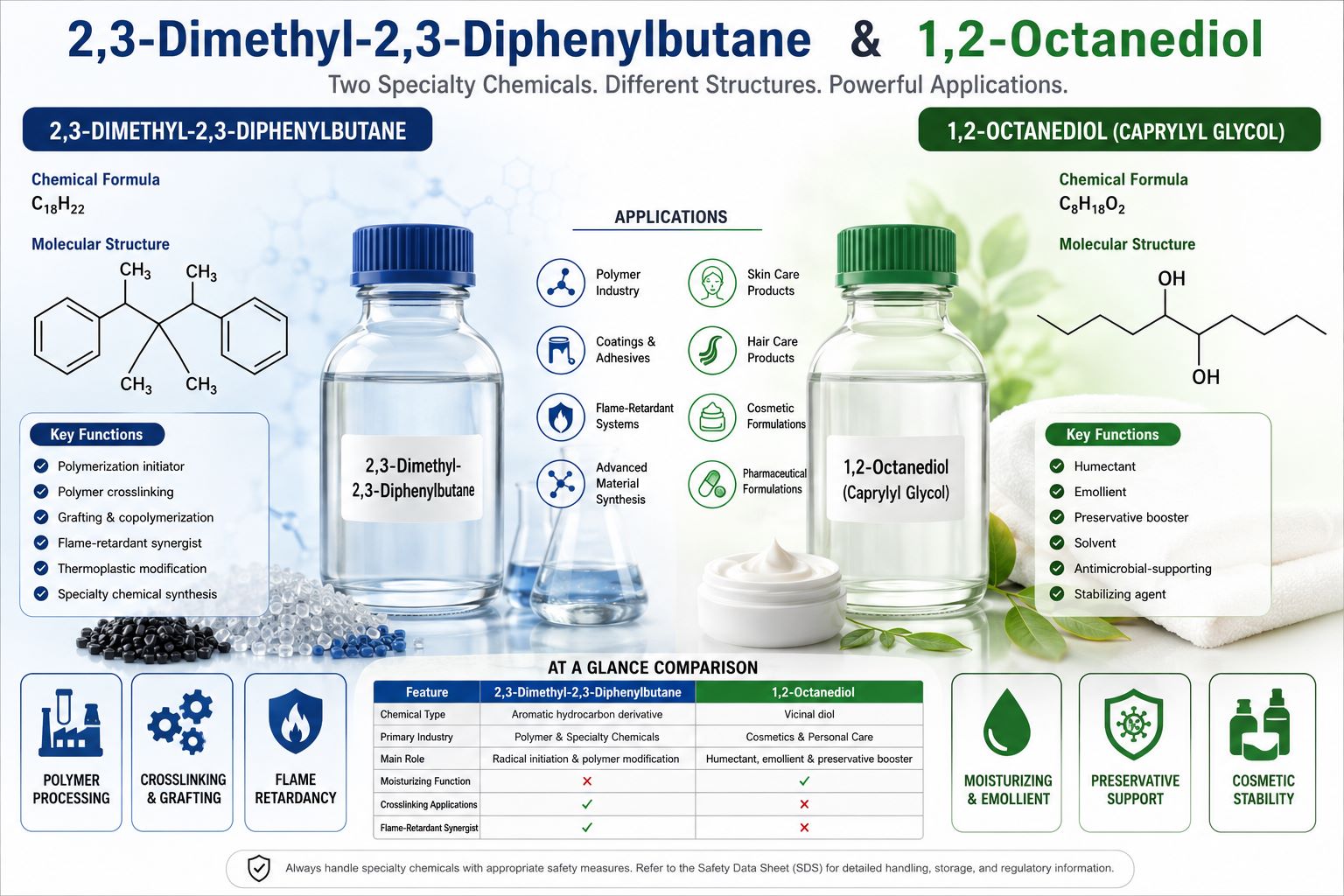
Specialty chemicals are essential to industries where ordinary raw materials cannot deliver the required performance, stability, processing behavior, or formulation efficiency. Among these specialized substances, 2,3-dimethyl-2,3-diphenylbutane and 1,2-octanediol represent two distinctly different areas of chemistry.
The first is particularly relevant to polymer modification and radical chemistry, whereas the second—also widely known as caprylyl glycol—has established importance in cosmetics, personal care, formulation science, and specialty chemical manufacturing.
Understanding their chemical behavior, functions, advantages, and selection criteria helps manufacturers choose materials based on actual performance requirements rather than simply comparing specifications.
The Chemistry Behind 2,3-Dimethyl-2,3-Diphenylbutane
2,3-Dimethyl-2,3-diphenylbutane is an organic compound characterized by a highly substituted carbon structure containing two phenyl groups and methyl substituents.
What makes this molecule particularly interesting is its behavior under thermal conditions. The central carbon-carbon bond can undergo homolytic cleavage under suitable conditions, producing radical species. This characteristic gives the compound relevance in processes where controlled radical formation is desirable.
Its chemistry has therefore attracted attention for applications involving polymerization, polymer modification, crosslinking, grafting, and specialized additive technologies.
Role in Polymer Processing and Modification
Polymer performance depends heavily on molecular architecture. Molecular weight, branching, crosslink density, additive compatibility, and processing conditions can all influence the final material.
2,3-dimethyl-2,3-diphenylbutane can be valuable when controlled radical activity is required to modify polymer behavior.
Typical areas of interest include:
- Controlled radical generation
- Polymer crosslinking
- Polymerization initiation
- Grafting reactions
- Copolymer modification
- Thermoplastic processing
- Specialty polymer additives
- Flame-retardant synergistic systems
The actual result depends on temperature, polymer chemistry, concentration, processing time, and other additives present in the formulation.
Importance in Flame-Retardant Systems
Another notable application of 2,3-dimethyl-2,3-diphenylbutane is its use in selected flame-retardant technologies.
Rather than always functioning as the primary flame-retardant substance, it may serve as a synergistic component. A synergist is incorporated to improve the performance of another additive or chemical system.
Why Synergistic Performance Matters
An effective synergistic formulation can potentially help manufacturers achieve:
- Improved flame-retardant efficiency.
- Better optimization of additive loading.
- Desired polymer-processing characteristics.
- Balanced mechanical properties.
- More specialized material performance.
However, laboratory testing remains essential because performance can vary significantly between polymer systems.
What Is 1,2-Octanediol?
1,2-octanediol is a multifunctional organic compound containing an eight-carbon chain and two hydroxyl groups positioned on adjacent carbon atoms. Its molecular formula is C8H18O2.
In the personal-care industry, it is commonly recognized as caprylyl glycol.
Its structure provides an important balance between hydrophilic and lipophilic characteristics. The hydroxyl groups contribute polarity, while the longer hydrocarbon chain provides compatibility with less polar environments.
This structural balance explains why 1,2-octanediol can perform several functions within sophisticated formulations.
1,2-Octanediol in Cosmetics and Personal Care
Modern cosmetic formulation increasingly focuses on multifunctional ingredients. Instead of introducing separate ingredients for every minor function, formulators often prefer substances capable of supporting several product characteristics simultaneously.
1,2-octanediol fits this approach particularly well.
It can be found in formulations such as:
- Facial creams
- Moisturizers
- Body lotions
- Serums
- Cleansing products
- Hair-care formulations
- Cosmetic emulsions
- Specialty personal-care products
Its exact concentration and function should always be determined according to the complete formulation and applicable regulatory requirements.
Moisture Retention and Skin Conditioning
One important reason for incorporating 1,2-octanediol into personal-care formulations is its ability to contribute to skin-conditioning performance.
As a humectant-type ingredient, it can support moisture management. Its emollient characteristics can also contribute to a softer, smoother sensory experience.
This is particularly useful in formulations where manufacturers are trying to balance functionality with desirable texture.
Formulation Benefits
Depending on the product system, the ingredient can contribute to:
- Moisture retention
- Skin conditioning
- Improved sensory properties
- Formulation stability
- Ingredient compatibility
- Preservation support
These characteristics make it more than simply a moisturizing ingredient.
Preservative-Boosting Potential of 1,2-Octanediol
Water-containing cosmetic formulations can provide conditions in which microorganisms may grow. Consequently, microbial protection is a critical part of formulation development.
1,2-octanediol is frequently valued for its ability to support preservation systems.
It may enhance the effectiveness of a broader antimicrobial strategy, allowing formulators to create preservation approaches suited to the complete product.
Its performance can be influenced by:
- Product pH
- Water activity
- Concentration
- Surfactant system
- Packaging
- Manufacturing conditions
- Other antimicrobial ingredients
A preservative challenge test should therefore be considered when validating a commercial formulation.
Key Differences Between the Two Chemicals
| Factor | 2,3-Dimethyl-2,3-Diphenylbutane | 1,2-Octanediol |
| Chemical family | Hydrocarbon-based organic compound | Aliphatic diol |
| Major application | Polymer chemistry | Formulation chemistry |
| Radical generation | Important characteristic | Not primary function |
| Crosslinking relevance | High | Low |
| Cosmetic relevance | Limited | High |
| Humectant properties | Not typical | Yes |
| Emollient function | Not typical | Yes |
| Preservation support | Not typical | Yes |
| Polymer modification | Important | Limited |
| Specialty synthesis | Applicable | Applicable |
The comparison demonstrates why the substances should not be viewed as alternatives. They solve fundamentally different formulation and processing challenges.
Industrial Quality and Purity Considerations
Chemical identity alone does not determine industrial performance. Purity, impurities, moisture content, manufacturing consistency, packaging, and storage can influence the reliability of specialty chemicals.
Manufacturers purchasing 2,3-dimethyl-2,3-diphenylbutane or 1,2-octanediol should therefore evaluate technical documentation carefully.
Essential Supplier Documentation
Important documents can include:
- Certificate of Analysis
- Safety Data Sheet
- Technical Data Sheet
- Product specification
- Batch information
- Storage recommendations
- Regulatory documentation
These records help purchasing and technical teams maintain traceability and consistent quality.
Storage and Handling Considerations
Proper handling is essential for maintaining chemical quality and workplace safety.
Products should generally remain in suitable, properly sealed containers under conditions specified by the manufacturer. Exposure to excessive heat, incompatible substances, contamination, or inappropriate storage conditions should be avoided.
Why the Safety Data Sheet Matters
The Safety Data Sheet should be consulted before industrial handling because it provides substance-specific information covering hazards, personal protective equipment, first aid, accidental release, firefighting, storage, transport, and disposal.
Companies should establish handling procedures according to the specific grade purchased and applicable local regulations.
Frequently Asked Questions
What is 2,3-dimethyl-2,3-diphenylbutane?
It is a specialty organic compound used in applications involving radical chemistry, polymer processing, crosslinking, and material modification.
Where is 2,3-dimethyl-2,3-diphenylbutane commonly used?
Its primary relevance is in polymer, specialty chemical, and advanced material-processing applications.
Why is it useful in polymer chemistry?
Its thermal behavior can enable radical formation, making it useful for selected polymerization and modification processes.
Can it support flame-retardant formulations?
Yes, it can function as a synergistic component in certain specialized flame-retardant polymer systems.
What is 1,2-octanediol?
It is an eight-carbon diol widely used as a multifunctional ingredient in cosmetic and specialty formulations.
Is 1,2-octanediol the same as caprylyl glycol?
Yes. Caprylyl glycol is the commonly used cosmetic ingredient name associated with 1,2-octanediol.
Why is 1,2-octanediol used in skin care?
It can provide humectant, emollient, skin-conditioning, and formulation-supporting benefits.
Does 1,2-octanediol work as a preservative?
It is frequently used to support or boost broader preservation systems rather than automatically replacing all preservatives.
Are these two chemicals interchangeable?
No. Their molecular structures, functions, target industries, and practical applications are substantially different.
What should buyers check before purchasing these chemicals?
Buyers should evaluate purity, specifications, batch consistency, documentation, packaging, storage requirements, and supplier reliability.
https://newsgrow.blogspot.com/2026/08/ethylhexylglycerin-emerges-as-key.html
https://newsgrow.blogspot.com/2026/08/inside-modern-formulations-science-and.html