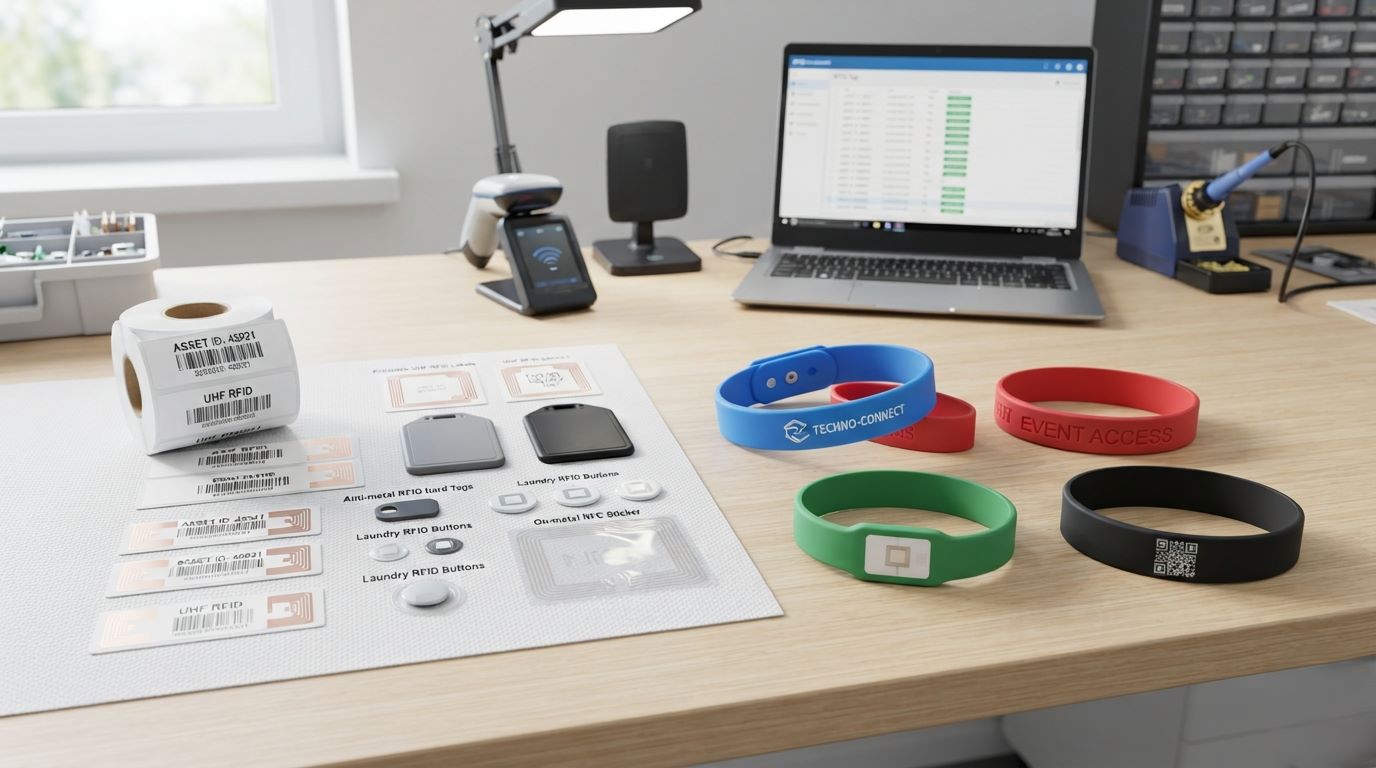
Radio-frequency identification has evolved from a specialized identification technology into a practical tool for inventory management, access control, events, healthcare, retail, hospitality, and logistics. Two increasingly useful formats are RFID labels and RFID silicone wristbands. Although both rely on RFID chips and antennas, their physical designs and applications are different. RFID tags can appear in labels, wristbands, cards, and embedded formats, while passive versions generally receive operating power from the reader rather than using a battery.
Understanding their past development helps explain where these technologies are heading. From simple identification to connected, data-driven experiences, RFID is moving toward greater automation, durability, personalization, and integration.
The Past: How RFID Identification Evolved
From Basic Identification to Smart Tracking
Early RFID concepts focused mainly on identifying objects without requiring direct visual contact. Over time, improvements in microchips, antennas, readers, manufacturing, and wireless communication made RFID more affordable and practical.
RFID labels became particularly valuable because an RFID inlay could be incorporated into a compact adhesive label. Businesses could attach these labels to cartons, products, files, equipment, packages, and other assets. Unlike conventional barcodes, RFID systems can identify multiple tags without requiring direct line-of-sight, depending on the system design.
Meanwhile, wearable RFID solutions developed for applications where people needed convenient identification. RFID silicone wristbands introduced a durable form factor suitable for repeated wear, water exposure, sports, hospitality, entertainment, and access management.
Why Silicone Changed Wearable RFID
Silicone offered an important advantage: durability combined with flexibility. Modern silicone RFID wristbands can protect embedded electronic components from everyday exposure to water, sweat, and physical handling. This makes them particularly useful for waterparks, resorts, gyms, festivals, sporting activities, and multi-day events.
Important Historical Milestones
- RFID moved from specialized identification into commercial tracking.
- Passive RFID reduced dependence on internal batteries.
- Smart labels expanded automated identification across supply chains.
- Wearable RFID introduced convenient identification for people.
- NFC and HF technologies broadened contactless interaction.
- UHF RFID expanded opportunities for longer-distance identification.
The Present: Where RFID Labels Are Used Today
Today, RFID labels are used across numerous operational environments. Their value comes from combining physical labeling with digital identification.
Common applications include:
- Inventory and warehouse management
- Retail product identification
- Supply-chain visibility
- Asset tracking
- Document and file management
- Pharmaceutical and healthcare logistics
- Shipment monitoring
- Automated receiving and dispatch
A label normally contains an RFID inlay consisting of a microchip and antenna, protected by label material selected for its application. Passive RFID labels are widely used because they do not require an onboard battery.
Businesses can also combine RFID with existing barcode, QR-code, ERP, warehouse-management, and inventory software. This creates a bridge between physical products and digital records.
The Present: Why RFID Silicone Wristbands Are Growing
RFID silicone wristbands have become practical wearable credentials for access control, membership, identification, and event management. Their major advantage is that the credential remains with the user instead of being carried separately.
Depending on the chip and system, wristbands can support access permissions, cashless applications, attendance, membership identification, or event authentication. HF/NFC and UHF versions serve different technical requirements, so frequency should be selected according to reader infrastructure and application objectives.
RFID Labels vs RFID Silicone Wristbands
| Feature | RFID Labels | RFID Silicone Wristbands |
| Primary purpose | Product and asset identification | Wearable identification |
| Form | Adhesive label | Flexible wristband |
| Typical users | Warehouses, retailers, manufacturers | Events, resorts, gyms, hospitals |
| Durability | Depends on label construction | Generally high |
| Reusability | Application-dependent | Often reusable |
| Branding | Printed label graphics | Colors, logos, numbering |
| Best advantage | Scalable item identification | Convenient human identification |
The Future: Smarter RFID Labels
The future of RFID labels is likely to focus on greater visibility and automation rather than simply replacing barcodes. As businesses demand faster inventory decisions, RFID can become part of connected identification ecosystems.
Emerging Directions
- Smaller and more efficient inlays
- Improved performance for challenging materials
- Greater integration with cloud platforms
- Automated inventory reconciliation
- Sensor-enabled identification solutions
- More recyclable and sustainable label constructions
- Stronger integration with artificial intelligence and analytics
The most important shift will be from simply answering “What is this?” to helping systems determine “Where is it, what is happening to it, and what should happen next?”
The Future: Next-Generation RFID Silicone Wristbands
The future of RFID silicone wristbands will increasingly combine identification with personalized digital experiences. Event organizers and hospitality providers may use wearable credentials as a central interface for entry, payments, membership, guest services, and engagement.
Future designs may emphasize:
- More comfortable ergonomic construction
- Reusable and lower-waste materials
- Improved security features
- Custom chip configurations
- Better integration with mobile platforms
- Real-time analytics
- Personalized customer experiences
As RFID systems become more connected, wristbands can function as part of a broader digital ecosystem rather than acting as standalone identification devices.
How Businesses Should Choose the Right RFID Format
Choosing between RFID labels and RFID silicone wristbands should begin with the operational requirement, not the product appearance.
- Define what must be identified.
- Determine required reading distance.
- Select the appropriate RFID frequency.
- Check environmental exposure.
- Evaluate durability and expected lifespan.
- Confirm reader and software compatibility.
- Consider encoding and customization requirements.
- Test samples before large-scale deployment.
A professional RFID supplier should be able to explain chip compatibility, antenna design, material selection, encoding, reader performance, and customization rather than focusing only on unit price.
FAQ About RFID Labels and RFID Silicone Wristbands
What are RFID labels?
RFID labels are adhesive identification products containing an RFID inlay with a chip and antenna for wireless identification.
What are RFID silicone wristbands?
RFID silicone wristbands are wearable bands containing an RFID or compatible NFC chip for identification, access, membership, or related applications.
Are RFID labels reusable?
Some are reusable, while many are designed for single-product or single-cycle applications. The choice depends on adhesive, label construction, and operating environment.
Are silicone RFID wristbands waterproof?
Many silicone designs are engineered for water-resistant or waterproof applications, but the exact protection level depends on construction and product specifications.
Do RFID wristbands require batteries?
Many common RFID wristbands use passive technology and therefore do not require an internal battery.
Can RFID labels replace barcodes?
They can complement or replace barcodes in suitable applications, particularly where automated, non-line-of-sight identification is valuable.
Can wristbands be customized?
Yes. Depending on the supplier, customization can include colors, logos, printing, numbering, encoding, and closure designs.
Which RFID frequency should businesses choose?
The correct frequency depends on the reader system, required range, environment, data requirements, and application.
Are RFID wristbands suitable for events?
Yes. They can support access control, attendee identification, cashless applications, and event-related experiences.
What is the future of RFID technology?
The future is expected to emphasize automation, connected systems, analytics, sustainable materials, and seamless integration between physical objects, people, and digital platforms.
Read more – https://newsgrow.blogspot.com/2026/08/building-smarter-entry-systems-what.html
https://bhoomijanatural.info/rfid-cards-and-keyfobs-move-to-the-center-of-modern-access-security/