Passenger transportation inside modern buildings is no longer simply about getting from one point to another. Airports, metro stations, hospitals, shopping malls, hotels, corporate towers, and large public facilities require mobility systems that can handle continuous traffic while maintaining safety, comfort, and operational reliability.
Two important elements of this infrastructure are the moving walkway and dependable elevator parts. One supports efficient horizontal passenger movement, while the other enables controlled vertical transportation. Behind both technologies is a sophisticated combination of motors, controllers, sensors, mechanical assemblies, safety devices, and structural components.
Understanding these systems from an operational perspective helps facility managers, engineers, contractors, and procurement teams make better decisions regarding installation, maintenance, modernization, and component replacement.
Why Moving Walkways Matter in Large Facilities
A moving walkway is designed primarily for locations where people regularly travel considerable distances within the same facility. Instead of requiring passengers to walk the entire route, it provides continuous mechanical transportation.
Airports are perhaps the most recognizable application. Passengers frequently travel between terminals while carrying luggage, making conventional walking tiring and time-consuming.
However, these systems are also valuable in:
- Metro and railway stations
- Large shopping centres
- Convention facilities
- Exhibition halls
- Transportation terminals
- Commercial complexes
- Large institutional buildings
A well-designed moving walkway can improve pedestrian flow while making large facilities easier to navigate.
Inside a Modern Moving Walkway System
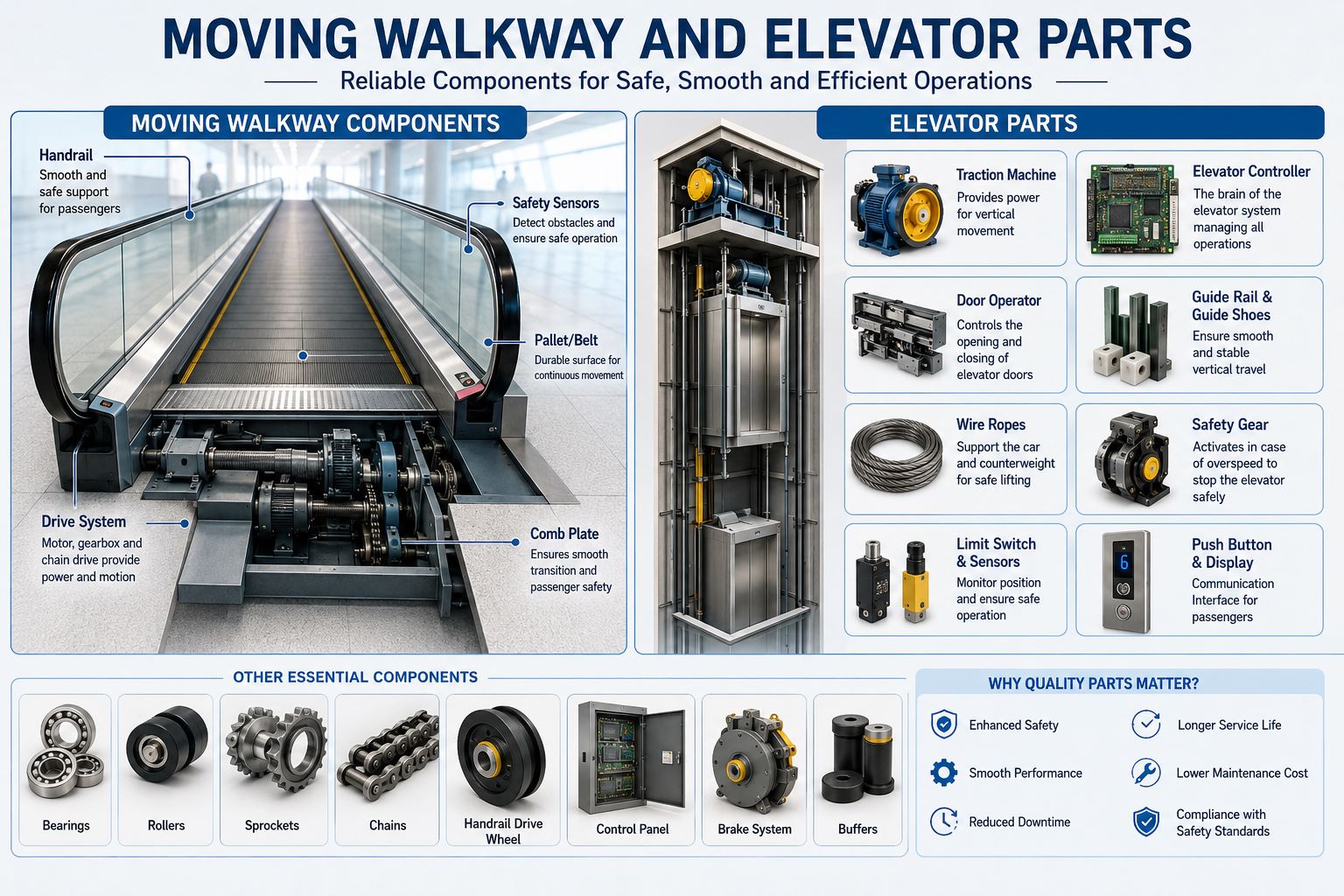
What passengers see is only the travelling surface and handrail. Underneath them is an interconnected mechanical and electrical system operating continuously.
Drive Motor and Transmission
The motor generates the power required to move the system. Depending on the equipment design, power is transferred through gearboxes, chains, sprockets, shafts, and other transmission components.
Consistent synchronization is important because irregular mechanical movement can affect passenger comfort and equipment reliability.
Pallets and Belt Assemblies
The passenger surface may consist of connected metal pallets or a continuous reinforced belt.
These components experience constant operational loads. Surface wear, alignment, structural condition, and traction therefore require regular monitoring.
Handrail Mechanism
Passengers depend on the handrail for additional stability. The handrail drive mechanism must maintain movement consistent with the travelling surface.
Rollers, guides, tensioners, handrail belts, and drive components collectively ensure smooth operation.
Comb Plates and Entry Areas
Entry and exit areas are particularly important safety zones. Comb plates create a transition between the stationary floor and moving surface.
Damage, obstruction, or improper alignment in these areas should be addressed immediately by qualified maintenance personnel.
The Engineering Behind Elevator Parts
An elevator appears simple from a passenger’s perspective: press a button, enter the cabin, select a floor, and arrive at the destination.
Behind that simple experience, numerous elevator parts communicate and operate within seconds.
The system must determine the requested destination, control acceleration, monitor speed, operate doors, detect obstacles, position the cabin accurately, activate braking mechanisms, and continuously monitor safety conditions.
This requires coordination between mechanical and electronic components.
Essential Elevator Parts Explained
Different elevator designs use different technologies, but several components are fundamental to reliable operation.
Elevator Motor and Traction Machine
The traction machine produces the mechanical movement required to raise and lower the elevator car. Depending on the system, elevators may use geared or gearless machines.
Modern gearless technology can offer advantages such as compact dimensions, reduced mechanical complexity, and efficient operation.
Elevator Control System
The controller is one of the most sophisticated elevator parts because it manages communication between multiple systems.
Its responsibilities may include:
- Processing passenger commands
- Controlling travel direction
- Managing acceleration and deceleration
- Coordinating door operation
- Monitoring safety circuits
- Recording operational faults
- Managing multiple elevators in a group
Modern controllers can also integrate with building automation and access-control systems.
Door Components
Elevator doors operate far more frequently than many other components.
Door systems may contain:
- Door motors
- Rollers
- Tracks
- Hangers
- Belts
- Interlocks
- Sensors
- Door operators
Because of this frequent movement, door-related elevator parts require careful preventive maintenance.
Guide Rails and Guide Shoes
Guide rails provide a controlled path for the elevator car and counterweight. Guide shoes or roller guides travel along these rails to maintain alignment.
Correct installation and maintenance help reduce unwanted vibration and support comfortable travel.
Moving Walkway and Elevator Comparison
| Category | Moving Walkway | Elevator |
| Travel direction | Mainly horizontal | Mainly vertical |
| Passenger movement | Continuous | Trip-based |
| Passenger enclosure | Open | Enclosed cabin |
| Common applications | Airports, stations, malls | Residential and commercial buildings |
| Key drive elements | Motor, gearbox, chain | Traction machine or hydraulic system |
| Major safety areas | Entry, exit, handrail | Doors, braking, speed control |
| Maintenance requirement | Continuous mechanical inspection | Mechanical, electrical and safety inspection |
Neither system should be considered maintenance-free. Continuous use naturally creates wear, making planned inspections essential.
Why Quality Elevator Parts Are Important
Price is often considered when purchasing replacement components, but compatibility and quality should take priority.
Poorly matched elevator parts may cause recurring faults or premature wear. More importantly, safety-related components must satisfy the technical requirements of the specific equipment and applicable standards.
A suitable replacement component should be evaluated for:
- Model compatibility
- Technical dimensions
- Electrical specifications
- Material quality
- Load requirements
- Operating environment
- Manufacturer recommendations
- Relevant safety requirements
Component selection should therefore be based on engineering specifications rather than appearance alone.
Maintenance Should Focus on Prevention
Waiting until a moving walkway or elevator completely stops working can result in unnecessary disruption and potentially higher repair costs.
Preventive maintenance focuses on identifying deterioration before it develops into serious failure.
A structured maintenance programme can include:
- Visual inspection of mechanical assemblies.
- Monitoring abnormal vibration and noise.
- Checking lubrication requirements.
- Inspecting electrical connections.
- Testing sensors and switches.
- Examining brakes and safety mechanisms.
- Checking doors, handrails, belts, and chains.
- Recording wear and component replacements.
Maintenance records are particularly valuable because they allow technicians to compare equipment behaviour over time.
When Should Components Be Replaced?
Not every component needs replacement simply because equipment becomes older. Decisions should consider actual component condition, operating cycles, manufacturer specifications, inspection findings, and performance history.
Warning signs may include unusual noise, excessive vibration, inconsistent movement, frequent fault codes, abnormal heating, delayed door operation, visible wear, or repeated shutdowns.
Safety-critical components should never be evaluated solely on whether they are still functioning. Professional inspection and applicable safety requirements must guide replacement decisions.
Smart Technology Is Changing Mobility Equipment
The future of the moving walkway and elevator industry increasingly involves connected technology.
Modern monitoring systems can collect information relating to:
- Motor temperature
- Equipment vibration
- Travel cycles
- Door movements
- Energy consumption
- Component performance
- Error codes
- Operating hours
This information supports condition-based and predictive maintenance.
Instead of discovering a deteriorating component only after failure, technicians may identify unusual performance patterns earlier and schedule inspection or replacement.
Energy Efficiency and Sustainable Operation
Energy efficiency is becoming another major consideration in mobility system design.
Modern drives can adjust motor performance according to operational requirements. Some walkway systems can operate at reduced speeds during periods of low passenger traffic and accelerate when approaching passengers are detected.
Elevator technologies can similarly incorporate efficient motors, intelligent dispatching, regenerative drives, LED cabin lighting, and standby functions.
Efficiency therefore depends on the complete system rather than one individual component.
Frequently Asked Questions
1. What is a moving walkway used for?
A moving walkway helps transport passengers continuously across relatively long horizontal or slightly inclined routes.
2. Where are moving walkways commonly installed?
They are commonly installed in airports, railway stations, shopping centres, exhibition venues, and large transportation facilities.
3. What are common moving walkway components?
Typical components include motors, pallets, belts, handrails, rollers, chains, comb plates, sensors, controllers, and safety switches.
4. What are the main elevator parts?
Major elevator parts include motors, controllers, doors, guide rails, brakes, suspension systems, sensors, buttons, and safety devices.
5. Why are elevator doors frequently serviced?
Elevator doors operate during almost every journey, creating substantial repetitive movement and mechanical wear.
6. Can elevator parts from different models be interchanged?
Not automatically. Compatibility must be confirmed using technical specifications, dimensions, electrical ratings, and manufacturer requirements.
7. Why does a moving walkway become noisy?
Noise can result from worn rollers, bearings, chains, incorrect tension, insufficient lubrication, misalignment, or drive-system problems.
8. What does an elevator controller do?
It manages elevator movement, passenger commands, floor selection, doors, safety circuits, speed control, and other operational functions.
9. What is predictive maintenance?
Predictive maintenance analyzes equipment condition and operating data to identify developing problems before major failures occur.
10. How can elevator service life be improved?
Regular inspections, preventive maintenance, correct adjustments, suitable replacement components, and professional servicing can support longer equipment life.
https://gosarkarijobs.com/how-escalator-companies-and-cargo-lifts-are-transforming-modern-buildings/
https://newsgrow.blogspot.com/2026/08/vertical-transportation-enters-new-era.html