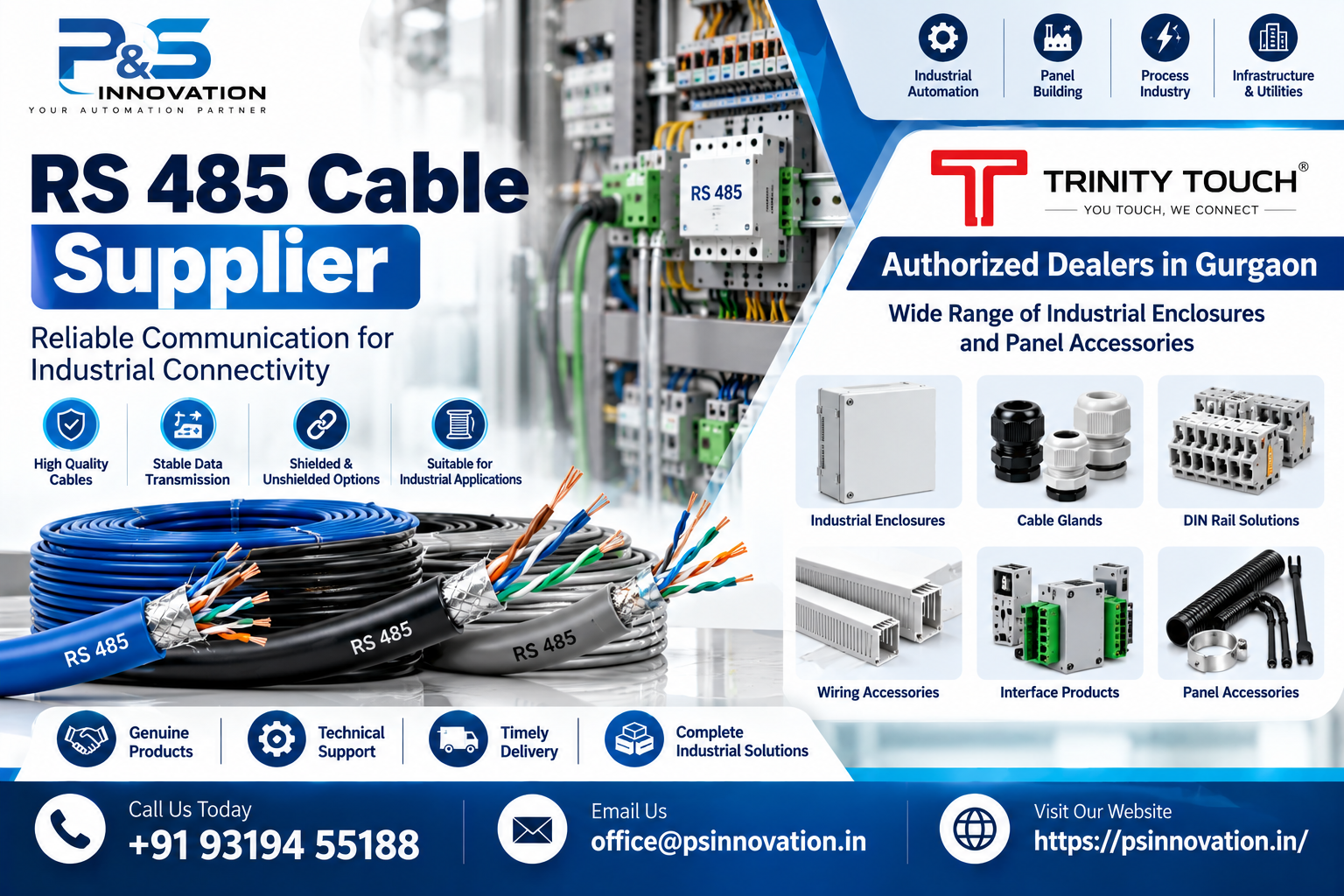
Reliable communication between industrial devices is essential for efficient machinery operation, equipment monitoring, and automated production processes. Even when controllers and sensors perform correctly, poorly selected communication cables or unsuitable wiring practices can cause intermittent network problems.
For industrial buyers searching for an Rs 485 Cable Supplier, product selection involves more than purchasing a cable with the correct number of conductors. Electrical characteristics, shielding, installation conditions, and compatibility with the communication network are equally important.
Meanwhile, businesses exploring trinity touch dealers in gurgaon may be looking for electrical and control panel accessories that support organised installations and dependable system maintenance.
Understanding the relationship between communication cabling and control panel infrastructure can help manufacturers, system integrators, and electrical contractors reduce installation problems.
Why Industrial Communication Reliability Matters
Industrial networks frequently connect devices such as programmable logic controllers, energy meters, sensors, drives, and monitoring instruments.
These devices must exchange information accurately for the system to function as intended.
Communication problems can result in missing readings, delayed responses, unexpected alarms, or interruptions in equipment monitoring.
Although incorrect software settings can cause these issues, physical wiring problems are also important potential causes.
Selecting suitable cables and following correct installation procedures can help prevent avoidable communication faults.
What Is an RS 485 Cable?
RS-485 is an electrical communication standard used for serial data transmission in industrial and commercial applications.
It defines physical-layer electrical characteristics rather than a complete communication protocol.
RS-485 networks commonly use differential signalling, which helps receivers distinguish communication signals in electrically noisy environments.
A suitable cable often contains twisted conductors, while shielding may be beneficial depending on the installation conditions.
Applications can include industrial automation, building management systems, instrumentation, and energy monitoring.
An experienced Rs 485 Cable Supplier should provide technical information that helps purchasers select a cable appropriate for their intended network.
Essential Features of a Reliable RS 485 Cable
Not every multicore cable is suitable for reliable RS-485 communication.
Several characteristics deserve attention.
Twisted-Pair Construction
Twisted conductors help maintain balanced signal transmission and reduce susceptibility to certain types of electromagnetic interference.
Characteristic Impedance
The cable’s characteristic impedance should match the requirements of the network design. Cables with a nominal impedance around 120 ohms are commonly used in RS-485 applications.
Shielding
Shielded cables can provide additional protection against electrical interference when specified and installed correctly.
Insulation and Jacket Material
Cable construction should suit the operating environment, including temperature, mechanical exposure, and applicable installation requirements.
Documentation
Technical datasheets should identify conductor characteristics, electrical properties, and relevant application limitations.
These details help engineers make informed purchasing decisions.
Why Wiring Topology Can Affect Communication
Cable selection is important, but the network arrangement also influences performance.
RS-485 networks are commonly designed around a linear bus configuration.
Excessive branching or poorly arranged connections may create signal reflections and communication problems.
Termination resistors are typically installed at the appropriate ends of the bus, according to the network design and equipment instructions.
Biasing arrangements may also be necessary to maintain a defined receiver state when devices are not actively transmitting.
Qualified technicians should follow device manufacturer instructions when configuring the network.
How an Rs 485 Cable Supplier Supports Industrial Projects
A professional Rs 485 Cable Supplier can support industrial procurement by offering clear product specifications and information about available cable configurations.
Purchasers should communicate the application requirements before ordering.
Important considerations include:
- Required cable construction and conductor configuration.
- Shielding requirements.
- Electrical characteristics and impedance.
- Installation environment.
- Required quantity and supplied length.
- Compatibility with the approved engineering design.
Suppliers may also provide product identification and documentation for procurement records.
Final cable suitability should be confirmed by the responsible engineering team.
Trinity Touch Dealers in Gurgaon: Supporting Panel Infrastructure
Gurgaon, also known as Gurugram, has a substantial presence of industrial engineering businesses, automation service providers, and electrical contractors.
Companies searching for trinity touch dealers in gurgaon may require control panel accessories and electrical products for their projects.
Trinity Touch is a brand associated with electrical and industrial control panel-related products.
Depending on the available catalogue and supplier inventory, buyers may enquire about panel accessories, connection products, and cable management solutions.
When selecting a dealer, businesses should verify product availability, technical specifications, and any claimed authorised distribution status.
A supplier’s ability to source a branded product does not automatically establish official dealer authorisation.
Why Cable Management Matters in Control Panels
Organised wiring makes industrial control panels easier to inspect, troubleshoot, and maintain.
Communication cables should be routed according to the equipment manufacturer’s recommendations and the electrical design.
Where practical, appropriate separation from interference-producing power circuits can help reduce communication disturbances.
Proper cable identification also helps maintenance personnel locate connections without unnecessary disturbance to adjacent wiring.
Suitable routing accessories, terminal connections, and labelling practices support better installation quality.
These considerations are particularly useful when communication networks operate near drives, contactors, and other electrical equipment.
Common RS-485 Communication Problems
When an industrial communication network becomes unreliable, engineers should investigate the complete installation rather than assuming the cable is defective.
Common areas to examine include:
- Incorrect wiring polarity or connection arrangements.
- Unsuitable network termination.
- Excessively long branches or inappropriate topology.
- Damaged cables or loose connections.
- Electromagnetic interference.
- Incorrect communication settings between devices.
Technicians should also check grounding and shielding arrangements against the approved system design.
Testing should be performed using suitable instruments and established electrical safety procedures.
Choosing Between Price and Technical Suitability
Industrial purchasers often compare quotations from several suppliers.
However, a lower price does not automatically indicate better procurement value.
Communication cable failures or unsuitable installations may create additional troubleshooting expenses.
When comparing an Rs 485 Cable Supplier with other vendors, purchasers should evaluate documentation, product traceability, technical suitability, and quotation accuracy.
Similarly, buyers comparing trinity touch dealers in gurgaon should review component identification, supply conditions, and the ability to provide the required product information.
Technical compatibility should remain the primary purchasing criterion.
Frequently Asked Questions (FAQs)
1. What should I check when choosing an Rs 485 Cable Supplier?
Check cable impedance, conductor construction, shielding, environmental suitability, technical documentation, and compatibility with the intended communication network.
2. Where are RS-485 cables commonly used?
They are used in industrial automation, building control, energy monitoring, instrumentation, and serial communication networks connecting compatible devices.
3. Are all twisted-pair cables suitable for RS-485 communication?
No. Cable suitability depends on electrical characteristics, network requirements, installation conditions, and the specifications of connected equipment.
4. How can businesses evaluate trinity touch dealers in gurgaon?
They should verify the required product specifications, quotation details, availability, supplier credentials, and claimed authorised-dealer status.
5. Why does an RS-485 network experience communication errors?
Possible causes include wiring faults, incorrect termination, unsuitable topology, electrical interference, damaged connections, and mismatched device settings.
Media Contact
Department: Industrial Communication and Electrical Automation Enquiries
Email: office@psinnovation.in
Phone: +91 93194 55188
Official Website: https://psinnovation.in/