When was the last time you thought about what is actually present in the water coming from your tap?
Most of us judge water by three simple things: it looks clear, it has no unusual smell, and it tastes normal. But these observations tell only part of the story. Dissolved minerals, certain chemicals and microorganisms may not produce an obvious change in appearance.
This is why professional water testing in Delhi can be valuable for homes, housing societies, schools, hospitals, hotels, restaurants and industrial facilities.
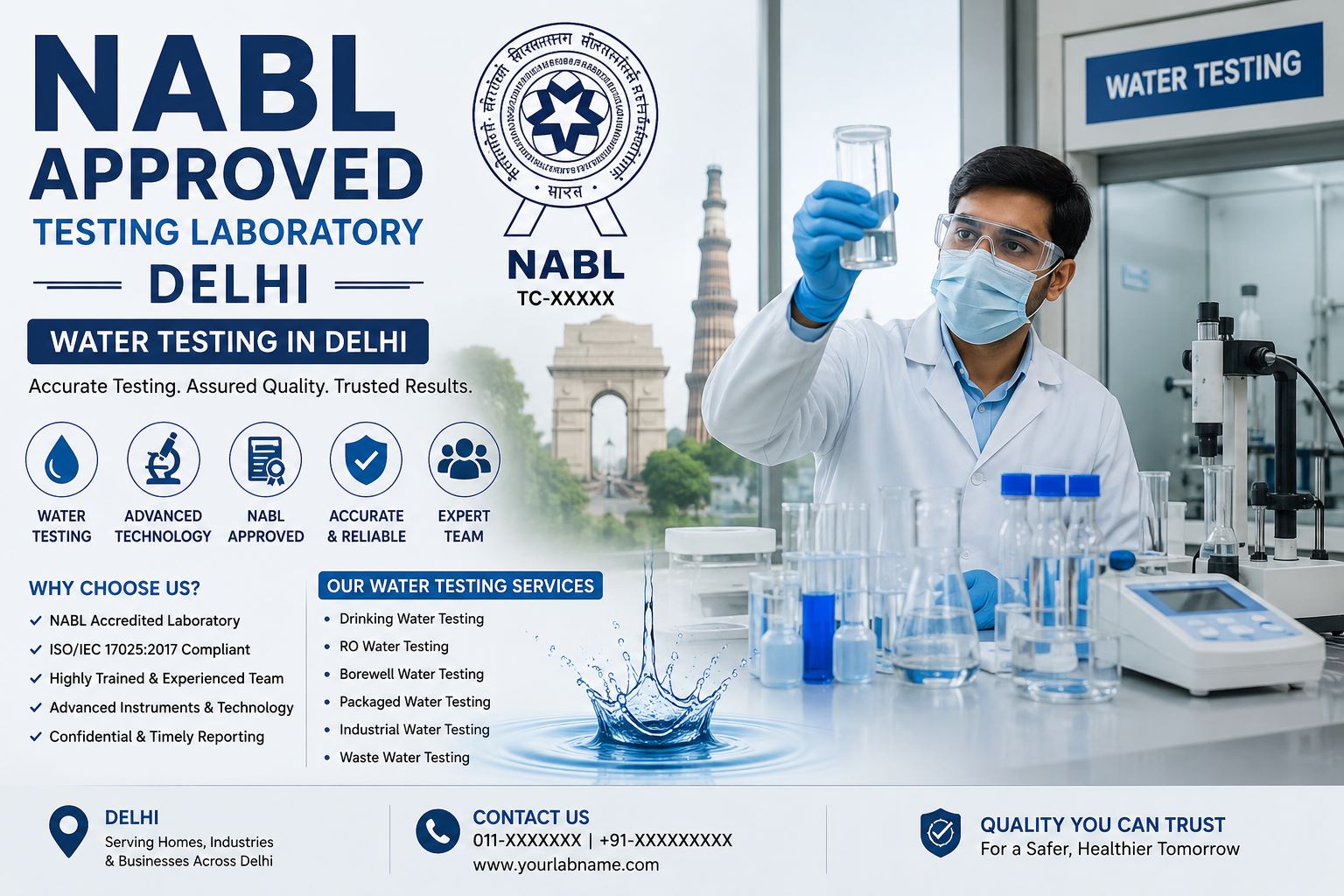
And when reliable laboratory analysis is required, many people start searching for a NABL approved testing laboratory Delhi. Before choosing one, however, it is worth understanding what NABL accreditation means, which water parameters matter and why correct sampling is just as important as laboratory testing itself.
Why Should You Test Water If It Looks Clean?
Clear water and tested water are two different things.
Some water-quality issues are easy to notice. High levels of suspended matter may make water cloudy, while other characteristics can affect its taste or smell.
Many parameters, however, require proper laboratory analysis.
Depending on the source and intended use, water may need to be examined for:
- pH
- Turbidity
- Total dissolved solids (TDS)
- Hardness
- Alkalinity
- Chloride
- Sulphate
- Fluoride
- Nitrate
- Iron
- Calcium
- Magnesium
- Selected heavy metals
- Microbiological indicators
Laboratory testing replaces guesswork with measurable information.
Why Water Testing in Delhi Is Particularly Relevant
Not every property in Delhi receives and uses water in exactly the same way.
One household might depend primarily on municipal water. Another may use borewell water. A residential society might supplement its regular supply with tanker water, while an industrial facility could treat raw water before using it in production.
Water can also pass through several stages before reaching you.
For example:
Main supply → Underground tank → Pump → Overhead tank → Internal pipeline → RO system → Tap
This journey matters because the characteristics of water at the final tap may differ from those at the original source.
Professional water testing in Delhi can therefore be planned around the point that actually needs investigation.
What Does NABL Accreditation Really Mean?
NABL stands for the National Accreditation Board for Testing and Calibration Laboratories.
For testing laboratories, accreditation against applicable requirements such as ISO/IEC 17025 provides formal recognition of competence for defined laboratory activities.
Accreditation considers important aspects such as:
- Competence of laboratory personnel
- Testing procedures
- Equipment management
- Calibration
- Quality-control processes
- Measurement traceability
- Documentation
- Reporting practices
There is one detail that should not be overlooked.
A NABL approved testing laboratory Delhi is not necessarily accredited for every test it offers.
NABL accreditation has a defined scope. If you specifically need accredited results, verify that the water parameter or test you require is covered by the laboratory’s current scope.
What Types of Water Can Be Laboratory Tested?
Water testing is not limited to household tap water.
Drinking Water
Drinking-water testing may include relevant physical, chemical and microbiological characteristics. In India, BIS IS 10500 is an important specification associated with drinking-water requirements.
Borewell Water
Groundwater characteristics can vary depending on geological and environmental conditions. Borewell analysis can help determine parameters such as hardness, dissolved minerals, chloride, fluoride, nitrate and iron where relevant.
Tanker Water
If your building frequently depends on tankers, testing a representative sample can provide objective information about the supplied water.
RO Water
Both raw and RO-treated water can be analysed. Comparing appropriate parameters before and after treatment can provide useful information about treatment performance.
Stored Water
Water from underground reservoirs and overhead tanks can also be tested, particularly when investigating differences between incoming water and water at the point of consumption.
Industrial Water
Industrial facilities may require testing according to process-specific requirements. The parameters needed for process water may be very different from those used for drinking-water assessment.
Physical, Chemical and Microbiological Testing Explained
A comprehensive water analysis can involve different groups of parameters.
| Testing Category | Common Examples | Purpose |
| Physical | Colour, odour, turbidity | Examines observable characteristics |
| General chemical | pH, alkalinity, hardness | Evaluates basic chemical properties |
| Dissolved substances | Chloride, sulphate, nitrate, fluoride | Measures selected constituents |
| Metals | Iron and selected heavy metals | Identifies relevant metallic constituents |
| Microbiological | Coliforms, E. coli | Evaluates microbiological indicators |
The right combination depends on why the water is being tested.
Is Checking TDS at Home Enough?
This is one of the most common questions about water testing.
The short answer is no if you need a comprehensive understanding of water quality.
A TDS meter measures total dissolved solids. It can be useful for routine monitoring and observing changes in an RO system.
However, it cannot tell you exactly which individual substances make up the reading, nor can it provide comprehensive microbiological information.
Think of TDS as one piece of a much larger puzzle.
If drinking-water quality needs to be evaluated more broadly, laboratory water testing in Delhi should consider other relevant physical, chemical and microbiological parameters.
Why Correct Sample Collection Matters
Imagine spending money on advanced laboratory analysis only to collect the sample incorrectly.
The result may not accurately represent the water you intended to investigate.
Sample collection deserves particular attention for microbiological analysis. Using an unsuitable bottle, touching the inside of a sterile container or delaying transportation can compromise sample integrity.
Before collecting water, ask the laboratory about:
- Required sample quantity
- Correct container
- Recommended sampling location
- Preservation requirements
- Transportation conditions
- Temperature requirements where applicable
- Maximum recommended time before laboratory submission
A professional NABL approved testing laboratory Delhi should be able to provide appropriate sample-handling guidance for the tests requested.
Where Should You Collect the Water Sample?
The best sampling point depends on what you are trying to discover.
If you want to check incoming municipal water, collect the appropriate sample before it enters the building’s storage system where practical.
If you suspect a problem with an overhead tank, the sampling strategy should focus on stored water.
If you want to understand the water people actually drink, the final point of use may be more relevant.
In some investigations, comparing multiple sampling points can be useful.
For example:
Incoming supply → Storage tank → Final tap
If results change significantly between points, further investigation may help determine where the change is occurring.
How to Choose a Water Testing Laboratory in Delhi
Avoid selecting a laboratory simply because it offers the lowest-priced package.
Instead, consider whether it can answer your actual testing question.
Before finalising a NABL approved testing laboratory Delhi, check:
- Current accreditation status
- Accredited testing scope
- Relevant water-testing capabilities
- Recommended parameters
- Sampling instructions
- Testing methodology where required
- Reporting turnaround
- Report format
- Technical support
A laboratory offering 50 tests is not automatically better than one recommending 15 carefully selected parameters relevant to your water source.
Who Should Consider Professional Water Testing?
Laboratory analysis can be relevant to many users, including:
- Homeowners
- Residential societies
- Schools and colleges
- Hospitals
- Hotels
- Restaurants
- Offices
- Shopping complexes
- Food-processing businesses
- Manufacturing units
- Industrial facilities
The appropriate parameters and testing frequency should be based on source, usage, risk and applicable requirements.
Frequently Asked Questions
1. What is water testing?
Water testing is the scientific analysis of selected physical, chemical, microbiological or other characteristics of a water sample.
2. Why should water be tested if it looks clean?
Many dissolved substances and microorganisms cannot be identified simply by looking at water.
3. What does NABL stand for?
NABL stands for the National Accreditation Board for Testing and Calibration Laboratories.
4. Does NABL accreditation cover every test?
No. Accreditation applies to activities included within the laboratory’s approved scope.
5. Can borewell water be tested?
Yes. Borewell and groundwater samples can be analysed for relevant physical, chemical and microbiological parameters.
6. Can tanker water be tested in Delhi?
Yes. A representative tanker-water sample can be submitted to a laboratory for appropriate analysis.
7. Is TDS testing sufficient for drinking water?
No. TDS is only one parameter and cannot provide a complete chemical and microbiological assessment.
8. What is IS 10500?
IS 10500 is the Indian Standard associated with drinking-water requirements and relevant methods of sampling and testing.
9. Can RO water be tested?
Yes. Testing before and after RO treatment can help evaluate changes in relevant water characteristics.
10. Can overhead tank water be tested?
Yes. Stored water can be tested, especially when investigating water quality at different points within a building.
https://newsgrow.blogspot.com/2026/08/chemical-testing-lab-in-delhi-and-water.html
https://newsgrow.blogspot.com/2026/08/bis-approved-labs-and-wood-testing-lab.html
https://newsgrow.blogspot.com/2026/08/nabl-approved-testing-laboratory-delhi.html
https://shopnets.com/is-your-water-really-safe-why-laboratory-testing-matters-more-than-you-think/