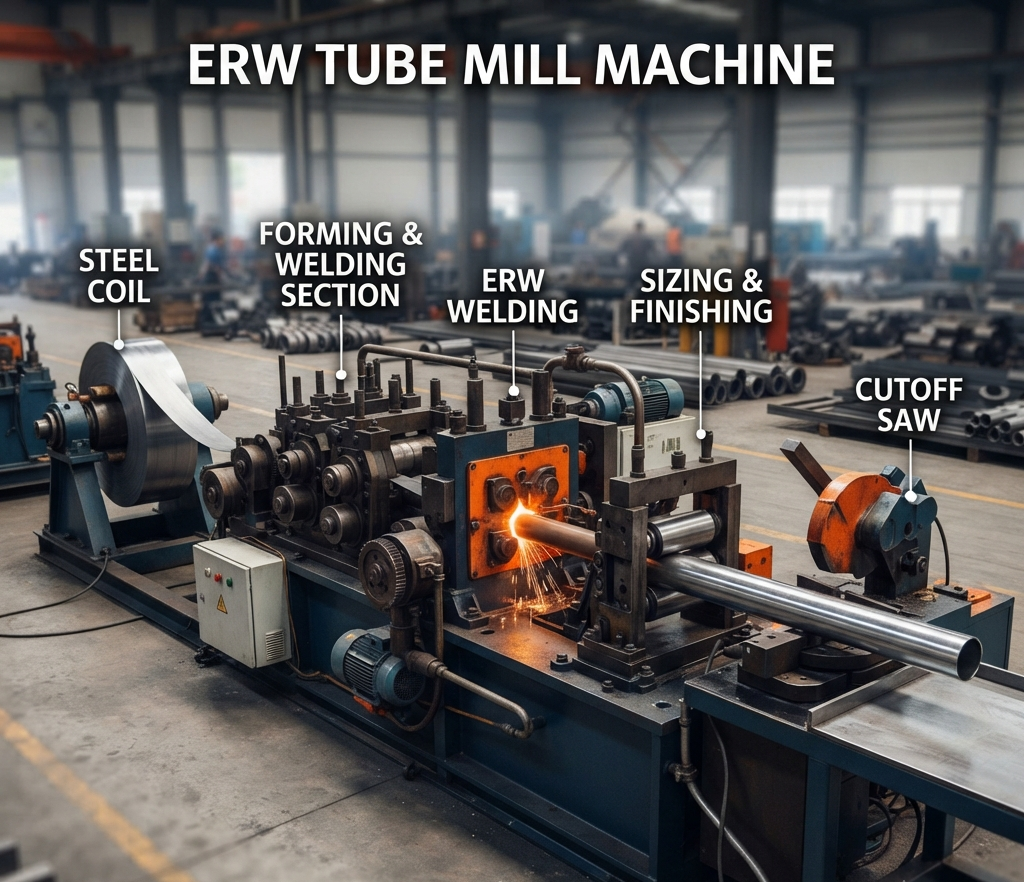
The tube manufacturing industry has changed significantly over the decades. What began as a relatively mechanical process has developed into a highly automated and digitally controlled manufacturing operation. At the center of this transformation is the Tube Mill Machine, which enables manufacturers to convert metal strip into accurately shaped tubes for construction, automotive, engineering, furniture, infrastructure, and numerous other applications.
Among modern tube production technologies, the ERW Tube Mill Machine has gained particular importance because it combines continuous roll forming with electrical resistance welding. Its development illustrates how manufacturers have continuously improved production speed, weld quality, dimensional accuracy, and operational efficiency.
Understanding where tube mill technology came from—and where it is going—can help manufacturers make better decisions about future production investments.
The Beginning of Modern Tube Production
Before automated tube mills became common, metal tube manufacturing required considerably more manual work. Flat metal sheets or strips had to be formed into cylindrical shapes before their edges were joined.
Production capacity was limited, and maintaining consistent dimensions across large quantities was difficult. As industrialization accelerated, industries needed stronger and more affordable tubes for buildings, machinery, transportation, pipelines, and structural applications.
Rolling technology gradually changed the manufacturing landscape. Instead of shaping every tube individually, manufacturers could progressively form continuous metal strips using a series of rollers. This concept became the foundation for continuous tube manufacturing.
The Rise of Continuous Tube Mills
The development of continuous forming systems represented a major step forward. A strip of steel could be continuously fed through multiple forming stations, with each station gradually changing its shape.
This process offered several advantages:
- Higher production volume
- Improved dimensional consistency
- Lower dependence on manual labor
- More efficient material handling
- Better repeatability
- Greater suitability for industrial-scale production
As forming technology became more sophisticated, welding systems were integrated directly into production lines.
How ERW Technology Changed the Industry
The emergence of electrical resistance welding brought another important transformation. An ERW Tube Mill Machine forms the edges of a steel strip and joins them using electrical resistance and controlled pressure.
The continuous welding approach eliminated many limitations associated with slower joining methods. Manufacturers could produce long lengths of welded tubing without repeatedly stopping the line.
Modern ERW systems can incorporate:
- Entry sections
- Uncoiling systems
- Strip leveling
- Forming rolls
- High-frequency welding equipment
- Weld bead removal
- Sizing stands
- Flying or cold saw cutting
- Straightening systems
- Automated inspection
The integration of these stages created a continuous production environment capable of supporting high-volume manufacturing.
The Transformation from Mechanical to Automated Mills
Early tube mills relied heavily on mechanical adjustments and operator experience. Modern equipment increasingly uses electronic controls, sensors, programmable systems, and servo technology.
This transition has changed the role of the machine operator. Instead of manually controlling every stage, operators can monitor production parameters through centralized interfaces.
Automation can control or monitor:
- Line speed
- Welding parameters
- Roll positioning
- Strip alignment
- Cutting length
- Motor performance
- Production faults
- Product specifications
The result is a more predictable and repeatable production process.
Tube Mill Machine and ERW Tube Mill Machine: Key Difference
A Tube Mill Machine is a general term covering machinery used to manufacture metal tubes through forming and, depending on the design, welding or other joining processes.
An ERW Tube Mill Machine specifically uses electrical resistance welding to join the formed strip.
| Parameter | Tube Mill Machine | ERW Tube Mill Machine |
| Definition | Broad tube manufacturing equipment | Tube mill using resistance welding |
| Forming | Roll forming commonly used | Roll forming commonly used |
| Welding | Depends on configuration | Electrical resistance welding |
| Production model | Depends on design | Continuous production |
| Automation | Varies by system | Frequently highly automated |
| Typical materials | Depends on machine configuration | Commonly steel strip |
Therefore, ERW mills can be considered an important category within the broader tube mill industry.
Why ERW Tube Mills Became Important
The popularity of ERW production comes from its ability to combine productivity with controlled manufacturing. Industries requiring large quantities of consistent tubing benefit from continuous production.
ERW tubes can be manufactured for applications such as:
- Structural frameworks
- Automotive components
- Agricultural equipment
- Furniture frames
- Industrial machinery
- General engineering
- Infrastructure projects
The appropriate tube specification depends on the application, material grade, dimensions, and required mechanical properties.
The Present Generation of Tube Mills
Today’s Tube Mill Machine is no longer simply a collection of forming rolls and welding equipment. It is increasingly an integrated production platform.
Modern systems can include computerized production recipes, automatic fault alerts, digital parameter monitoring, and sophisticated quality-control mechanisms.
Some advanced production lines also integrate measurement technologies that continuously monitor tube dimensions. This allows deviations to be identified earlier instead of discovering problems only during final inspection.
Such improvements can help reduce:
- Production downtime
- Material waste
- Manual adjustment
- Quality inconsistencies
- Unplanned maintenance
The Future: Smart ERW Tube Mill Machines
The next major stage of tube mill development is likely to involve smart manufacturing.
Connected sensors can collect information from motors, bearings, welding units, forming stands, and other components. Manufacturing software can then analyze this information to identify trends and abnormal operating conditions.
Future ERW Tube Mill Machine systems may increasingly incorporate predictive maintenance. Instead of waiting for a component to fail, manufacturers could receive warnings based on vibration, temperature, electrical performance, or other operating indicators.
This could transform maintenance from a reactive activity into a planned production-management strategy.
Artificial Intelligence and Automated Quality Control
Artificial intelligence is another technology with potential applications in tube manufacturing. Vision-based inspection systems can examine surfaces and weld areas while production continues.
AI-assisted systems may eventually help identify:
- Surface defects
- Weld inconsistencies
- Dimensional variations
- Alignment problems
- Surface contamination
- Abnormal production patterns
Rather than replacing the entire manufacturing process, AI is more likely to become an additional layer of monitoring and decision support.
Energy Efficiency Will Become More Important
Energy consumption is an increasingly important factor when evaluating industrial machinery. Future tube mills are expected to place greater emphasis on efficient motors, optimized welding systems, intelligent drives, and reduced idle operation.
Energy-efficient manufacturing can provide two benefits simultaneously: lower environmental impact and reduced operating expenses.
Manufacturers may also focus more on reducing scrap because efficient material utilization directly affects both sustainability and production economics.
Flexible Manufacturing for Changing Markets
Customer requirements are becoming more diverse. A manufacturer may need to produce multiple tube sizes, thicknesses, profiles, and material grades rather than focusing on a single product.
Future tube mills will therefore need greater flexibility.
Important developments may include:
- Faster tooling changes
- Automated roll adjustment
- Digital production recipes
- Improved setup procedures
- Modular production systems
- Automated product identification
Flexible equipment can allow manufacturers to respond faster to changing orders without sacrificing production efficiency.
How to Select a Future-Ready Tube Mill
Choosing a machine should involve more than evaluating maximum production speed. Manufacturers should consider the entire production environment.
A practical evaluation should include:
- Raw material specifications
- Tube diameter range
- Wall thickness
- Required production output
- Welding requirements
- Automation capabilities
- Tooling flexibility
- Quality-control systems
- Energy consumption
- Technical support and maintenance
A lower initial purchase price does not necessarily represent the lowest long-term manufacturing cost.
Frequently Asked Questions
What does a Tube Mill Machine do?
A Tube Mill Machine continuously forms metal strip into tubes and may include welding, sizing, cutting, and finishing operations.
What makes an ERW Tube Mill Machine different?
An ERW Tube Mill Machine uses electrical resistance welding to join the edges of the formed metal strip.
When did tube mills become industrially important?
Their importance increased as industrialization created demand for large quantities of standardized metal tubes for construction, transportation, machinery, and infrastructure.
Why is continuous production valuable?
Continuous production reduces interruptions and allows manufacturers to produce long lengths of tubing efficiently.
Are ERW tube mills suitable for high-volume manufacturing?
Yes. ERW technology is widely associated with continuous, high-productivity tube manufacturing.
Can tube mills be automated?
Yes. Modern machines can incorporate PLC controls, sensors, servo drives, digital monitoring, automated cutting, and quality-control technologies.
What is the role of high-frequency welding?
High-frequency welding enables the edges of formed strip to be joined continuously during tube production.
How can automation improve production?
Automation can improve repeatability, reduce manual intervention, monitor machine conditions, and help maintain consistent production parameters.
What will AI do in future tube mills?
AI may assist with predictive maintenance, defect detection, process monitoring, production optimization, and quality analysis.
What should manufacturers consider before buying?
They should evaluate tube dimensions, material grades, production capacity, welding requirements, automation, tooling, energy efficiency, maintenance, and future expansion plans.
Read more – https://tandtlawassociates.com/past-and-future-of-erw-tube-mill-line-and-tube-mill-line/
https://newsgrow.blogspot.com/2026/08/erw-tube-mill-line-and-tube-mill-line.html
https://tandtlawassociates.com/tube-mill-machine-and-erw-tube-mill-machine-past-present-and-future/