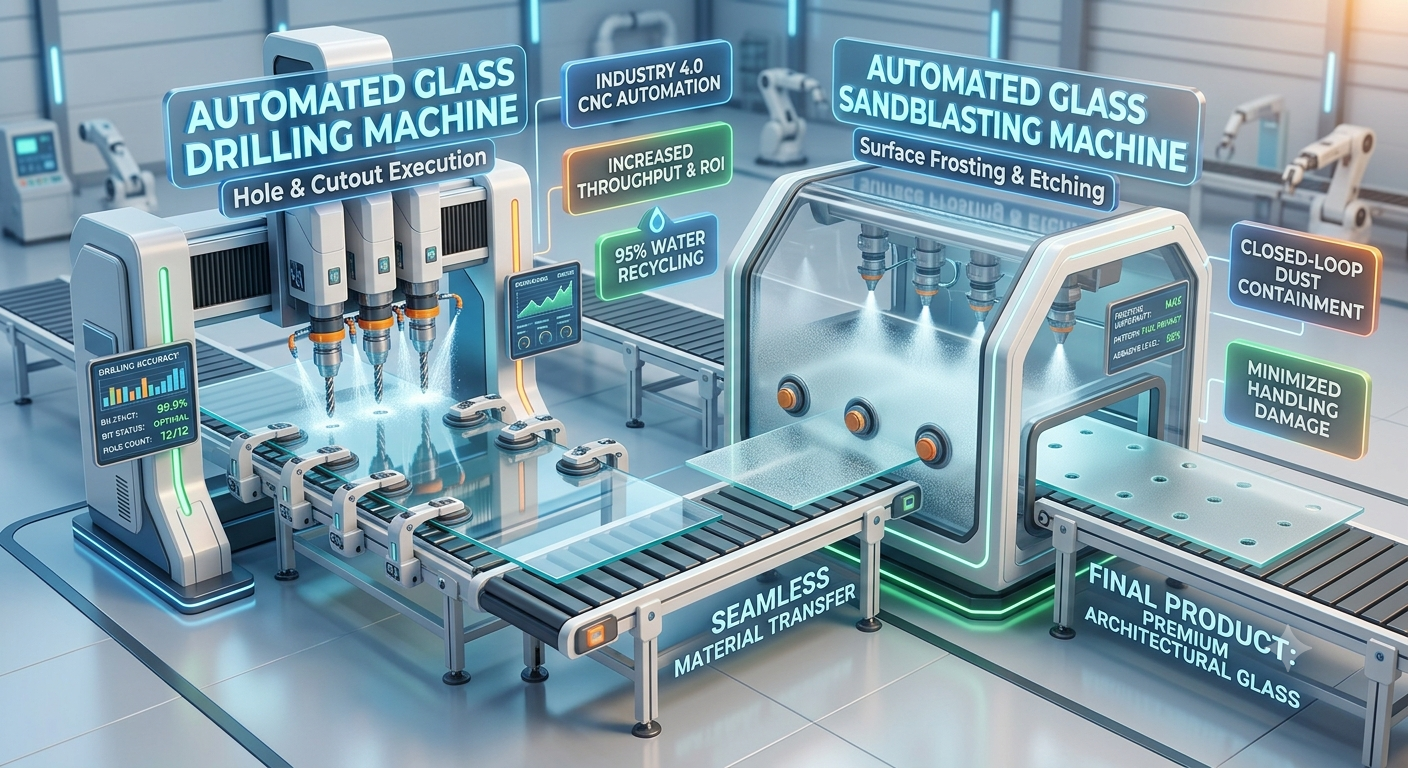
It is shaped, drilled, decorated, frosted, engraved, and customized for doors, partitions, shower enclosures, furniture, façades, mirrors, and commercial interiors. Producing these applications accurately requires specialized equipment. Two important technologies are the Glass Sandblasting Machine and Glass Drilling Machine.
Although these machines perform completely different operations, they often work within the same glass-processing facility. Sandblasting improves appearance and surface functionality, while drilling creates accurate holes required for fittings, hinges, handles, and structural hardware. Understanding their operation helps manufacturers improve productivity, reduce breakage, and deliver higher-quality finished glass.
What Is a Glass Sandblasting Machine?
A Glass Sandblasting Machine is designed to create frosted, matte, decorative, or engraved finishes on glass surfaces. It works by directing abrasive material at controlled pressure against the glass.
The abrasive action removes a microscopic layer from the surface, transforming transparent glass into a textured or opaque finish.
Manufacturers commonly use sandblasting for:
- Decorative glass doors
- Office partitions
- Shower screens
- Mirrors
- Architectural panels
- Signage and logos
- Privacy glass
- Furniture glass
Modern automatic sandblasting systems can process large sheets with greater consistency than manual blasting methods.
How Does Glass Sandblasting Work?
The working process of a Glass Sandblasting Machine is relatively straightforward but requires precise control.
Main Sandblasting Process
- The glass sheet enters the machine.
- Conveyor rollers move it toward the blasting chamber.
- Spray guns release abrasive particles onto the surface.
- Controlled pressure creates the required frosting effect.
- Dust collection equipment removes airborne particles.
- The processed glass exits for cleaning and inspection.
Pressure, conveyor speed, nozzle distance, and abrasive size determine the final surface finish.
Why Automation Matters
Automatic systems deliver consistent frosting across large glass surfaces. They also reduce operator exposure to abrasive dust while allowing manufacturers to achieve repeatable decorative patterns.
Benefits of Using a Glass Sandblasting Machine
Investing in a modern Glass Sandblasting Machine can significantly improve decorative glass production.
Important advantages include:
- Uniform surface finishing
- Faster production
- Reduced manual labor
- Better pattern consistency
- Adjustable frosting intensity
- Efficient processing of large sheets
- Improved workplace cleanliness
- Support for customized designs
The technology is particularly valuable for companies supplying interior designers, construction contractors, furniture manufacturers, and architectural glass projects.
What Is a Glass Drilling Machine?
A Glass Drilling Machine creates precise holes in glass without producing cracks or excessive edge damage. Holes are often necessary before glass undergoes tempering because tempered glass generally cannot be drilled afterward without breaking.
Glass drilling is required for hardware such as handles, bolts, connectors, hinges, locks, and mounting systems.
Applications include:
- Frameless glass doors
- Shower enclosures
- Glass railings
- Furniture
- Display systems
- Architectural façades
- Glass partitions
- Interior installations
How Does Glass Drilling Technology Work?
A Glass Drilling Machine usually uses diamond-coated drilling tools because diamond provides excellent cutting performance on hard glass surfaces.
The glass is securely positioned before drilling begins. Water or another coolant is supplied continuously to reduce heat and remove glass particles.
Typical Drilling Sequence
The operator first determines the required hole position and diameter. The glass is aligned and securely supported before the drill contacts the surface.
Advanced machines may drill from both sides. Double-sided drilling helps prevent chipping when the drill breaks through the glass.
Cooling During Drilling
Cooling is essential because excessive heat can increase stress around the drilling area. Continuous water circulation improves cutting quality, extends tool life, and minimizes damage.
Glass Sandblasting Machine vs Glass Drilling Machine
| Feature | Glass Sandblasting Machine | Glass Drilling Machine |
| Main purpose | Surface finishing | Hole creation |
| Process | Abrasive blasting | Diamond drilling |
| Result | Frosted or decorative surface | Accurate circular holes |
| Common use | Privacy and decoration | Hardware installation |
| Automation | Manual or automatic | Manual, semi-auto, CNC |
| Key control | Pressure and blasting speed | Diameter and positioning |
| Glass processing stage | Surface finishing | Usually before tempering |
Both machines contribute differently to professional glass fabrication.
Choosing the Right Glass Processing Equipment
Selecting suitable machinery requires more than comparing purchase prices. Manufacturers should evaluate production volume, glass dimensions, automation level, maintenance requirements, and expected product quality.
Consider these factors:
- Maximum glass size
- Supported glass thickness
- Processing speed
- Machine accuracy
- Automation capabilities
- Energy consumption
- Dust or water management
- Spare-parts availability
- Operator safety
- Technical support
A company producing decorative panels may prioritize an automatic Glass Sandblasting Machine, while a manufacturer specializing in frameless doors may require a high-precision Glass Drilling Machine.
Improving Quality in Glass Fabrication
Reliable machinery still requires good production practices. Glass must be inspected for scratches, edge damage, and manufacturing defects before processing.
Operators should also monitor abrasive materials, drilling tools, pressure settings, cooling systems, and conveyor alignment.
Proper maintenance helps prevent:
- Uneven frosting
- Glass scratches
- Hole chipping
- Incorrect dimensions
- Excessive tool wear
- Production downtime
- Unexpected glass breakage
Regular cleaning and calibration can considerably improve machine life and production consistency.
Future of Automated Glass Processing
Glass fabrication is increasingly moving toward automation, digital controls, CNC positioning, energy efficiency, and integrated production lines. Manufacturers want higher output without sacrificing accuracy.
Automated Glass Sandblasting Machine systems can maintain consistent surface textures across repeated production batches. Similarly, advanced Glass Drilling Machine technology allows accurate hole positioning with reduced manual intervention.
As customized architectural glass becomes more popular, flexible machinery capable of producing different designs and dimensions will become increasingly valuable.
Frequently Asked Questions
1. What does a Glass Sandblasting Machine do?
It uses abrasive particles to create frosted, matte, engraved, or decorative finishes on glass surfaces.
2. Why is sandblasted glass popular?
It provides privacy while maintaining an elegant architectural appearance and allowing controlled light transmission.
3. Can sandblasting create logos?
Yes. Stencils and controlled blasting techniques can produce logos, patterns, lettering, and decorative graphics.
4. What is a Glass Drilling Machine used for?
It creates accurate holes required for handles, hinges, bolts, fittings, and other glass hardware.
5. Can tempered glass be drilled?
Generally, drilling should be completed before tempering because drilling finished tempered glass can cause immediate breakage.
6. Why are diamond drills used?
Diamond tools provide the hardness and cutting precision required for efficient glass drilling.
7. Why is water used during glass drilling?
Water reduces heat, removes particles, improves hole quality, and helps increase drilling-tool life.
8. What causes chipped glass holes?
Incorrect drilling speed, worn tools, insufficient cooling, excessive pressure, or poor glass support can cause chipping.
9. Are automatic sandblasting machines better?
For high-volume manufacturing, automation generally provides faster processing and more consistent surface finishes.
10. How should glass machinery be maintained?
Regularly inspect moving components, nozzles, drilling tools, water systems, dust collectors, conveyors, sensors, and safety equipment.