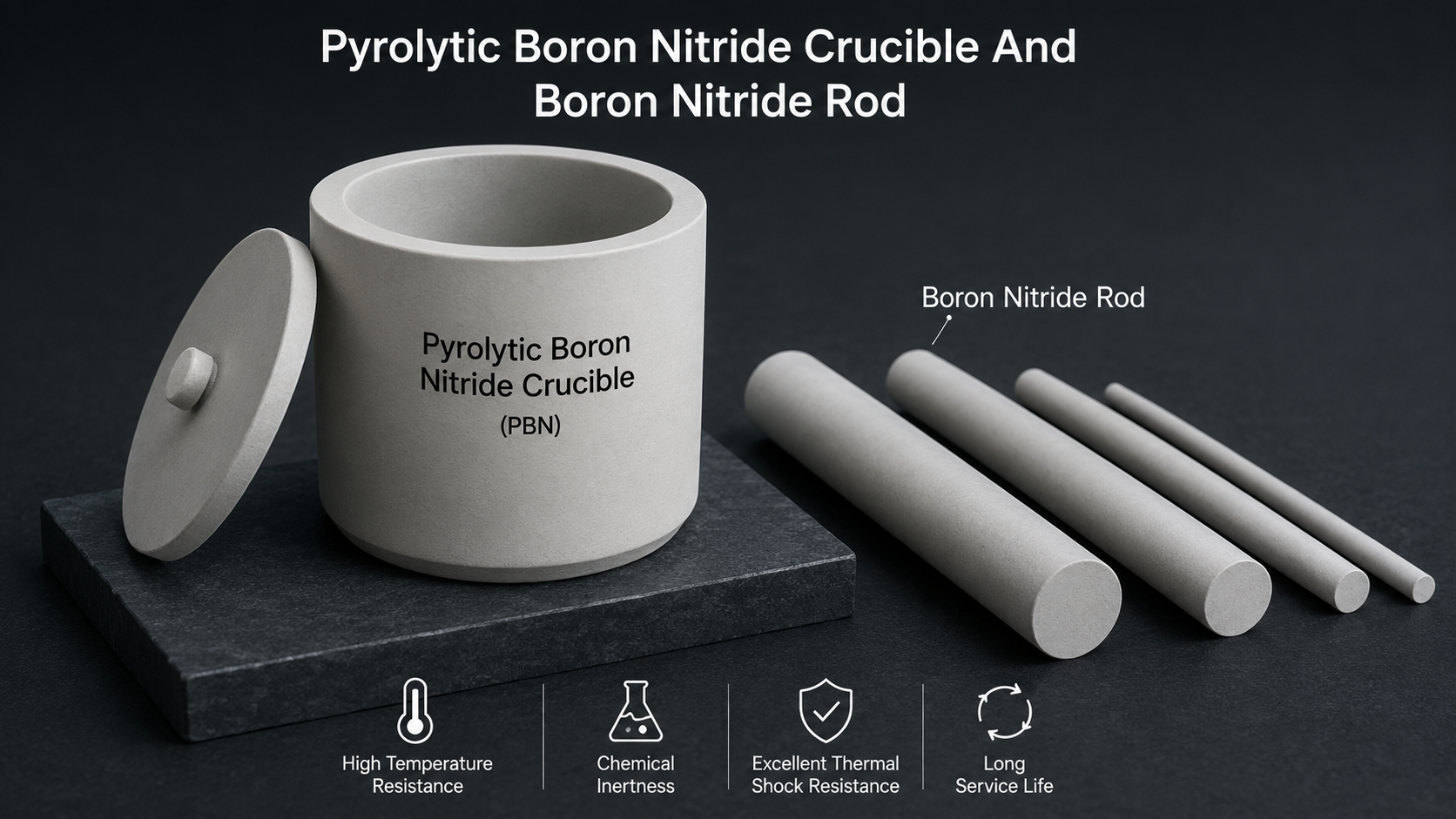
Advanced manufacturing, semiconductor processing, vacuum technology, metallurgy, and scientific research increasingly depend on ceramic materials capable of operating under extreme thermal and chemical conditions. Among these materials, Pyrolytic Boron Nitride Crucible and Boron Nitride Rod products are valued for their combination of thermal stability, electrical insulation, chemical resistance, and low interaction with many molten materials.
Although both products are based on boron nitride, their manufacturing methods, structures, performance characteristics, and ideal applications can differ significantly. Understanding these differences helps engineers select the right ceramic component for demanding industrial environments.
What Is a Pyrolytic Boron Nitride Crucible?
A Pyrolytic Boron Nitride Crucible, commonly called a PBN crucible, is manufactured through a chemical vapour deposition process rather than conventional powder pressing and sintering. During production, boron- and nitrogen-containing gases react on a heated substrate, gradually forming dense layers of pyrolytic boron nitride.
This deposition process can produce extremely pure ceramic structures suitable for sensitive semiconductor and vacuum applications. PBN is particularly recognised for purity, thermal stability and anisotropic thermal behaviour. Research has documented its use in semiconductor crystal growth and metal evaporation because of these characteristics.
Unlike many conventional ceramic containers, PBN crucibles can provide a relatively smooth, low-contamination surface, making them useful where material purity is critical.
Important Properties of Pyrolytic Boron Nitride Crucible
The performance of a Pyrolytic Boron Nitride Crucible comes from a distinctive layered crystal structure.
Important characteristics include:
- Excellent resistance to high-temperature environments
- Strong electrical insulation properties
- High chemical stability
- Good resistance to thermal shock
- Low interaction with many molten metals and semiconductor materials
- High-purity composition for contamination-sensitive processing
- Suitability for high-vacuum environments
- Direction-dependent thermal conductivity
PBN can be heated to exceptionally high temperatures under appropriate vacuum or inert-atmosphere conditions. However, actual allowable operating temperature depends on atmosphere, component design, process conditions and manufacturer specifications.
Applications of PBN Crucibles
A Pyrolytic Boron Nitride Crucible is especially useful when both high-temperature performance and contamination control are required.
Typical applications include semiconductor crystal growth, molecular beam epitaxy, vacuum evaporation, compound semiconductor processing and specialised thin-film deposition.
PBN crucibles have been used for materials such as gallium arsenide and indium phosphide and as evaporation containers in molecular beam epitaxy systems.
Their combination of chemical inertness and purity helps reduce unwanted interaction between the processing material and its container.
What Is a Boron Nitride Rod?
A Boron Nitride Rod is generally manufactured from hexagonal boron nitride, frequently using hot pressing followed by precision machining. Hexagonal boron nitride has a layered structure similar in appearance and behaviour to graphite, which is why solid BN is sometimes described as “white graphite.”
Unlike graphite, however, boron nitride is electrically insulating. Hot-pressed BN is also highly machinable compared with many technical ceramics, allowing manufacturers to produce specialised rods, sleeves, insulators, supports and other components with precise dimensions.
A Boron Nitride Rod may be supplied as pure BN or as a composite grade containing additives or binders engineered for specific mechanical, thermal or environmental requirements.
Key Benefits of Boron Nitride Rod
A high-quality Boron Nitride Rod combines several properties that are difficult to obtain from traditional engineering materials.
Major benefits include good thermal conductivity combined with electrical insulation, excellent thermal-shock resistance, relatively low thermal expansion, chemical stability and convenient machinability.
These characteristics make BN rods suitable for furnace assemblies, high-temperature electrical insulation, vacuum equipment, thermocouple components, metal-processing systems and experimental equipment.
Different BN grades can provide considerably different mechanical and thermal properties, so material grade should always be selected according to actual operating conditions.
Pyrolytic Boron Nitride Crucible vs Boron Nitride Rod
| Feature | Pyrolytic Boron Nitride Crucible | Boron Nitride Rod |
| Typical material | Pyrolytic BN | Hot-pressed hexagonal BN |
| Production | Chemical vapour deposition | Powder pressing and machining |
| Main form | Crucible or container | Rod or machined component |
| Purity potential | Extremely high | Depends on selected grade |
| Key use | Material containment | Structural or insulating component |
| Machinability | Specialised fabrication | Generally highly machinable |
| Typical industries | Semiconductor, vacuum coating | Furnaces, metallurgy, electronics |
Neither product is universally better. Selection depends on geometry, purity requirements, mechanical loads, atmosphere and process temperature.
How to Choose the Right Boron Nitride Component
Selecting either a Pyrolytic Boron Nitride Crucible or Boron Nitride Rod should involve more than simply comparing temperature ratings.
Consider:
- Maximum continuous operating temperature.
- Vacuum, inert, reducing or oxidising atmosphere.
- Chemical compatibility with processed materials.
- Required purity and contamination limits.
- Component dimensions and tolerances.
- Electrical insulation requirements.
- Thermal cycling frequency.
- Mechanical loading and handling conditions.
For semiconductor evaporation or high-purity crystal growth, PBN may offer important advantages. For machinable furnace fixtures, electrical insulation and customised structural ceramic parts, hot-pressed BN rods can be more practical.
Handling and Maintenance Considerations
Both materials should be handled as precision technical ceramics. Even when a ceramic demonstrates excellent thermal-shock performance, careless mechanical impact can cause cracking or edge damage.
Avoid unnecessary impact, contamination and excessive mechanical stress. Clean components according to the process requirements and supplier recommendations. Before reuse, inspect crucibles and machined rods for cracks, delamination, surface deterioration or dimensional changes.
Storage conditions also matter because some hot-pressed BN grades contain binders whose environmental behaviour differs from binder-free grades.
Frequently Asked Questions
1. What is a Pyrolytic Boron Nitride Crucible?
It is a high-purity ceramic container produced through chemical vapour deposition and designed for demanding thermal, vacuum and semiconductor applications.
2. What is a Boron Nitride Rod used for?
It is commonly machined into high-temperature insulators, furnace parts, supports, sleeves and specialised ceramic components.
3. Are PBN and hot-pressed BN identical?
No. Their manufacturing processes, structures and resulting properties differ.
4. Is boron nitride electrically conductive?
Most conventional hexagonal and pyrolytic BN grades provide strong electrical insulation.
5. Can BN withstand rapid temperature changes?
Boron nitride is known for excellent thermal-shock resistance, although practical limits depend on component design and grade.
6. Why are PBN crucibles used in semiconductor processing?
Their purity, stability and compatibility with high-vacuum processing help minimise contamination.
7. Can Boron Nitride Rod be machined?
Yes. Machinability is one of the major advantages of many hot-pressed BN grades.
8. Does boron nitride react with molten metals?
It shows good chemical resistance and non-wetting behaviour toward many molten metals, but compatibility should be verified for the specific material and temperature.
9. Is PBN suitable for vacuum applications?
Yes. PBN is widely associated with high-vacuum semiconductor and evaporation processes.
10. Can custom BN components be produced?
Yes. Rods can be precision-machined into complex components, while PBN products can be manufactured in specialised crucible geometries.