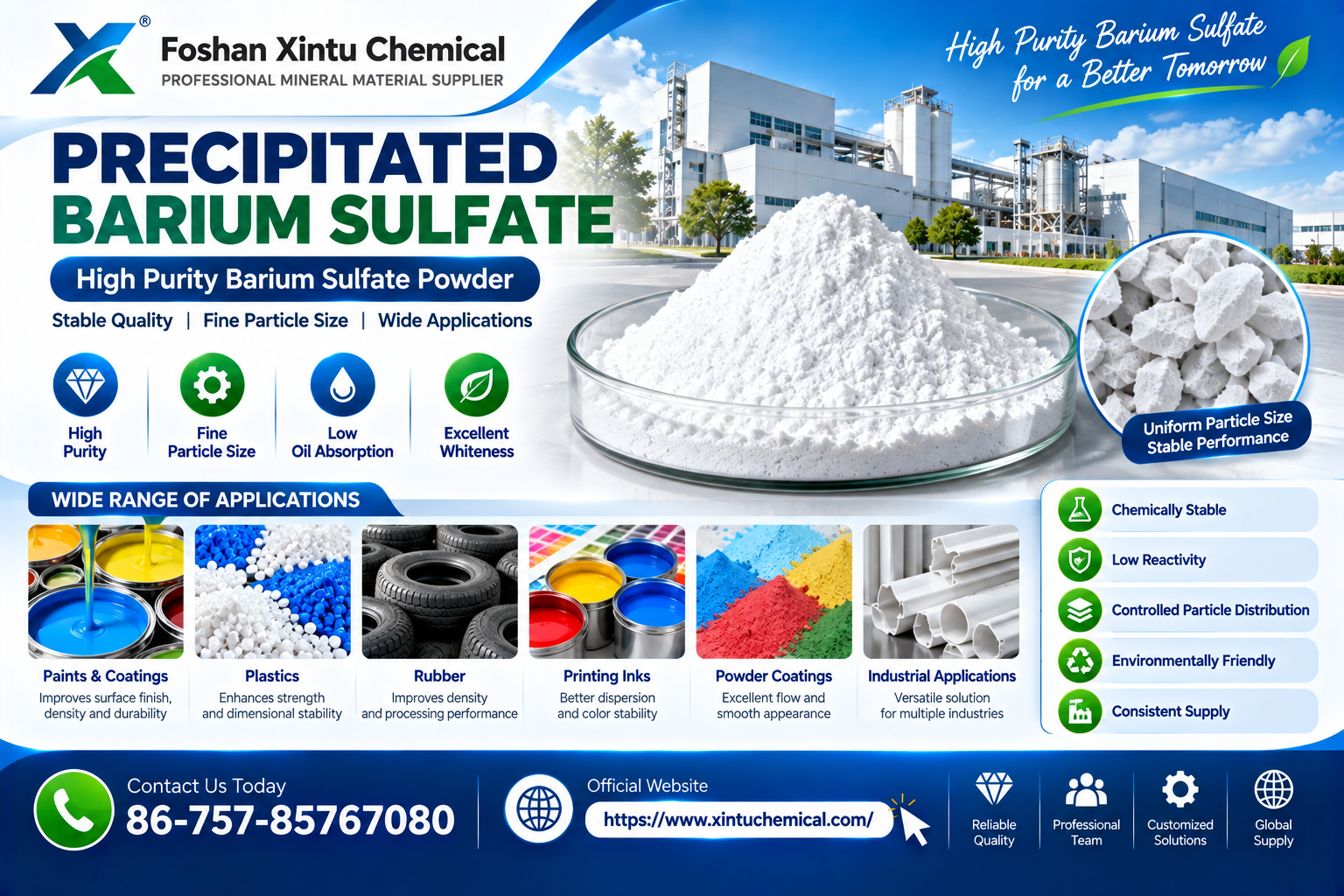
Demand for high-purity mineral fillers continues to grow across coatings, plastics, rubber, inks, powder coatings, batteries, adhesives, and other industrial applications. Among the materials receiving strong attention are Precipitated Barium Sulfate and Barium Sulfate Powder, valued for their high density, chemical stability, whiteness, low oil absorption, and ability to improve selected performance characteristics in formulated products.
As manufacturers seek better surface finish, controlled rheology, dimensional stability, opacity management, and cost-efficient formulation, barium sulfate is becoming an important functional mineral rather than simply a conventional filler.
What Is Precipitated Barium Sulfate?
Precipitated Barium Sulfate is a synthetically produced form of barium sulfate created through a controlled chemical precipitation process.
Unlike naturally mined barite, precipitated grades can be engineered to achieve more controlled properties such as:
- High purity
- Fine particle size
- Narrow particle-size distribution
- High whiteness
- Low soluble impurities
- Good dispersion
- Consistent batch quality
These characteristics make the material useful in applications where appearance, processing consistency, and formulation control are important.
How Precipitated Barium Sulfate Is Produced
The production process generally involves a controlled reaction that forms insoluble barium sulfate particles.
After precipitation, the material may undergo several processing stages, such as:
Reaction → Precipitation → Washing → Filtration → Drying → Milling → Classification → Packaging
Process control can influence particle size, purity, moisture content, and final powder performance.
For industrial users, consistency between production batches is particularly important because even relatively small variations can affect coating viscosity, plastic processing, or final surface appearance.
What Is Barium Sulfate Powder?
Barium Sulfate Powder is a white mineral powder based on BaSO₄ that can be produced from either natural or synthetic sources.
It is known for several useful properties, including:
- High specific gravity
- Strong chemical resistance
- Low water solubility
- Thermal stability
- Good weather resistance
- Neutral color
- Low reactivity
These characteristics allow it to function effectively in a variety of industrial formulations.
The exact performance depends on grade, purity, particle size, surface treatment, and intended application.
Precipitated vs Natural Barium Sulfate
Although both materials contain barium sulfate, their characteristics can differ.
Natural barium sulfate is typically produced by processing barite ore, while Precipitated Barium Sulfate is manufactured through a chemical reaction.
Precipitated grades may offer advantages where manufacturers require:
- Finer particles
- Higher purity
- Better whiteness
- More controlled particle distribution
- Lower impurity levels
Natural grades may remain suitable for applications where these characteristics are less critical.
Material selection should therefore be based on the specific formulation rather than assuming that one grade is universally superior.
Applications in Paints and Coatings
One of the major markets for Barium Sulfate Powder is paints and coatings.
Depending on the formulation, it may be used in:
- Industrial coatings
- Automotive coatings
- Powder coatings
- Architectural coatings
- Protective finishes
Potential benefits can include improved film density, surface smoothness, mechanical stability, and filler efficiency.
Because barium sulfate is chemically stable, it can perform well in systems where low reactivity is important.
Use in Powder Coatings
Precipitated Barium Sulfate can be useful in powder-coating formulations because of its whiteness, heat resistance, and fine particle characteristics.
Potential formulation goals may include:
- Improved surface appearance
- Better flow behavior
- Increased hardness
- Controlled gloss
- Improved mechanical properties
The appropriate loading level depends on the resin system, pigment package, and desired coating characteristics.
Formulators should perform application-specific testing before commercial production.
Applications in Plastics
Barium sulfate can also serve as a functional filler in thermoplastic and polymer applications.
Depending on the resin and product design, Barium Sulfate Powder may contribute to:
- Increased density
- Improved dimensional stability
- Surface-quality enhancement
- Reduced formulation cost
- Improved processing characteristics
It may be used in products such as engineered plastic components, masterbatches, films, and molded parts.
The correct grade should be selected according to dispersion behavior and compatibility with the polymer system.
Role in Rubber Manufacturing
In rubber compounds, barium sulfate may function as a mineral filler that contributes to density and processing behavior.
Applications may include:
- Industrial rubber goods
- Sealing products
- Molded rubber components
- Automotive-related rubber parts
Particle size and surface characteristics can influence dispersion within the rubber matrix.
Poorly dispersed mineral particles may reduce uniformity, making quality control important.
Printing Inks and Pigment Systems
Precipitated Barium Sulfate can also be used in certain ink, pigment, and color-masterbatch formulations.
Its neutral color and controlled particle size can make it useful where manufacturers want to modify:
- Viscosity
- Printability
- Surface characteristics
- Pigment distribution
Compatibility should always be evaluated within the full formulation.
Importance of Particle Size
Particle size is one of the most important specifications when selecting a barium sulfate grade.
Finer particles may offer:
- Smoother surfaces
- Better dispersion
- Reduced visible texture
- More uniform finished products
However, extremely fine powders can also affect viscosity and handling.
For this reason, the smallest possible particle size is not automatically the best choice.
Manufacturers should match particle characteristics to processing and product requirements.
Whiteness and Purity
Whiteness is especially important in coatings, plastics, and pigment-related applications.
High-purity Barium Sulfate Powder may help reduce unwanted color influence in a finished formulation.
Impurity control can also be important for:
- Product consistency
- Processing stability
- Customer specifications
- Appearance
Manufacturers should request technical documentation appropriate to their intended use.
Dispersion Performance
A mineral filler only performs effectively when it is properly distributed within the formulation.
Factors affecting dispersion may include:
- Particle size
- Moisture
- Surface chemistry
- Mixing equipment
- Processing temperature
- Binder or polymer compatibility
Proper dispersion helps reduce agglomeration and improves finished-product uniformity.
Quality Control and Product Specifications
Industrial buyers should evaluate more than price.
Useful specifications for Precipitated Barium Sulfate may include:
- BaSO₄ content
- Particle-size distribution
- Whiteness
- Moisture
- Oil absorption
- Specific gravity
- pH
- Soluble impurities
The importance of each specification depends on the application.
Manufacturers should establish incoming quality requirements before moving to large-scale purchasing.
Storage and Handling
Barium sulfate products should generally be stored in dry, clean conditions.
Good handling practices may include:
- Keeping packaging sealed
- Preventing moisture exposure
- Avoiding contamination
- Following supplier storage recommendations
- Using appropriate dust-control procedures
Industrial users should also follow applicable workplace safety requirements and review the relevant safety data sheet.
Frequently Asked Questions
What is Precipitated Barium Sulfate?
Precipitated Barium Sulfate is a synthetic form of BaSO₄ produced through controlled chemical precipitation to achieve high purity and controlled particle properties.
What is Barium Sulfate Powder used for?
Barium Sulfate Powder is commonly used in coatings, plastics, rubber, inks, powder coatings, and other industrial formulations.
Is precipitated barium sulfate the same as natural barite?
No. Natural barite is mined, while precipitated barium sulfate is chemically manufactured.
Why is particle size important?
Particle size can influence dispersion, surface quality, viscosity, and final product consistency.
Is barium sulfate soluble in water?
Barium sulfate has very low water solubility.
Why is barium sulfate used in coatings?
It can support density, surface smoothness, chemical stability, and filler performance depending on the formulation.
Can it be used in plastics?
Yes. Suitable grades may be used as functional fillers in various polymer systems.
What does high whiteness mean?
High whiteness indicates minimal color contamination, which can be important in light-colored formulations.
How should the correct grade be selected?
Selection should consider particle size, purity, whiteness, oil absorption, dispersion, and application requirements.
Should industrial users request technical documentation?
Yes. Technical data and safety documentation can help determine whether a grade is suitable for the intended application.
Media Contact
Industrial Materials & Business Enquiries
Contact: 86-757-85767080
Official Website: https://www.xintuchemical.com/