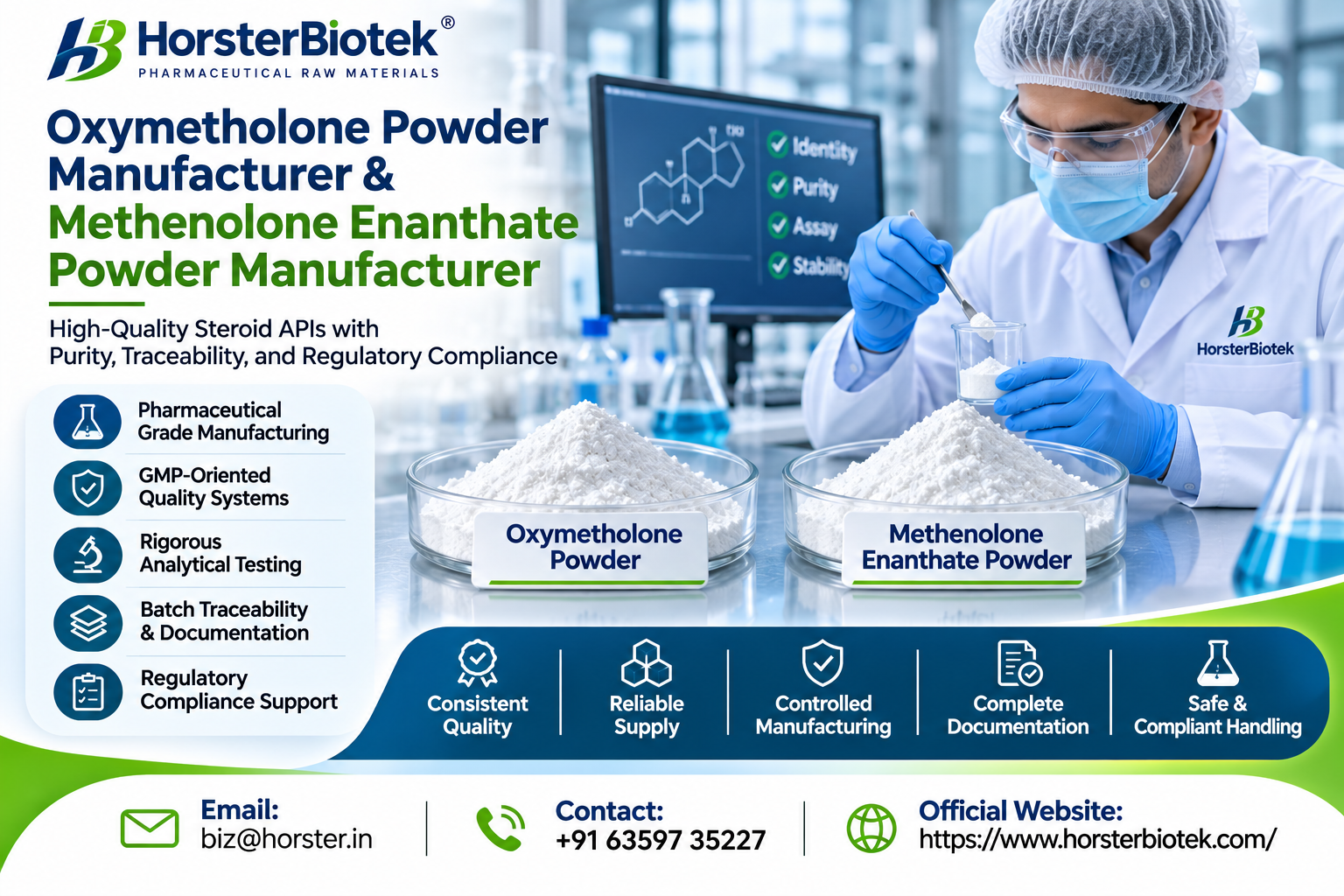
Pharmaceutical manufacturing depends on accurately defined raw materials, reliable analytical methods, and clear communication between suppliers and authorised buyers.
These requirements become particularly important when handling pharmacologically active steroidal substances, including oxymetholone and methenolone enanthate.
Organisations researching an Oxymetholone Powder Manufacturer or Methenolone Enanthate Powder Manufacturer must distinguish between chemical identity, pharmaceutical suitability, and regulatory permission.
A material description alone cannot establish that an ingredient meets the requirements for a particular medicinal application.
For pharmaceutical quality teams, laboratory professionals, and authorised procurement departments, the central issue is ensuring that product specifications accurately reflect the substance being evaluated.
Why Precise Specifications Matter in Pharmaceutical Manufacturing
A pharmaceutical specification defines the characteristics a material must satisfy before it can be accepted for an intended purpose.
These characteristics may include identity, assay, impurity limits, and other relevant quality attributes.
Without clear specifications, two materials with similar commercial descriptions may not meet identical requirements.
This can create difficulties during laboratory testing, manufacturing validation, and regulatory review.
Specifications should therefore be established by qualified professionals using appropriate scientific and regulatory criteria.
Understanding Oxymetholone Powder
Oxymetholone is a synthetic anabolic-androgenic steroid associated with certain medical applications under professional supervision.
Its regulatory status and authorised uses vary between jurisdictions.
An Oxymetholone Powder Manufacturer supplying authorised pharmaceutical operations must be assessed according to applicable manufacturing permissions and material quality requirements.
A technical review should consider chemical identity, established specifications, analytical documentation, and appropriate controls.
Oxymetholone should not be treated as an ordinary nutritional supplement or a substance suitable for unsupervised personal use.
Its pharmacological activity requires appropriate medical and regulatory oversight.
Understanding Methenolone Enanthate Powder
Methenolone enanthate is an esterified anabolic-androgenic steroid compound.
Its chemical characteristics differ from those of oxymetholone, making accurate identification essential.
A Methenolone Enanthate Powder Manufacturer involved in lawful pharmaceutical or research supply should provide documentation appropriate to the material and its permitted application.
The product’s identity should not be inferred from a general steroid category or promotional description.
Importantly, chemical identification does not establish that a material is approved for medicinal use.
Any intended pharmaceutical application requires independent assessment of the relevant regulatory and quality requirements.
Why Chemical Identity Comes Before Commercial Evaluation
Pharmaceutical buyers may receive product descriptions containing technical names, abbreviations, or alternative terminology.
These descriptions must be interpreted carefully.
Chemical identity can be supported through appropriate analytical methods and reference information.
However, a material’s name, appearance, or supplier statement is insufficient proof of identity.
Qualified laboratories should determine which analytical procedures are appropriate for the particular substance.
Incorrect identification can create significant quality and safety concerns.
For this reason, technical verification should take priority over purchasing convenience or promotional claims.
The Role of Analytical Method Suitability
Analytical testing provides evidence about specified material characteristics.
Depending on the substance and intended application, laboratories may use appropriate validated or otherwise qualified analytical procedures.
The chosen method must be suitable for the property being examined.
For example, an identity test addresses a different question from an impurity assessment.
An assay result alone cannot establish that all relevant quality requirements have been satisfied.
Analytical documentation should therefore be evaluated within the complete quality framework.
Comparing Important Pharmaceutical Quality Considerations
| Quality Consideration | Main Purpose | Why It Matters |
| Chemical Identity | Confirms the substance | Helps prevent material substitution |
| Assay Testing | Evaluates specified content | Supports quality assessment |
| Impurity Evaluation | Examines relevant unwanted substances | Supports product safety review |
| Material Specifications | Defines acceptance criteria | Establishes consistent expectations |
| Batch Documentation | Records material-related information | Supports investigation and traceability |
| Regulatory Authorisation | Establishes permitted activities | Supports lawful operations |
The applicable requirements depend on the material, jurisdiction, and intended use.
Understanding Impurities and Material Safety
Pharmaceutical raw materials may contain process-related impurities, degradation products, or other unwanted substances.
Their relevance depends on the compound and its intended application.
Impurity assessment requires suitable methods and scientifically justified acceptance criteria.
A material should not be considered acceptable solely because it has a high reported assay value.
Quality professionals must consider the complete specification rather than relying on one numerical result.
This distinction is particularly important for biologically active substances that require careful safety evaluation.
Why Documentation Consistency Is Essential
Different records relating to the same material should provide consistent information.
Product specifications, analytical reports, batch identification, and accompanying quality documents must be appropriately connected.
Inconsistent nomenclature or unidentified batch differences can complicate quality assessment.
Document control procedures help organisations manage approved information and investigate discrepancies.
When technical information changes, relevant records should be reviewed and updated through appropriate quality processes.
Good documentation does not guarantee product quality, but it creates an essential foundation for accountability.
Preventing Misleading Pharmaceutical Claims
Commercial descriptions sometimes use expressions such as pharmaceutical grade, premium purity, or laboratory tested.
These terms should not replace objective evidence.
A supplier’s marketing statement does not establish compliance with Good Manufacturing Practice or confirm suitability for an approved medicine.
Similarly, an analytical report does not independently authorise distribution or clinical use.
Organisations should distinguish verified technical information from promotional language.
This helps prevent procurement decisions based on unsupported assumptions.
Managing Regulatory and Supply Chain Risks
Anabolic-androgenic steroids may be subject to pharmaceutical and controlled-substance restrictions.
Manufacturing, possession, importation, exportation, and distribution requirements can vary across jurisdictions.
Authorised organisations must identify the permissions relevant to their activities.
Cross-border supply requires particular attention because compliance in one country does not automatically establish compliance elsewhere.
Supplier qualification should therefore include legal and regulatory considerations alongside technical quality assessment.
Where requirements are uncertain, qualified regulatory professionals should review them before commercial decisions are made.
Building a Risk-Based Supplier Evaluation Process
Pharmaceutical procurement teams should establish clear evaluation criteria for specialised raw material suppliers.
Important factors include:
- Verified Business Identity: Confirm the supplier’s legal and operational details.
- Manufacturing Permissions: Review applicable licences and authorisations.
- Technical Specifications: Obtain clearly defined material requirements.
- Analytical Evidence: Assess relevant testing documentation.
- Quality Management: Evaluate appropriate quality systems and responsibilities.
- Change Communication: Establish procedures for reporting material-related changes.
A risk-based approach helps organisations focus on issues that may materially affect product quality, safety, and regulatory compliance.
Frequently Asked Questions (FAQs)
1. What does an Oxymetholone Powder Manufacturer do?
It refers to a manufacturer of oxymetholone raw material. Any manufacturing or supply activity must comply with applicable pharmaceutical and controlled-substance requirements.
2. What should be evaluated in a Methenolone Enanthate Powder Manufacturer?
Authorised buyers should assess legal permissions, material specifications, analytical documentation, quality systems, and appropriate supply chain controls.
3. Why is chemical identity testing important?
Identity testing helps confirm that a material corresponds to the substance specified in the relevant quality documentation.
4. Does a high purity claim guarantee pharmaceutical suitability?
No. Pharmaceutical suitability depends on multiple quality attributes, regulatory requirements, and the intended application.
5. Are oxymetholone and methenolone enanthate suitable for unsupervised use?
No. Both are pharmacologically active anabolic-androgenic steroids associated with significant health risks and require appropriate medical and regulatory oversight.
Media Contact
Department: Pharmaceutical Raw Materials and Technical Enquiries
Enquiry Categories: Pharmaceutical API Specifications, Analytical Quality Assessment, Supplier Qualification, Regulatory Documentation, and Specialised Chemical Materials.
Contact : +91 63597 35227
Email : biz@horster.in
Official Website: https://horsterbiotek.com/