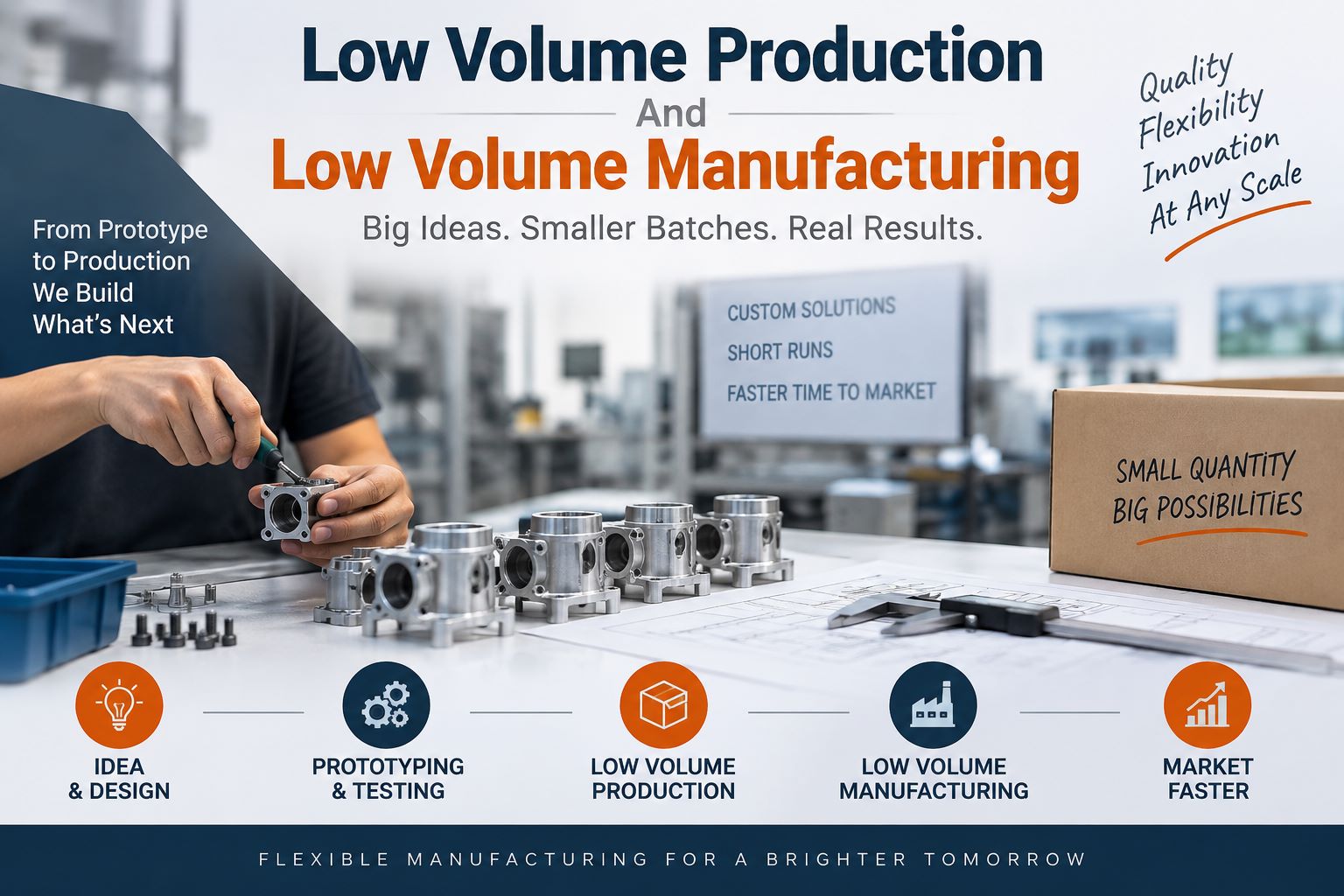
Global manufacturing strategies are changing as businesses look for faster, more flexible, and less risky ways to bring products to market. One approach receiving growing attention is low volume production, supported by advances in rapid tooling, CNC machining, additive manufacturing, and flexible supply-chain models.
Manufacturers across automotive, aerospace, medical technology, electronics, robotics, and consumer products are increasingly considering low volume manufacturing as an alternative to committing immediately to large-scale mass production.
The shift reflects a broader change in industrial priorities. Instead of focusing only on producing the highest possible number of units at the lowest cost, companies are paying greater attention to speed, customization, inventory control, product testing, and changing customer demand.
Companies Seek More Flexible Manufacturing Models
Traditional manufacturing has often depended on economies of scale. Companies invested heavily in tooling, molds, machinery, and production lines because large quantities helped distribute those costs across many products.
That model remains important for mature products with predictable demand.
However, businesses launching new or specialized products face different challenges.
Demand may not yet be proven, product designs may still evolve, and market conditions can change quickly.
As a result, low volume production offers companies an opportunity to manufacture smaller commercial batches before committing to full-scale production.
Industry users typically apply the approach when they need:
- Hundreds or several thousand components
- Early market-launch quantities
- Customized products
- Replacement parts
- Engineering validation units
- Limited-edition products
- Bridge production before mass manufacturing
Low Volume Manufacturing Moves Beyond Prototyping
Industry specialists increasingly view low volume manufacturing as more than an extension of prototyping.
A prototype normally demonstrates whether a design can work. Low-volume manufacturing, by comparison, focuses on producing functional and market-ready products in controlled quantities.
Manufacturers may use actual engineering plastics, production metals, commercial surface finishes, and realistic assembly processes.
This gives companies the opportunity to evaluate how a product performs under conditions closer to real commercial use.
CNC Machining Remains Important for Small Batches
CNC machining continues to play a major role in low-volume projects.
Unlike injection molding, CNC machining generally does not require a dedicated mold. This makes it suitable for businesses that require precision parts but are not ready to invest in expensive tooling.
Materials frequently used include aluminum, stainless steel, brass, titanium, engineering plastics, and other industrial materials.
Manufacturers can also modify digital designs between batches with relatively limited disruption.
Rapid Tooling Expands Injection Molding Opportunities
Injection molding has traditionally been associated with high production volumes because tooling can require a significant upfront investment.
Rapid tooling has changed that calculation for some projects.
Aluminum molds, simplified tooling, and other rapid manufacturing methods can reduce tooling costs and shorten development times.
This allows companies to use injection molding for selected low volume manufacturing programs while still achieving production-like materials and finishes.
Additive Manufacturing Supports Complex Designs
Industrial 3D printing has also contributed to the growth of smaller production runs.
Processes including selective laser sintering, stereolithography, multi jet fusion, and metal additive manufacturing can produce complex parts without conventional molds.
Manufacturers Gain Design Freedom
Additive methods can be particularly useful when a component contains internal channels, lightweight structures, complex geometry, or highly customized features.
Short Runs Become More Practical
For some applications, eliminating tooling can make small production quantities commercially practical even when the unit price remains higher than mass-production alternatives.
Low Volume Production vs Mass Production
Manufacturing specialists emphasize that low-volume and mass-production models serve different purposes.
| Factor | Low Volume Production | Mass Production |
| Quantity | Small to medium | Very large |
| Initial investment | Usually lower | Usually higher |
| Tooling | Flexible or simplified | Production-focused |
| Product changes | Easier to implement | More expensive |
| Inventory exposure | Lower | Higher |
| Unit price | Usually higher | Lower at scale |
| Market testing | Strong advantage | Limited flexibility |
| Best suited for | New or specialized products | Established demand |
The decision therefore depends on the product lifecycle, forecast demand, engineering requirements, and available manufacturing budget.
Inventory Risk Becomes a Key Business Concern
Inventory management is one reason businesses are examining smaller production batches.
Producing tens of thousands of units before understanding real demand can leave companies with excess stock, storage expenses, and products that may become outdated.
Low volume production provides an alternative.
Companies can manufacture a controlled quantity, release it to customers, study market response, and then decide whether to expand production.
This strategy can also help businesses improve cash-flow management by reducing the amount of capital tied up in unsold inventory.
Faster Market Entry Gains Importance
Speed-to-market remains another important factor.
Long tooling programs can delay a product launch. In fast-moving industries, several months of delay can allow competitors to introduce alternative products.
Rapid tooling, CNC machining, 3D printing, and flexible manufacturing systems can shorten the journey between engineering development and market entry.
This makes low volume manufacturing attractive for businesses competing in markets where technology or customer preferences change frequently.
Customer Feedback Can Influence Future Batches
Manufacturers also gain an opportunity to improve designs after real-world use.
Early buyers may identify issues involving ergonomics, durability, assembly, packaging, product appearance, or functionality.
Companies using smaller batches can incorporate this feedback into later versions more easily than businesses holding large inventories of an unchanged product.
Industries Increasingly Using Small-Batch Manufacturing
A wide range of industries can benefit from low-volume approaches.
Common applications include:
- Aerospace components
- Automotive parts
- Medical equipment
- Robotics
- Industrial machinery
- Consumer electronics
- Renewable-energy systems
- Research instruments
- Custom enclosures
- Specialty consumer goods
For many of these sectors, production demand may be too specialized to justify conventional mass manufacturing.
Frequently Asked Questions
What is low volume production?
Low volume production is the manufacture of products or components in relatively small quantities rather than mass-production volumes.
What is low volume manufacturing?
It is a flexible manufacturing strategy designed for smaller production runs, faster changes, and reduced upfront manufacturing commitments.
How many products qualify as low volume?
There is no fixed universal quantity. Depending on the product and process, it can range from dozens to several thousand units.
Why is low volume manufacturing growing?
Companies want faster product launches, lower inventory risk, easier customization, and more flexibility during product development.
Is CNC machining suitable for low-volume projects?
Yes. CNC machining is commonly used because it can produce accurate parts without dedicated production molds.
Can injection molding be used for smaller quantities?
Yes. Rapid tooling and aluminum molds can make injection molding practical for certain small-batch projects.
Is 3D printing used for final production parts?
Yes. Industrial additive manufacturing is increasingly used for selected end-use parts as well as prototypes.
Does low volume production reduce risk?
It can reduce inventory and tooling exposure because businesses can manufacture smaller quantities before scaling.
Is the unit price higher than mass production?
Usually, yes. However, lower tooling investment and reduced inventory risk can make the overall business case attractive.
Can companies move from low volume to mass production?
Yes. Many manufacturers use low-volume batches as a bridge before increasing production once demand becomes more predictable.