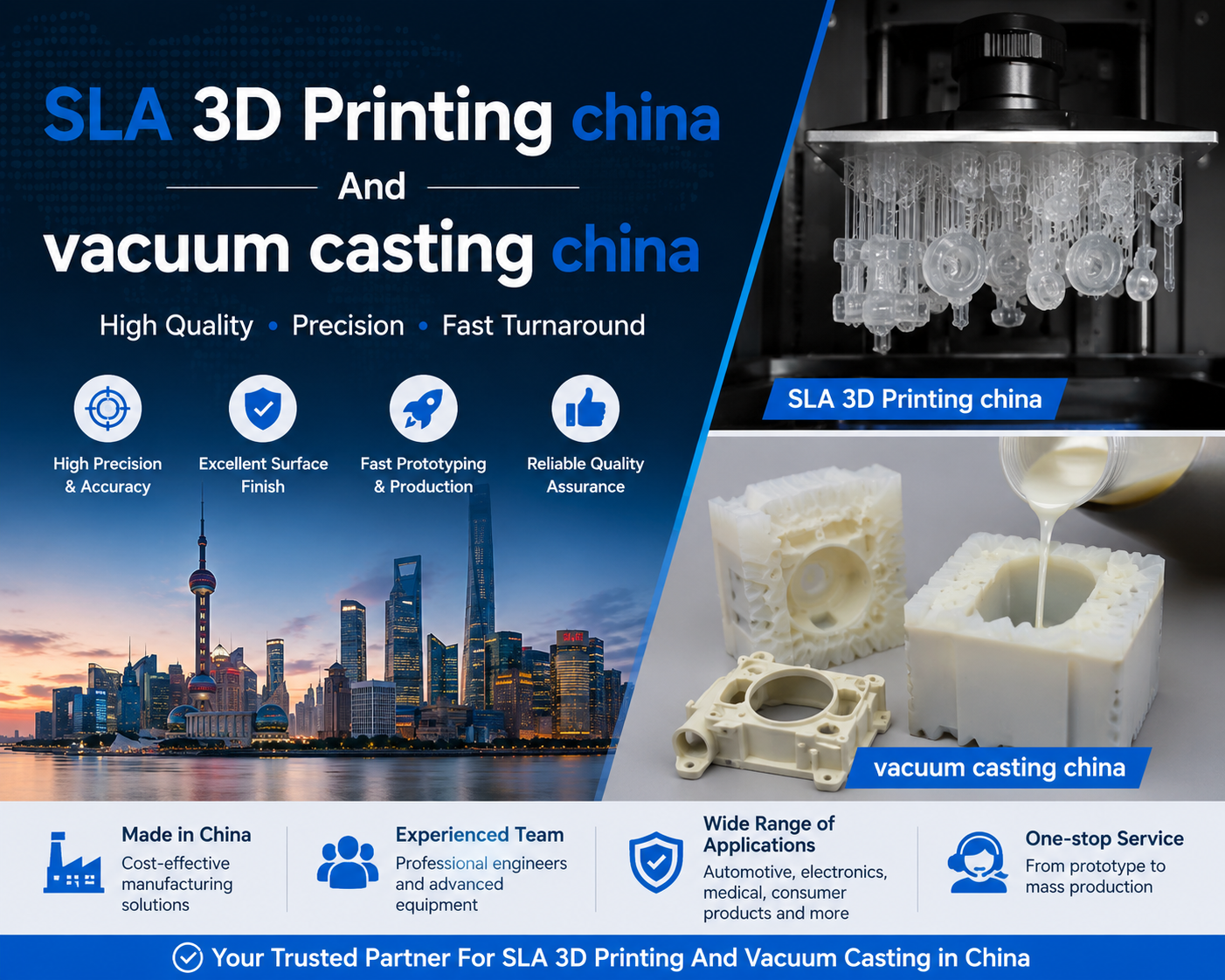
Product development has changed considerably over the past decade. Businesses no longer have to move directly from a finished CAD model to expensive production tooling just to understand how a new product will look and function in the real world.
Rapid prototyping provides an intermediate stage where designs can be manufactured, evaluated, modified and tested before larger investments are made. Two technologies that are particularly useful in this area are SLA 3D Printing China and vacuum casting China.
Although these processes work differently, they can complement each other throughout product development. SLA is well suited to detailed prototypes and frequent design iterations, while vacuum casting provides a practical option when several similar plastic-like components are required.
Here is what product developers should understand before deciding which process fits their next project.
Why Physical Prototypes Still Matter in a Digital Design World
Modern CAD and simulation software can provide impressive information about a product before anything is manufactured. However, a digital model cannot always answer every practical question.
How does the product feel in someone’s hand? Do two housing sections align properly? Is a button positioned comfortably? Does the physical size match what the design team imagined?
A prototype helps answer these questions.
Physical models can reveal problems involving:
- Assembly clearances
- Ergonomics
- Component interfaces
- External proportions
- Internal space
- Fastener positions
- Cosmetic details
- Accessibility of controls
Identifying such issues before production tooling can prevent unnecessary redesign later.
Where SLA 3D Printing China Fits into Product Development
SLA 3D Printing China refers to stereolithography services offered by Chinese rapid-prototyping manufacturers.
SLA is an additive manufacturing technology that uses liquid photopolymer resin. Controlled light selectively cures the resin, forming the component progressively according to a three-dimensional CAD model.
Once printing is complete, parts normally require cleaning, support removal and post-curing. Additional sanding, polishing, priming or painting may be performed when a higher-quality cosmetic appearance is needed.
The main advantage is straightforward: a conventional production mould is not required.
A designer can change the CAD file and manufacture another version without modifying expensive hard tooling.
What Makes SLA Different from Other Prototype Methods?
SLA is particularly recognised for its combination of fine detail and smooth surface quality.
This makes SLA 3D Printing China attractive for prototypes where appearance matters as much as geometry.
Typical applications can include:
- Electronic device housings
- Automotive interior components
- Medical equipment prototypes
- Consumer-product models
- Industrial equipment enclosures
- Transparent covers
- Appliance prototypes
- Presentation models
- Ergonomic studies
- Master patterns for silicone moulding
For example, imagine that a company is designing a smart-home controller.
An SLA prototype could allow the development team to evaluate the screen opening, button positions, enclosure proportions and internal component arrangement before deciding whether the design is ready for the next manufacturing stage.
The Point Where Direct 3D Printing May No Longer Be Enough
SLA is highly useful when one or several prototypes are required. But product-development requirements can change once a design is approved.
A company may suddenly need 15, 30 or more representative parts for customer demonstrations, internal trials, exhibitions or market testing.
Producing each component separately through SLA may not always be the preferred approach.
At this stage, vacuum casting China becomes worth considering.
Vacuum casting provides a way to reproduce an approved master model using a silicone mould and casting materials.
How Vacuum Casting China Works
The process begins with a high-quality master pattern.
This master can be produced using SLA 3D printing or another precision manufacturing process. Its quality is extremely important because the silicone mould will reproduce its geometry and surface characteristics.
Silicone is formed around the master and allowed to cure. The mould is then carefully opened and the original master removed.
Casting material is introduced into the resulting cavity. Vacuum processing helps minimise trapped air and supports the reproduction of fine details.
Once cured, the component is removed and can undergo finishing operations.
These may include:
- Trimming
- Sanding
- Polishing
- Painting
- Colour matching
- Texturing
- Pad printing
- Insert installation
- Assembly
This makes vacuum casting China useful for low-volume components requiring a more production-like presentation.
The Real Advantage Comes from Combining Both Technologies
A common mistake is to think that SLA and vacuum casting are competing manufacturing technologies.
In reality, they can form different stages of the same development strategy.
Consider a company designing a new handheld electronic product.
First, SLA 3D Printing China can be used to manufacture the initial prototype.
Engineers evaluate it and discover that the enclosure needs a small dimensional adjustment. The CAD model is updated, and a revised SLA prototype is produced.
After final approval, a professionally finished SLA component becomes the master pattern.
A silicone mould is then created, allowing vacuum casting China to manufacture multiple replicas.
The workflow becomes:
Idea → CAD Design → SLA Prototype → Evaluation → Design Revision → Final Master → Silicone Mould → Vacuum Casting → Low-Volume Parts
This staged approach allows production quantities to increase as confidence in the design improves.
SLA 3D Printing vs Vacuum Casting: A Simple Comparison
| Factor | SLA 3D Printing | Vacuum Casting |
| Best suited to | Prototype iteration | Small production batches |
| Starting point | CAD model | Physical master |
| Hard tooling | Not required | Not required |
| Silicone mould | Not required | Required |
| Common material | Photopolymer resin | Polyurethane |
| Design modifications | Relatively easy | May require a new mould |
| Complex geometry | Excellent | Depends on mould design |
| Surface finish | Smooth and detailed | Closely reproduces master |
| One-off prototype | Highly suitable | Usually unnecessary |
| Multiple replicas | Possible | Particularly suitable |
The appropriate choice therefore depends on where the product currently sits in its development cycle.
Choosing Materials Based on What You Need to Test
Prototype material should be chosen according to the purpose of the component rather than simply its appearance.
For SLA 3D Printing China, manufacturers may offer standard, tough, flexible, transparent or heat-resistant resin systems.
If the prototype is intended only for a sales presentation, cosmetic quality may be the priority.
If engineers need to check assembly or handling, material durability may become more important.
Vacuum casting offers a different range of material characteristics. Depending on supplier capabilities, options may include rigid polyurethane, flexible materials, rubber-like formulations and clear casting resins.
ABS-like and PP-like materials are also commonly discussed.
However, “ABS-like” does not mean that a polyurethane casting resin is identical to injection-moulded ABS. Technical data should always be reviewed when mechanical performance matters.
What Should You Ask Before Choosing a Supplier in China?
Choosing the right manufacturing process is only half of the decision. Supplier capability can significantly affect prototype quality.
Before ordering SLA 3D Printing China or vacuum casting China, consider asking:
- Which SLA materials are available?
- What is the maximum printable component size?
- What tolerances can realistically be maintained?
- Which vacuum-casting materials are offered?
- What finishing services are available?
- How are critical dimensions inspected?
- Can colour matching be provided?
- Does the supplier offer DFM feedback?
- How are cosmetic requirements controlled?
- What information is included in quality inspection?
Providing complete technical information will also improve the quotation process.
Ideally, buyers should send CAD files, 2D drawings, quantities, material requirements, tolerances, colour references and finishing expectations.
Cost Should Be Evaluated Across the Whole Project
Price comparisons can be misleading when manufacturing methods are evaluated only on a per-part basis.
With SLA, cost can be influenced by resin consumption, component dimensions, geometry, support structures, selected material and post-processing.
With vacuum casting China, initial expenses include master preparation and silicone mould production. Once the mould exists, however, multiple components can be produced from it until the mould reaches the end of its usable life.
This means the most economical process can change depending on quantity.
A single prototype may favour SLA, while a small batch of identical components may make vacuum casting worth evaluating.
Frequently Asked Questions
What is SLA 3D printing mainly used for?
SLA is widely used for detailed prototypes, visual models, design validation and master-pattern production.
Does SLA need production tooling?
No. Parts are manufactured directly from digital CAD data.
What is vacuum casting mainly used for?
Vacuum casting is commonly used for small batches of plastic-like components and pre-production prototypes.
Can SLA be used before vacuum casting?
Yes. SLA is frequently used to produce the master pattern from which the silicone mould is created.
Is SLA suitable for complex geometry?
Yes. Complex shapes and fine details are among the main strengths of SLA technology.
Can vacuum casting produce flexible components?
Yes. Flexible and rubber-like casting materials may be available.
Can transparent prototypes be manufactured?
Yes. Both technologies can offer clear-material options, although the required optical quality should be discussed with the manufacturer.
Is vacuum casting suitable for mass production?
Usually not. It is primarily a low-volume process. Injection moulding may become more appropriate at higher quantities.
Can vacuum-cast components be painted?
Yes. Painting, polishing, texturing and printing can be applied depending on the required finish.
Which process is better for a new product?
During frequent design changes, SLA usually offers greater flexibility. Once the design is stable and multiple copies are required, vacuum casting may be the more appropriate next stage.
Read more – https://shopnets.com/china-cnc-custom-machining-how-to-choose-the-right-manufacturing-partner/
https://newsgrow.blogspot.com/2026/08/china-cnc-custom-machining-practical.html
https://newsgrow.blogspot.com/2026/08/china-cnc-machining-suppliers-and.html
https://newsgrow.blogspot.com/2026/08/sla-3d-printing-china-and-vacuum.html