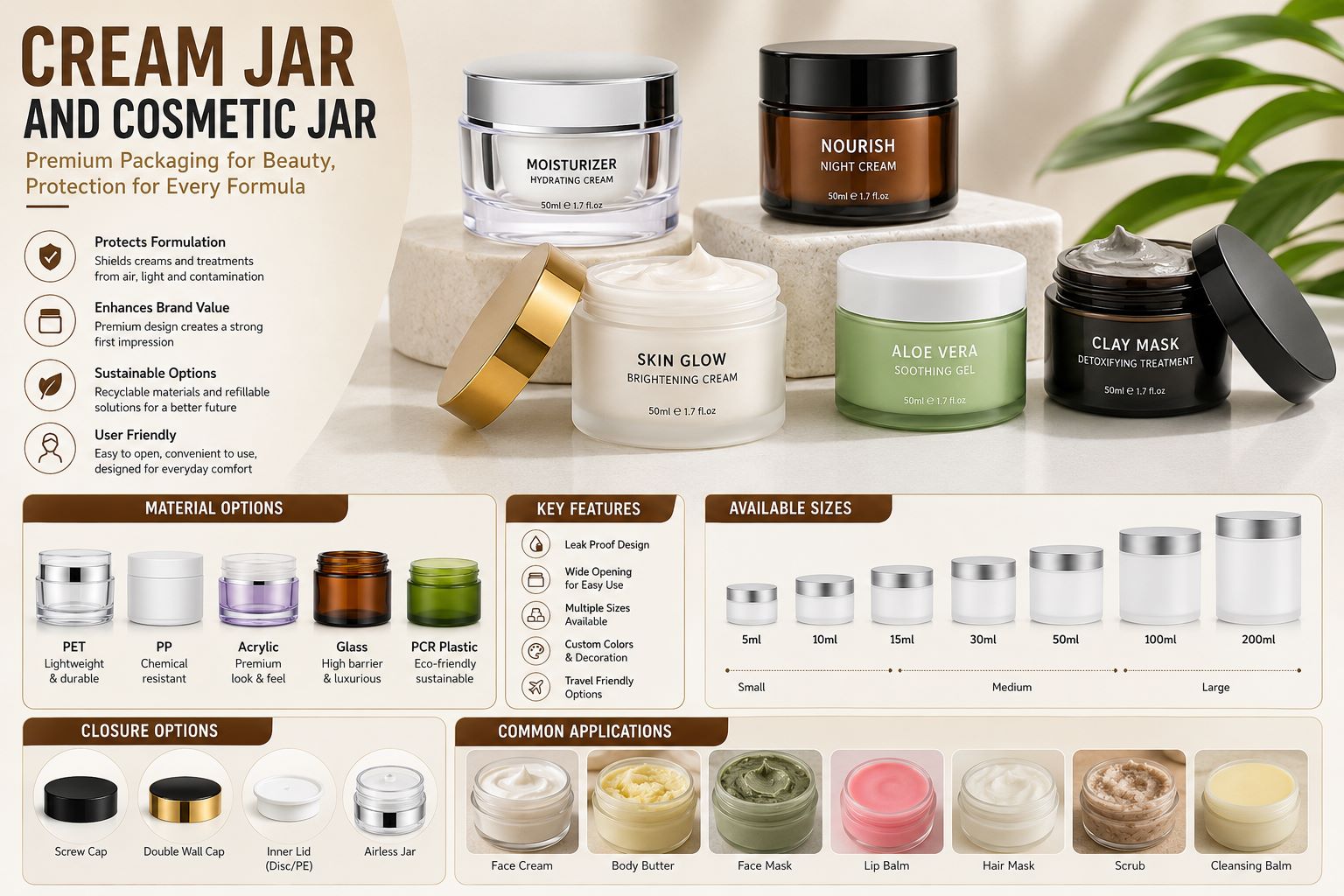
In the beauty industry, packaging has evolved from a simple container into an important part of product performance, brand identity, and customer experience. A thoughtfully designed cream jar can make a moisturizer feel more premium, protect the formulation during storage, and make everyday application easier. At the same time, the right cosmetic jar can help a brand differentiate its products in an increasingly competitive skincare and personal care market.
Choosing jar packaging involves much more than selecting an attractive shape. Material compatibility, barrier properties, closure design, capacity, decoration, transportation, sustainability, and consumer behavior all influence the final decision.
Why Jar Packaging Remains Popular in Beauty Products
Jars remain widely used because they offer easy access to thick and semi-solid formulations. Consumers can conveniently scoop out the required amount without struggling with pumps or narrow bottle openings.
A cream jar is particularly suitable for products such as:
- Face moisturizer
- Night cream
- Body butter
- Facial mask
- Cleansing balm
- Hair mask
- Massage cream
- Hand and foot cream
- Styling wax
- Exfoliating scrub
A cosmetic jar has even broader applications because it can accommodate skincare, haircare, makeup, spa, and personal care formulations.
The wide opening also allows consumers to see the texture and appearance of the product, which can contribute to the sensory experience associated with premium beauty products.
How Cream Jar Design Influences Product Performance
The design of a cream jar should match the physical and chemical characteristics of the formulation.
A thick body butter, for example, requires different packaging considerations from a lightweight facial gel. Formulas containing sensitive active ingredients may also require greater protection against oxygen, moisture, light, or contamination.
Protection Against External Conditions
Cosmetic formulations may be affected by:
- Oxygen exposure
- Excessive heat
- UV radiation
- Moisture
- Microbial contamination
- Repeated consumer contact
Selecting suitable packaging helps minimize these risks throughout the intended shelf life.
The Importance of Jar and Cap Compatibility
Even an excellent container can perform poorly when paired with an unsuitable closure. The cap should fit securely and consistently without requiring excessive force.
Liners, inner discs, seals, or specialized closure systems can provide additional protection depending on product requirements.
Choosing the Right Cosmetic Jar Material
Material selection affects appearance, weight, durability, cost, protection, and environmental impact.
The most commonly considered options include glass and several types of plastic.
| Jar Material | Key Benefit | Suitable For | Appearance |
| Glass | Strong barrier properties | Premium skincare | Elegant |
| PET | Lightweight and durable | Scrubs and gels | Clear and modern |
| PP | Good chemical resistance | Creams and balms | Versatile |
| Acrylic | Premium visual effect | Luxury cosmetics | High-end |
| PCR Plastic | Uses recycled material | Eco-conscious ranges | Contemporary |
There is no universal material that is best for every cosmetic jar. Packaging should be evaluated according to the actual formulation and intended market.
Glass vs Plastic Cosmetic Packaging
Glass is often associated with premium skincare because its weight and appearance can create a luxurious experience. It can also offer strong barrier properties.
Plastic offers different advantages. It is lightweight, resistant to breakage, easier to transport, and available in numerous shapes and structures.
Brands should consider the complete product journey—from filling and warehousing to shipping, retail display, customer use, and disposal—before making a decision.
When Glass May Be Suitable
Glass may be preferred when:
- Premium positioning is important
- Product weight contributes to perceived luxury
- Strong barrier performance is required
- The formulation is compatible with glass
When Plastic May Be Suitable
Plastic may be preferable when:
- Lightweight packaging is required
- Transportation efficiency matters
- Breakage must be minimized
- Flexible shapes are desired
- Cost optimization is important
Understanding Cosmetic Jar Capacity
Selecting the correct capacity can influence pricing, usability, and customer expectations.
Small jars are commonly used for eye treatments, lip products, samples, and concentrated formulas. Medium-sized jars are popular for facial skincare, while larger containers are generally selected for body care and professional products.
Common Capacity Applications
| Capacity Range | Typical Application |
| 5–15 ml | Samples, eye products, lip care |
| 20–30 ml | Specialized facial treatments |
| 50 ml | Moisturizers and facial creams |
| 100–200 ml | Masks, scrubs, body products |
| 250 ml+ | Professional and salon products |
The appropriate capacity should reflect realistic product usage rather than simply creating the appearance of larger packaging.
How Cosmetic Jar Design Builds Brand Identity
Packaging often creates the customer’s first physical interaction with a beauty brand.
A minimalist cream jar with clean typography can communicate dermatological or scientific positioning. Frosted glass and metallic details may create a luxury impression, while soft colors and natural textures can support botanical positioning.
Customization options can include:
- Screen printing
- Hot foil stamping
- Labels
- Embossing
- Debossing
- Matte finishes
- Gloss finishes
- Frosted effects
- Metallization
- Custom-colored caps
Design elements should support the brand rather than interfere with important product information.
Product Safety and Compatibility Testing
Before approving a cosmetic jar for mass production, packaging and formulation should be tested together.
A package that performs perfectly with one formulation may behave differently with another because cosmetic ingredients can interact with packaging materials.
Important Packaging Tests
Manufacturers commonly evaluate:
- Leakage resistance
- Closure performance
- Drop resistance
- Material compatibility
- Temperature stability
- Decoration durability
- Transportation resistance
- Product discoloration
- Packaging deformation
Why Testing Cannot Be Ignored
Problems may not appear immediately after filling. Some interactions become noticeable only after prolonged storage or exposure to different temperatures.
Testing helps identify these issues before products reach consumers.
Sustainability and the Future of Cosmetic Jars
Environmental considerations are reshaping beauty packaging.
Brands are exploring lightweight designs, recycled materials, refill systems, mono-material packaging, and reduced secondary packaging.
However, sustainable packaging requires a broader perspective.
A heavy package made from a recyclable material may require more transportation energy, while an extremely lightweight package containing multiple inseparable materials could be difficult to recycle.
Brands should evaluate:
- Material quantity
- Recycled content
- Transportation weight
- Reusability
- Refill potential
- Local recyclability
- Component separation
The objective should be meaningful environmental improvement rather than sustainability claims based only on appearance.
Airless Jar Technology for Advanced Skincare
Traditional jars expose products to external air whenever consumers remove the lid. For many stable formulations, this is manageable when products are properly formulated and preserved.
Sensitive skincare products may require additional protection.
Airless jar systems are designed to dispense the formulation while reducing direct exposure to external conditions and repeated finger contact.
This technology can be particularly valuable for premium skincare products containing sensitive ingredients, although suitability should always be evaluated through testing.
What Brands Should Check Before Ordering Cosmetic Jars
Packaging procurement can affect production schedules, inventory costs, and launch timelines.
Before ordering a cream jar or cosmetic jar, brands should confirm:
- Material specification
- Available capacity
- Neck and closure dimensions
- Minimum order quantity
- Production lead time
- Decoration options
- Sample availability
- Custom mold requirements
- Packaging tolerances
- Quality inspection procedures
- Shipping configuration
Ordering and testing samples before committing to mass production can prevent expensive mistakes.
Frequently Asked Questions
1. What products can be packed in a cream jar?
A cream jar can hold moisturizers, body creams, masks, balms, scrubs, hair treatments, and many semi-solid formulations.
2. What makes a good cosmetic jar?
Good packaging combines formulation compatibility, secure closure, convenient use, suitable barrier protection, durability, and attractive presentation.
3. Is glass better for skincare products?
Glass can provide premium appearance and strong barrier properties, but suitability depends on formulation, transportation, cost, and brand positioning.
4. Are plastic cosmetic jars safe?
Suitable cosmetic-grade plastics can be used when they are properly selected and tested for compatibility with the intended formulation.
5. Can cream jars be customized?
Yes. Shape, size, color, cap, printing, coating, labels, embossing, and decorative finishes can often be customized.
6. Why do cosmetic jars have inner discs?
Inner discs can improve cleanliness, minimize product contact with the cap, and provide additional protection during transportation.
7. What is the most popular cream jar size?
The ideal size varies by product, although 50 ml is commonly associated with facial moisturizers and skincare creams.
8. What is an airless cosmetic jar?
An airless jar uses a dispensing mechanism designed to reduce direct exposure of the formulation to external air and consumer contact.
9. Can cosmetic jars use recycled plastic?
Yes. PCR materials can reduce reliance on virgin plastic when appropriate for the product and packaging requirements.
10. How should brands select jar suppliers?
Evaluate manufacturing quality, technical expertise, material documentation, customization capability, testing support, consistency, lead times, and communication.