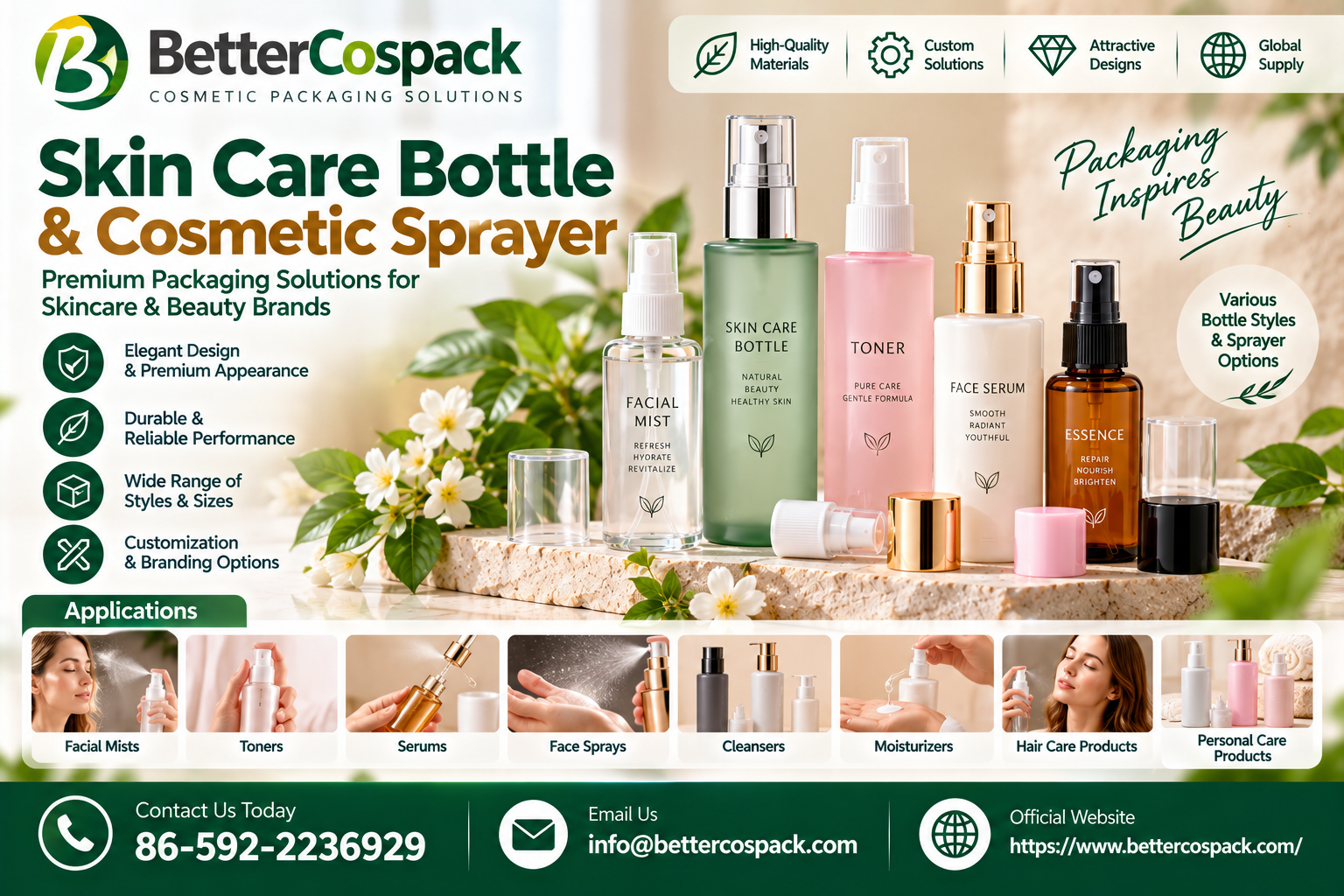
Packaging has become an essential consideration in skincare product development. Beyond visual appeal, manufacturers must select containers and dispensing systems that support formulation stability, convenient application, and a consistent customer experience.
A well-designed skin care bottle helps protect cosmetic formulations while supporting product presentation and brand recognition.
Meanwhile, a compatible cosmetic sprayer provides controlled liquid dispensing for facial mists, toners, body sprays, and other suitable skincare products.
For cosmetic manufacturers, emerging beauty brands, and private-label businesses, understanding packaging materials, dispensing technologies, and customization options can improve product development decisions.
What Is a Skin Care Bottle?
A skin care bottle is a packaging container designed to store and dispense skincare or personal care formulations.
These bottles are available in different materials, capacities, colors, and designs, depending on product characteristics and manufacturing requirements.
Common applications include:
- Facial toners and cleansing solutions.
- Moisturizing lotions.
- Facial serums.
- Body care products.
- Haircare liquids.
- Hydrating facial mists.
- Selected cosmetic treatment formulations.
The appropriate bottle should accommodate the formulation while providing suitable protection during storage, transportation, and everyday use.
Popular Materials Used in Skincare Bottles
Material selection influences packaging performance, appearance, weight, and chemical compatibility.
PET Bottles
Polyethylene terephthalate (PET) is commonly used for clear and colored cosmetic containers.
Its lightweight construction and clarity make it suitable for selected skincare formulations.
HDPE Bottles
High-density polyethylene (HDPE) is widely used in personal care packaging because of its durability and chemical resistance to many substances.
PP Bottles
Polypropylene (PP) offers design flexibility and is used in selected cosmetic containers and dispensing components.
Glass Bottles
Glass provides a distinctive presentation and may be appropriate for certain formulations.
However, its weight and breakage characteristics require consideration.
No single material is suitable for every skincare formulation. Compatibility testing is essential.
What Is a Cosmetic Sprayer?
A cosmetic sprayer is a dispensing component designed to release suitable liquid formulations as droplets through a spray nozzle.
Many sprayers use a manually operated pump mechanism that draws liquid from the container and releases it when the actuator is pressed.
Cosmetic sprayers are frequently used for:
- Facial hydration mists.
- Liquid toners.
- Body sprays.
- Hair refreshing sprays.
- Fragrance products.
- Selected skincare liquids.
The formulation’s viscosity, ingredients, and intended application influence sprayer selection.
How Does a Cosmetic Sprayer Work?
A conventional mechanical sprayer generally includes an actuator, nozzle, pump mechanism, internal valves, and dip tube.
Pressing the actuator creates the pumping action required to dispense the liquid.
Several characteristics influence performance.
Spray Pattern: Determines how droplets are distributed.
Dispensing Output: Defines the approximate liquid quantity released per actuation.
Priming Performance: Influences how quickly the pump begins dispensing.
Nozzle Design: Affects spray distribution and user experience.
Material Compatibility: Helps ensure that formulation ingredients do not adversely affect dispensing components.
Skin Care Bottle vs Cosmetic Sprayer: Key Differences
Although closely related, these packaging products serve different functions.
| Feature | Skin Care Bottle | Cosmetic Sprayer |
| Main purpose | Stores cosmetic formulations | Dispenses compatible liquids |
| Product category | Packaging container | Dispensing component |
| Common materials | PET, HDPE, PP, glass | Plastic components and suitable internal parts |
| Customization | Shape, capacity, color, decoration | Nozzle, actuator, color, output |
| Main consideration | Product stability and compatibility | Spray performance and compatibility |
For a complete spray-packaging solution, the bottle and sprayer must function together.
Why Bottle and Sprayer Compatibility Matters
A high-quality bottle alone cannot guarantee reliable dispensing.
The complete packaging system must be evaluated before commercial production.
Neck Finish Compatibility
Bottle threads and sprayer dimensions must match the specified connection.
Dip Tube Length
The dip tube should be selected according to container dimensions and intended use.
Formulation Viscosity
Thick creams and gels generally require different dispensing mechanisms from low-viscosity facial mists.
Leakage Resistance
The assembled packaging should be evaluated under relevant storage and transportation conditions.
Product Stability
Ingredients must remain compatible with all packaging materials contacting the formulation.
These evaluations help manufacturers identify potential problems before launching a product.
Customization Opportunities for Skincare Brands
Customized packaging can support product differentiation and consistent brand identity.
Depending on supplier capabilities, options may include:
- Custom bottle shapes and capacities.
- Transparent, opaque, or colored containers.
- Matte or glossy surface finishes.
- Coordinated sprayer and bottle colors.
- Screen printing and label decoration.
- Alternative actuator designs.
- Decorative metallic finishes.
- Brand-specific packaging combinations.
Customization should balance appearance, technical performance, production feasibility, and cost.
Quality Testing Before Bulk Packaging Orders
Businesses purchasing a skin care bottle with a cosmetic sprayer should conduct suitable product testing.
Important assessments include:
Leakage Testing: Checks product containment under defined conditions.
Spray Testing: Evaluates output consistency and spray distribution.
Compatibility Testing: Examines interactions between the formulation and packaging materials.
Stability Testing: Evaluates product characteristics during intended storage conditions.
Transportation Testing: Assesses packaging performance during handling and shipment.
For products containing light-sensitive ingredients, the protection offered by the selected bottle should also be evaluated.
Sustainable Packaging Considerations
Beauty brands may explore packaging approaches that reduce unnecessary material use and improve end-of-life management.
Potential options include lightweight containers, suitable recycled-content materials, and packaging designs that support local recycling systems.
However, cosmetic sprayers can contain multiple materials, which may complicate recycling.
Environmental claims should be supported by appropriate evidence and consider available collection and processing infrastructure.
How to Choose a Reliable Cosmetic Packaging Supplier
Selecting a supplier requires evaluating both technical capabilities and commercial reliability.
Buyers should request material specifications, samples, available customization options, and relevant quality information.
Before ordering, confirm packaging dimensions, minimum order quantities, production requirements, lead times, and delivery arrangements.
Testing samples with the intended formulation is particularly important for avoiding compatibility problems.
Frequently Asked Questions (FAQs)
1. What is a skin care bottle?
It is a container designed to store and dispense skincare formulations such as lotions, toners, serums, and facial mists.
2. What is a cosmetic sprayer?
It is a dispensing component that releases compatible liquid products through a spray nozzle.
3. Which materials are commonly used for skincare bottles?
PET, HDPE, PP, and glass are commonly used, depending on product requirements.
4. Can cosmetic sprayers be used for facial toners?
Yes, suitable low-viscosity toner formulations may be dispensed using compatible sprayers.
5. Are skincare bottles customizable?
Yes. Options may include size, shape, color, printing, and decorative finishes.
6. Can a cosmetic sprayer be used for thick lotions?
Most fine-mist sprayers are intended for suitable liquids rather than thick lotions.
7. How do I choose the correct sprayer size?
Check the bottle neck finish, pump specifications, dip tube length, and formulation requirements.
8. Are plastic skincare bottles recyclable?
Some are recyclable where suitable local collection and processing facilities exist.
9. What affects cosmetic packaging prices?
Material, bottle capacity, design complexity, dispensing components, customization, and order quantity influence pricing.
10. How can businesses choose a dependable packaging supplier?
Compare product samples, material specifications, quality testing, customization options, supply capabilities, and commercial terms.
Media Contact
Industry: Cosmetic Packaging, Skincare Containers & Beauty Packaging Solutions
Service Enquiries: Skin Care Bottles, Cosmetic Sprayers, Fine Mist Sprayers, Cosmetic Containers & Customized Skincare Packaging
Email: info@bettercospack.com
Contact Number: +86-592-2236929
Official Website: https://www.bettercospack.com/