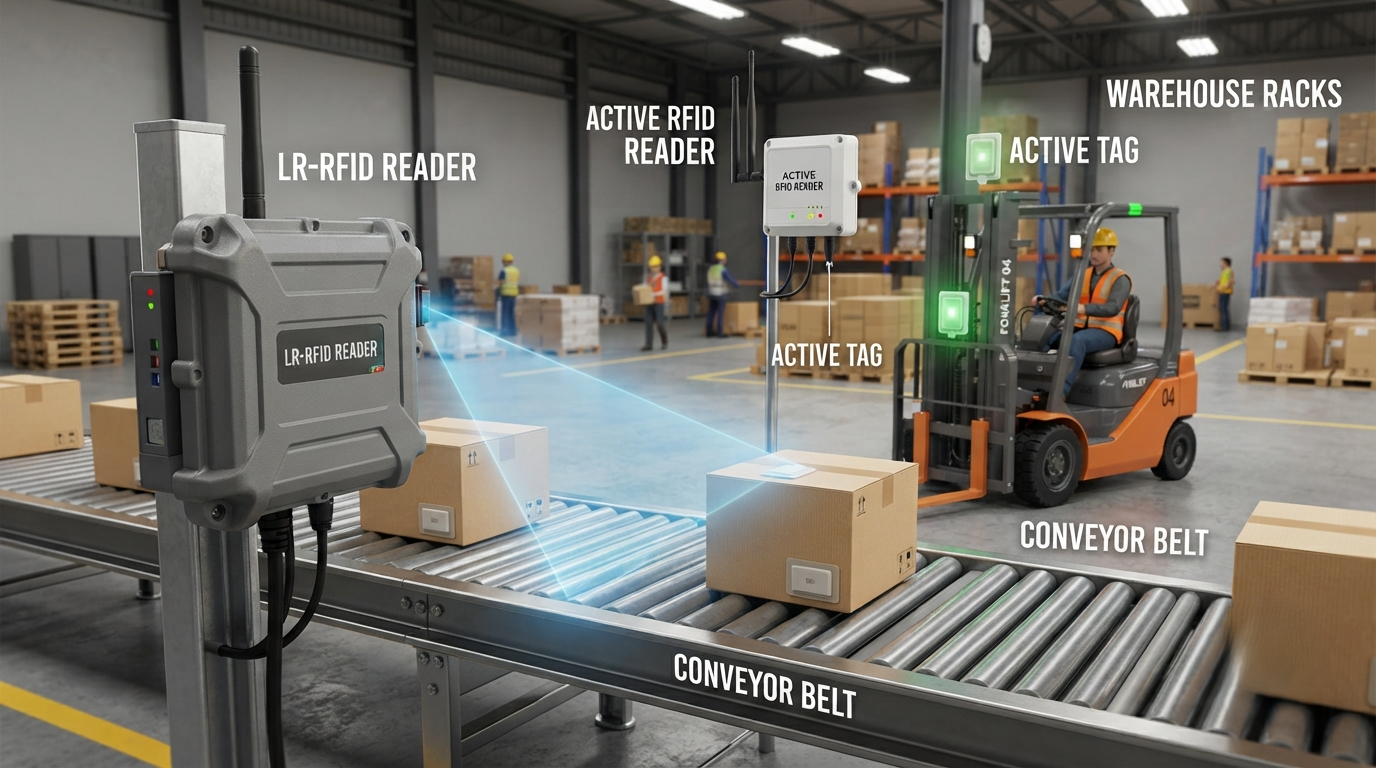
Two technologies frequently used in advanced tracking environments are the Long Range RFID Reader and Active RFID Reader. Although both can support identification over significant distances, they differ in tag technology, communication methods, infrastructure requirements, maintenance, and application suitability.
A deeper understanding of these differences is essential before investing in an RFID deployment.
Understanding the Architecture of Long Range RFID Systems
A Long Range RFID Reader is generally designed to detect RFID tags several meters away from the antenna. Many commercial implementations use UHF RFID technology operating within regional frequency regulations.
The complete system normally includes:
- RFID reader hardware
- One or multiple antennas
- RFID tags
- Middleware
- Network connectivity
- Application software
- Database or cloud platform
When an RFID tag enters the antenna’s electromagnetic field, the reader exchanges information with the tag and retrieves its unique identification data.
In passive UHF systems, the tag does not normally contain a battery. Instead, it receives energy from the reader’s radio-frequency signal.
This design makes passive tags economical and suitable for large-scale applications involving thousands or millions of items.
How Active RFID Technology Operates
An Active RFID Reader works with active RFID tags equipped with an internal battery.
Because these tags have their own power source, they can transmit signals independently rather than depending completely on energy supplied by the reader.
Active tags may broadcast information periodically or respond when communication is initiated.
Depending on the system design, transmitted information can include:
- Tag identity
- Asset status
- Location information
- Sensor data
- Battery condition
- Movement events
This architecture makes active RFID highly useful in environments requiring frequent location updates or continuous asset visibility.
Long Range RFID Reader vs Active RFID Reader
The fundamental difference is the way the RFID tag receives and uses power.
| Technology Factor | Long Range RFID Reader | Active RFID Reader |
| Common tag type | Passive UHF | Battery-powered active |
| Tag power source | Reader-generated RF energy | Internal battery |
| Typical tag cost | Lower | Higher |
| Maintenance requirement | Minimal | Battery management |
| Reading coverage | Long range | Very long range |
| Real-time monitoring | Limited | Excellent |
| Mass inventory use | Highly suitable | Less economical |
| High-value asset tracking | Suitable | Highly suitable |
Neither technology is universally better. Selection depends on the operational objective.
Why Reading Range Is Not the Only Important Factor
One of the biggest mistakes in RFID planning is selecting a reader only because the manufacturer specifies a long maximum range.
Actual RFID performance depends on multiple variables.
Important factors include:
- Reader transmission power
- Antenna gain
- Antenna polarization
- Tag sensitivity
- Tag orientation
- Mounting surface
- Environmental interference
- Building structure
- Object movement speed
- Regional frequency regulations
For example, the same Long Range RFID Reader may provide different performance when a tag is mounted on cardboard, plastic, metal, glass, or liquid-filled containers.
Therefore, real-world testing is essential.
Antenna Design and RFID Performance
Antennas are one of the most important components of an RFID installation.
The reader generates the RFID signal, but the antenna determines where that signal is transmitted and received.
Directional antennas can create focused reading zones around:
- Entry gates
- Warehouse doors
- Conveyor systems
- Parking barriers
- Production checkpoints
Circularly polarized antennas are often selected when tag orientation changes, while linearly polarized antennas may offer stronger performance when tag orientation is controlled.
Correct antenna positioning can improve accuracy without unnecessarily increasing reader power.
RFID in Vehicle Identification Systems
Vehicle identification is a major application of the Long Range RFID Reader.
A UHF tag may be installed on the windshield or another suitable area of an authorized vehicle.
When the vehicle approaches an entrance, the reader detects the tag.
The software then performs several actions:
- Receives the RFID number.
- Checks the authorization database.
- Confirms vehicle permission.
- Records entry time.
- Activates the barrier.
- Stores the transaction.
This automation can reduce manual verification at corporate campuses, factories, residential properties, logistics facilities, and parking areas.
Deep Asset Tracking with Active RFID
The Active RFID Reader becomes especially valuable when businesses need more than checkpoint identification.
Imagine a manufacturing facility with hundreds of expensive tools, machines, and mobile equipment.
Knowing that an asset passed through a doorway yesterday may not be sufficient.
Management may need to know its current zone or most recent detected location.
Active RFID infrastructure can provide this visibility by receiving regular transmissions from battery-powered tags.
If equipment enters an unauthorized area, software can generate an alert.
This improves asset security and reduces search time.
Warehouse and Supply Chain Applications
RFID can create greater supply-chain transparency.
Passive long-range readers may be installed near receiving docks and dispatch doors.
When tagged pallets move through these locations, the system can automatically record the transaction.
The information may update:
- Inventory levels
- Purchase orders
- Warehouse records
- Shipment status
- Dispatch confirmation
An Active RFID Reader can complement this infrastructure by monitoring forklifts, reusable containers, trailers, or expensive equipment that constantly moves within the facility.
RFID Middleware and Software Integration
RFID hardware alone does not create business intelligence.
Every reader can generate large amounts of raw RFID data.
Middleware processes this information before it reaches business software.
Middleware may perform functions such as:
- Removing duplicate reads
- Filtering unwanted tags
- Applying business rules
- Generating events
- Sending alerts
- Connecting APIs
- Updating databases
Integration can connect RFID with ERP, WMS, access-control, parking-management, manufacturing, or custom cloud platforms.
This integration converts simple tag readings into meaningful operational actions.
Challenges in Long Range RFID Deployment
RFID technology offers significant advantages, but poor system design can produce unreliable results.
Common problems include:
- Unwanted tag detection
- Missed tags
- Antenna interference
- Metal reflections
- Incorrect tag placement
- Excessive reader power
- Overlapping reading zones
- Network connectivity issues
Testing different tags and antenna configurations can solve many of these challenges.
A controlled reading zone is usually more important than maximum possible range.
Security Considerations in RFID Systems
Security should be considered during the initial architecture stage.
Organizations should protect:
- Reader login credentials
- Network communication
- APIs
- Databases
- RFID identifiers
- User permissions
- Management dashboards
Sensitive systems may require encrypted communication, authentication, role-based access, and detailed event logging.
For active systems involving employee or personnel tracking, organizations should also establish appropriate privacy policies and clearly define how location information is collected, retained, and accessed.
How to Select the Correct RFID Technology
Businesses should begin by identifying the exact problem they want to solve.
A Long Range RFID Reader may be appropriate when the requirement involves large numbers of economical passive tags.
An Active RFID Reader may be more appropriate when organizations require frequent location information about valuable mobile assets.
Consider these questions:
- How far must tags be detected?
- How many tags will be deployed?
- Is real-time location required?
- Are assets constantly moving?
- What is the acceptable tag cost?
- Will tags require maintenance?
- Is the environment indoors or outdoors?
- Are metal or liquids present?
- Which software requires integration?
- How will the system expand later?
These answers provide a better foundation for technology selection.
Frequently Asked Questions
1. What is a Long Range RFID Reader?
A Long Range RFID Reader identifies compatible RFID tags across relatively large distances using radio-frequency communication.
2. What is an Active RFID Reader?
An Active RFID Reader communicates with battery-powered RFID tags that can transmit signals over longer distances.
3. Can RFID work without line of sight?
Yes. RFID uses radio waves and generally does not require direct visual contact.
4. Why are passive RFID tags cheaper?
Passive tags usually have no internal battery and contain fewer powered electronic components.
5. Can RFID identify moving vehicles?
Yes. Properly configured readers can identify tagged vehicles moving through controlled access zones.
6. Can active RFID track employees?
Technically yes. Active RFID can support personnel location applications when implemented with appropriate privacy, security, and organizational policies.
7. Is active RFID suitable for expensive equipment?
Yes. It is particularly useful for locating valuable mobile assets.
8. Can RFID connect with ERP systems?
Yes. Middleware and APIs can connect RFID infrastructure with ERP, WMS, and other enterprise applications.
9. What affects RFID reading distance?
Reader power, antenna type, tag design, environment, material, orientation, interference, and installation quality all affect range.
10. Does active RFID require maintenance?
Yes. Active tags contain batteries that eventually require replacement or tag servicing.