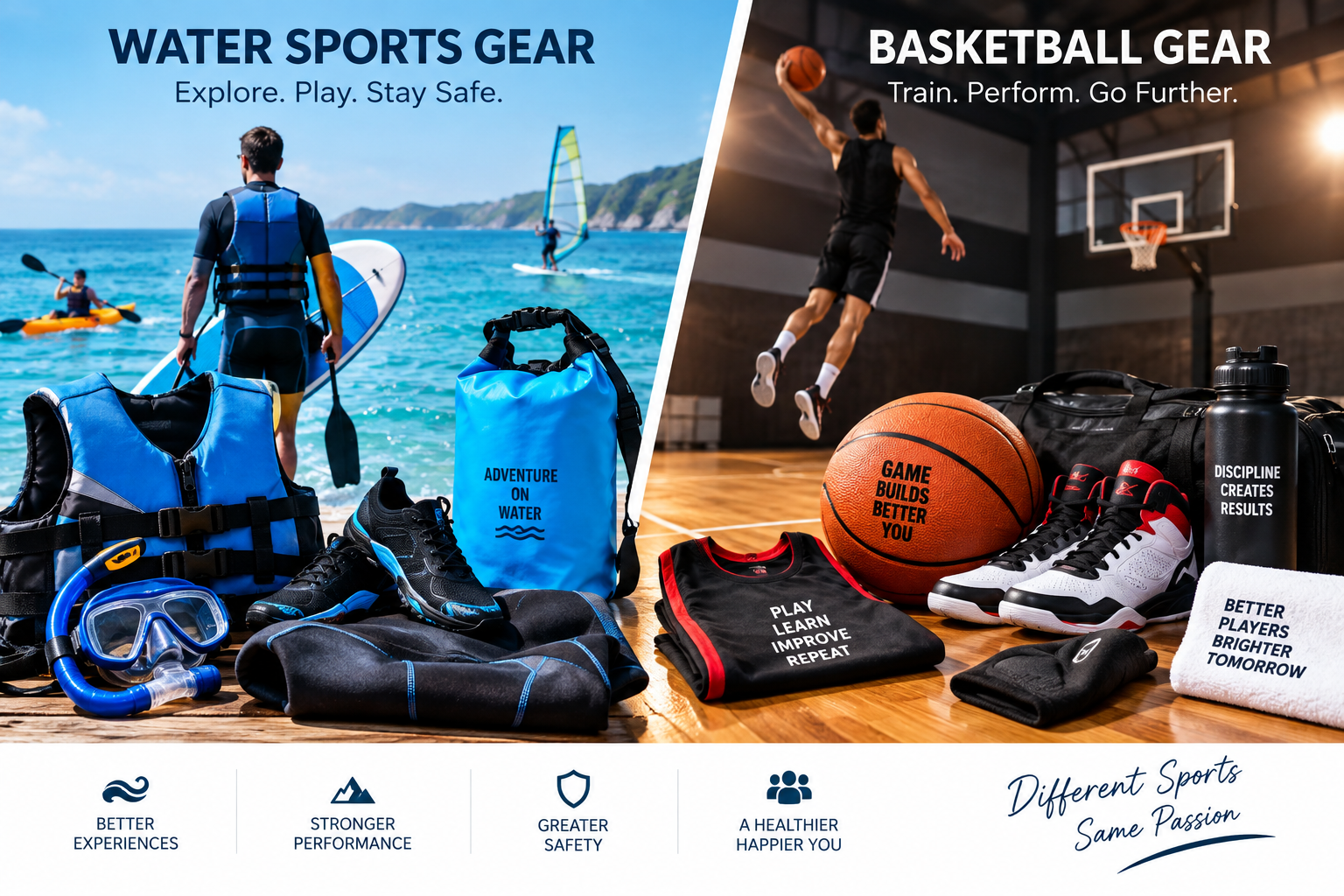
Sports equipment has changed dramatically as athletes demand better safety, performance, comfort, and durability. Two categories that clearly demonstrate this transformation are Water Sports Gear and Basketball Gear. Although these sports take place in completely different environments, their equipment has evolved through the same combination of craftsmanship, material science, athlete feedback, and technological innovation.
From simple wooden boards and basic leather basketball shoes to smart wearables and advanced composite materials, sports gear has become increasingly specialized. Understanding its past also gives us valuable clues about what athletes can expect in the future.
The Early History of Water Sports Gear
Water-based recreation existed long before modern sporting equipment appeared. Early swimmers, surfers, sailors, and divers depended mostly on natural materials and handmade equipment.
Traditional surfboards, for example, were constructed from solid wood. They were heavy and difficult to transport, but they represented an important beginning in the development of modern Water Sports Gear. Early swimming equipment was equally simple, while divers often relied on basic masks and manually designed breathing devices.
The earliest equipment focused mainly on allowing people to participate rather than improving athletic performance.
Common early water sports equipment included:
- Wooden surfboards
- Basic swimming goggles
- Rubber swimming caps
- Simple diving masks
- Heavy flotation devices
- Traditional wooden paddles
- Basic life jackets
As recreational swimming, surfing, kayaking, diving, and sailing became more popular, manufacturers started developing specialized products for individual activities.
How Water Sports Gear Became More Advanced
The introduction of synthetic materials completely changed water sports equipment. Fiberglass, neoprene, lightweight plastics, carbon fiber, and advanced polymers allowed manufacturers to create lighter and stronger products.
Modern wetsuits became more flexible while providing better thermal protection. Surfboards became significantly lighter than traditional wooden models. Diving masks received improved seals and wider visibility, while personal flotation devices became less bulky.
Today, professional and recreational Water Sports Gear may include:
- Performance wetsuits
- Lightweight surfboards
- Diving masks and snorkels
- Waterproof footwear
- Paddleboards
- Life jackets and buoyancy aids
- Waterproof sports watches
- Protective helmets
Modern manufacturers increasingly balance hydrodynamics, protection, mobility, and environmental resistance when developing equipment.
The Early Development of Basketball Gear
Basketball was invented in 1891, and its original equipment was remarkably simple. Players initially used a soccer-style ball and peach baskets as goals. Specialized Basketball Gear did not yet exist.
Early basketball players commonly wore ordinary athletic clothing and basic canvas or leather footwear. These shoes offered limited ankle protection, cushioning, and traction compared with modern basketball footwear.
As professional basketball developed, manufacturers recognized that players required equipment specifically designed for jumping, running, changing direction, and handling repeated impact.
The basketball itself also changed. Improvements in leather construction, internal bladder design, grip patterns, and manufacturing consistency created balls that performed much more predictably.
Evolution of Modern Basketball Gear
Modern basketball equipment focuses heavily on performance and injury prevention. Basketball shoes now incorporate sophisticated cushioning systems, engineered traction patterns, lightweight materials, and ankle-support structures.
Clothing has also evolved. Heavy cotton uniforms were gradually replaced by breathable synthetic fabrics capable of managing moisture and allowing greater movement.
Modern Basketball Gear commonly includes:
- Performance basketball shoes
- Moisture-wicking jerseys
- Basketball shorts
- Compression clothing
- Knee sleeves
- Ankle supports
- Protective mouthguards
- Training cones
- Basketball backpacks
- Indoor and outdoor basketballs
Equipment manufacturers now study biomechanics, pressure distribution, movement patterns, and athlete feedback when designing basketball products.
Water Sports Gear and Basketball Gear Comparison
| Feature | Water Sports Gear | Basketball Gear |
| Main Environment | Water and coastal environments | Indoor and outdoor courts |
| Primary Challenge | Water resistance and buoyancy | Impact, jumping and traction |
| Important Materials | Neoprene, fiberglass, carbon fiber | Synthetic mesh, rubber, foam |
| Safety Focus | Flotation and thermal protection | Joint and impact protection |
| Performance Focus | Hydrodynamics and mobility | Grip, cushioning and agility |
| Future Direction | Smart waterproof equipment | Sensor-based performance equipment |
Despite their differences, both industries increasingly depend on advanced materials and athlete-centered product development.
Technology Changing Water Sports Gear
Digital technology is becoming an important part of modern Water Sports Gear. GPS-enabled watches already help swimmers, surfers, sailors, and paddleboarders monitor distance, speed, location, and workout performance.
Future equipment could become even more intelligent.
Potential developments include:
- Smart surfboards with movement sensors
- Advanced GPS safety trackers
- Wearable water-performance monitors
- Intelligent flotation systems
- Improved shark-detection technologies
- Temperature-responsive wetsuits
- AI-assisted swimming analysis
Sensors could provide athletes with detailed information about movement efficiency, speed, technique, and environmental conditions.
The Future of Basketball Gear
The future of Basketball Gear will likely be driven by smart technology, biomechanics, customization, and sustainable manufacturing.
Smart basketballs can already collect information about shooting performance and training activity. Future versions could become more accurate and provide real-time coaching information through connected applications.
Basketball footwear could also become increasingly personalized. Manufacturers may use athlete movement data to customize cushioning, support, and traction according to playing style.
Possible future developments include:
- Sensor-integrated basketball shoes
- Smart basketballs
- AI-powered training equipment
- Personalized protective supports
- Advanced performance fabrics
- 3D-printed footwear components
- Real-time biometric monitoring
Such technology could help coaches understand player performance while allowing athletes to improve specific skills more efficiently.
Sustainability in Future Sports Equipment
Environmental responsibility is becoming increasingly important in sporting-goods manufacturing.
Future Water Sports Gear may use recycled plastics, natural rubber alternatives, responsibly sourced materials, and recyclable components. Manufacturers are also exploring alternatives to conventional neoprene because traditional production can have environmental impacts.
Similarly, future Basketball Gear could use recycled polyester, bio-based foams, environmentally responsible rubber, and circular manufacturing systems.
Durability will also become important. Products that last longer can reduce waste while offering better long-term value.
Smart Technology and Athlete Safety
Future sports equipment will not focus exclusively on performance. Safety technology will become equally important.
Water athletes could benefit from wearable emergency-location devices capable of automatically sending alerts when dangerous situations occur. Smart life jackets may eventually monitor unusual motion patterns or prolonged immersion.
Basketball technology could monitor player workload, landing forces, acceleration, and fatigue patterns. Such information may help athletes and qualified professionals make more informed training decisions.
However, technology should support good coaching, proper technique, and responsible safety practices rather than replace them.
How Buyers Can Choose Better Sports Gear
Whether purchasing Water Sports Gear or Basketball Gear, buyers should avoid selecting products based only on appearance.
Important considerations include:
- Intended activity
- Skill level
- Correct sizing
- Material quality
- Safety certification where applicable
- Comfort
- Durability
- Maintenance requirements
- Manufacturer reputation
- Playing or environmental conditions
Professional athletes may need highly specialized products, while beginners generally benefit most from reliable, comfortable, safety-focused equipment.
FAQ About Water Sports Gear and Basketball Gear
1. What is Water Sports Gear?
It includes equipment, clothing, safety products, and accessories designed for activities such as swimming, surfing, diving, kayaking, sailing, and paddleboarding.
2. What is essential Basketball Gear?
Common essentials include basketball shoes, suitable sportswear, a quality basketball, socks, and appropriate protective accessories.
3. How has Water Sports Gear changed over time?
It has progressed from heavy natural materials to lightweight synthetic and composite materials offering improved durability, flexibility, and performance.
4. How has Basketball Gear evolved?
Basketball equipment has developed from basic footwear and clothing into specialized performance products designed around traction, cushioning, breathability, and support.
5. Why are wetsuits important?
Wetsuits help provide thermal insulation while allowing athletes to move effectively in water.
6. Why are basketball shoes different from regular shoes?
Basketball shoes are designed to manage rapid directional movement, jumping, landing, traction, and repeated court impact.
7. Will smart technology influence water sports?
Yes. Waterproof sensors, GPS systems, smart wearables, and connected safety equipment are likely to become increasingly common.
8. What technology may appear in future basketball equipment?
Smart shoes, connected basketballs, motion sensors, customized equipment, and AI-supported training systems could become more widespread.
9. Is sustainable sports gear becoming important?
Yes. Manufacturers are increasingly exploring recycled, renewable, durable, and lower-impact materials.
10. How should beginners choose sports equipment?
Beginners should prioritize correct fit, comfort, safety, durability, and equipment appropriate for their skill level.