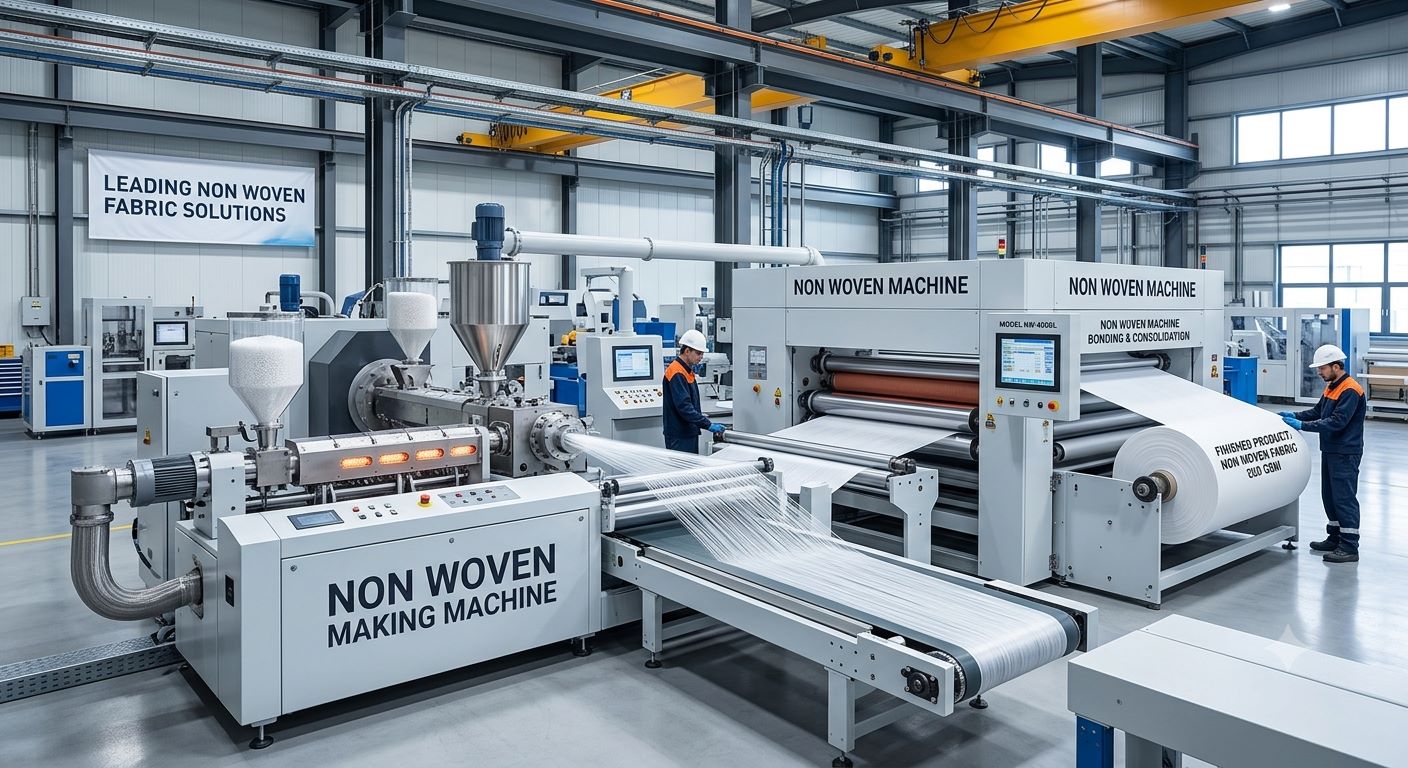
At the center of this manufacturing process is the Non Woven Making Machine, an advanced production system designed to convert polymer raw materials into durable nonwoven fabric.
A modern Non Woven Machine combines extrusion, fiber formation, web development, bonding, cooling, winding, and process control into an integrated production line. Understanding how these machines operate helps manufacturers select suitable technology, control production costs, improve fabric quality, and increase manufacturing efficiency.
What Is a Non Woven Making Machine?
A Non Woven Making Machine is industrial equipment used to manufacture fabric without conventional weaving or knitting. Instead of interlacing yarns, the machine converts fibers or polymer resin into a continuous web and bonds those fibers through thermal, mechanical, chemical, or other processes.
Polypropylene, commonly called PP, is one of the most widely used raw materials for spunbond nonwoven production.
The finished material may be manufactured in different:
- Fabric widths
- GSM ranges
- Colors
- Strength levels
- Surface textures
- Breathability levels
- Functional specifications
Modern machinery can produce lightweight fabrics for disposable products as well as stronger materials for agriculture, packaging, and industrial applications.
How Does a Non Woven Machine Work?
The working process of a Non Woven Machine depends on the production technology, but polypropylene spunbond lines generally follow several important stages.
First, polypropylene granules are fed into the extruder. Heat melts the polymer into a uniform liquid material.
The molten polymer then passes through filtration and metering systems before entering the spinneret. Thousands of extremely fine continuous filaments are created through spinneret holes.
These filaments are cooled and stretched before being deposited onto a moving forming belt.
The fiber web is then passed through heated calender rollers. Heat and pressure bond the fibers together, creating a stable nonwoven fabric.
Finally, the fabric moves through cooling and winding systems before being prepared for storage, cutting, packaging, or further processing.
Major Components of a Non Woven Making Machine
The performance of a Non Woven Making Machine depends heavily on the quality and coordination of its individual components.
Important sections generally include:
- Raw material feeding system
- Polymer extruder
- Melt filtration unit
- Metering pump
- Spinning box and spinneret
- Cooling system
- Fiber stretching system
- Web forming equipment
- Thermal bonding calender
- Fabric cooling system
- Winding machine
- PLC and electrical control system
Advanced production lines may also include automatic dosing equipment, online inspection systems, tension control, edge trimming equipment, recycling systems, and centralized monitoring.
Different Types of Non Woven Machine Technology
Several technologies are available depending on the required fabric characteristics and application.
| Machine Type | Main Technology | Typical Applications |
| Spunbond Machine | Continuous filament spinning | Bags, agriculture, furniture, hygiene |
| Meltblown Machine | Microfiber formation | Filtration, masks, absorbent materials |
| SMS Machine | Spunbond + Meltblown + Spunbond | Medical and hygiene products |
| Needle Punch Machine | Mechanical fiber entanglement | Geotextiles, carpets, automotive |
| Spunlace Machine | High-pressure water bonding | Wipes, medical products, cosmetics |
Choosing the correct production technology is important because every system produces different fabric properties.
Advantages of Modern Non Woven Manufacturing Equipment
Modern nonwoven production technology provides several advantages compared with traditional textile manufacturing.
One important benefit is high production speed. Continuous automated manufacturing enables large quantities of fabric to be produced efficiently.
Additional advantages include:
- Reduced dependency on traditional yarn production
- High level of process automation
- Flexible GSM production
- Consistent fabric thickness
- High production capacity
- Lower labor requirements
- Customizable fabric characteristics
- Efficient raw material utilization
- Continuous manufacturing capability
Automation also helps operators maintain stable temperature, extrusion pressure, line speed, fabric weight, and winding tension.
Applications of Non Woven Fabric
Products manufactured using a Non Woven Machine are used across numerous industries.
In the medical sector, nonwoven materials are commonly found in surgical gowns, protective clothing, masks, shoe covers, medical sheets, and disposable healthcare products.
The hygiene industry uses nonwoven materials in diapers, sanitary products, wet wipes, and personal care products.
Agricultural applications include:
- Crop protection fabric
- Ground cover
- Seedling protection
- Frost protection
- Weed control fabric
Nonwoven materials are also widely used for shopping bags, furniture lining, mattress components, filtration systems, automotive interiors, packaging, construction materials, and geotextiles.
How to Select the Right Non Woven Making Machine
Choosing appropriate equipment requires more than comparing machine prices.
Manufacturers should first determine their intended fabric application and production capacity.
Important factors include:
- Required fabric width
- Target GSM range
- Daily production capacity
- Number of spinning beams
- Production speed
- Raw material compatibility
- Automation level
- Electricity consumption
- Machine footprint
- Maintenance requirements
- Spare parts availability
- Technical support
Manufacturers producing general-purpose polypropylene fabric may choose a spunbond line, while businesses targeting medical or filtration applications may require SMS or meltblown technology.
Single Beam and Multi-Beam Production Lines
Spunbond equipment can be configured with different numbers of spinning beams.
Single-beam systems are generally suitable for standard applications where economical production and simpler operation are priorities.
Double-beam or multi-beam lines provide improved fabric uniformity, strength, production flexibility, and output.
For example, manufacturers may encounter configurations such as:
- S spunbond
- SS spunbond
- SSS spunbond
- SMS
- SMMS
- SSMMS
The right configuration depends on product specifications and market requirements rather than simply selecting the largest machine.
Quality Factors in Non Woven Fabric Production
Producing high-quality nonwoven fabric requires precise process control.
Important parameters include polymer quality, extrusion temperature, spinneret condition, airflow, fiber stretching, web distribution, bonding temperature, production speed, and winding tension.
Operators should regularly inspect:
- Fabric GSM consistency
- Tensile strength
- Elongation
- Width accuracy
- Surface appearance
- Color uniformity
- Bonding quality
- Roll formation
Consistent preventive maintenance also reduces downtime and extends machine life.
Future of Non Woven Machine Technology
The nonwoven manufacturing industry is gradually moving toward smarter and more energy-efficient equipment.
Future Non Woven Making Machine systems are expected to use more advanced automation, digital monitoring, intelligent quality inspection, energy optimization, and predictive maintenance technology.
Manufacturers are also focusing on reducing production waste and developing materials that support sustainability objectives.
Automatic process control can help optimize temperature, pressure, airflow, line speed, and material consumption while maintaining stable fabric quality.
These developments can improve productivity while reducing unnecessary energy consumption and manufacturing waste.
Frequently Asked Questions
1. What does a Non Woven Making Machine produce?
It produces nonwoven fabric used in medical, hygiene, agriculture, packaging, furniture, filtration, and industrial products.
2. Which raw material is commonly used?
Polypropylene is one of the most commonly used materials for spunbond production.
3. What is GSM in nonwoven fabric?
GSM means grams per square meter and represents fabric weight.
4. What is a spunbond machine?
It produces continuous polymer filaments and bonds them into nonwoven fabric.
5. What is an SMS production line?
SMS combines spunbond, meltblown, and spunbond layers.
6. Can one machine produce different GSM fabrics?
Yes. Modern machines can operate across specified GSM ranges.
7. What determines production capacity?
Machine width, operating speed, beam configuration, GSM, and production technology influence capacity.
8. Is nonwoven production automated?
Modern production lines typically use PLC-based automation and process monitoring.
9. Which machine is suitable for medical fabric?
SMS, SMMS, or SSMMS equipment is commonly considered for many medical and hygiene applications.
10. How should manufacturers choose a machine supplier?
Evaluate equipment quality, technical support, installation service, spare parts, automation, energy consumption, and after-sales assistance.