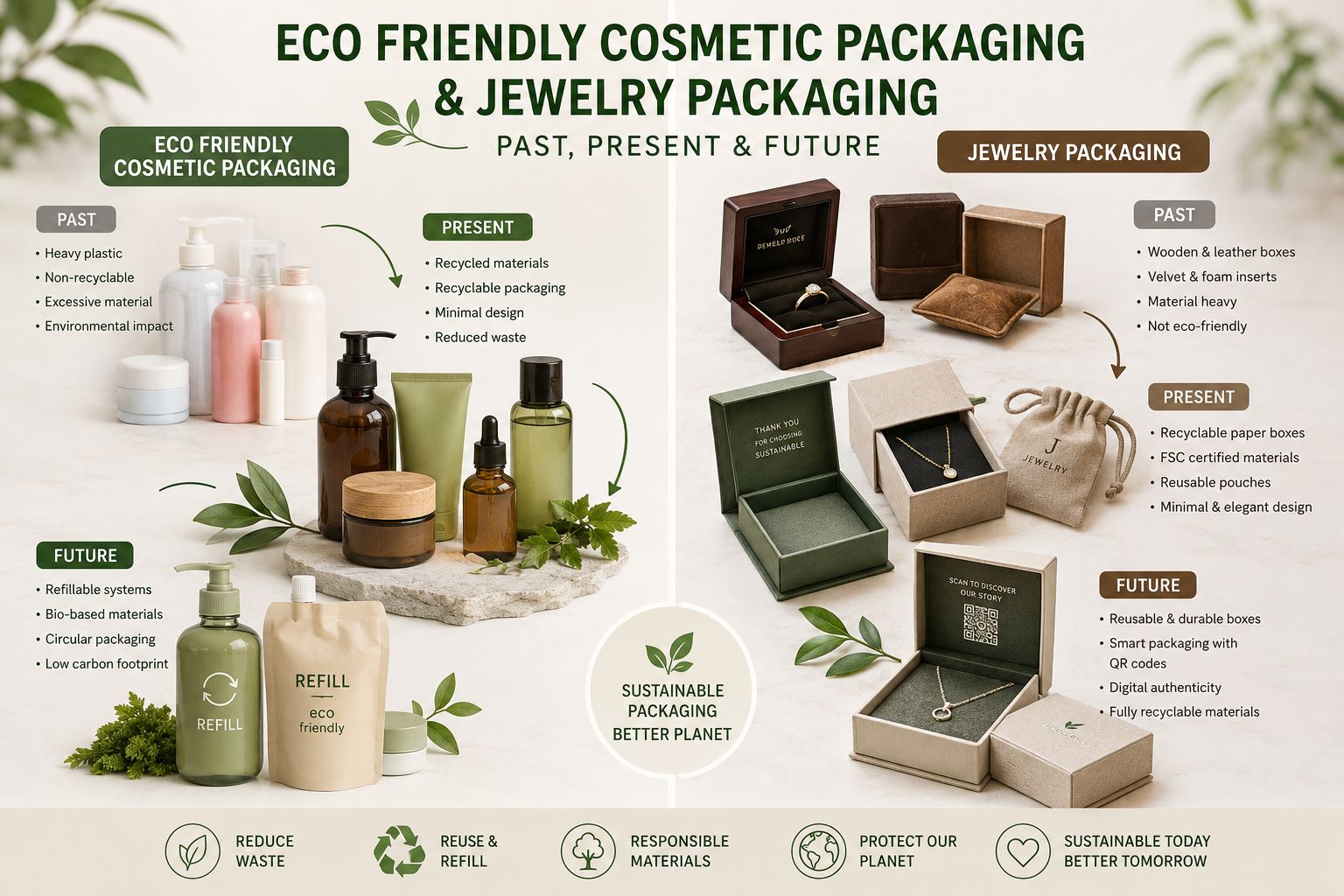
Packaging has evolved from being a simple protective layer into an important part of brand identity, customer experience, and environmental responsibility. Businesses in beauty, cosmetics, fashion, and jewellery are increasingly choosing packaging solutions that look premium while reducing unnecessary environmental impact. This shift has increased demand for eco friendly cosmetic packaging and professionally designed jewellery packaging boxes.
Modern consumers often notice packaging before they experience the product itself. Sustainable materials, thoughtful design, minimal waste, and premium presentation can influence how customers perceive a brand. For cosmetic and jewellery businesses, packaging therefore plays a major role in product protection, branding, gifting, and customer retention.
Understanding Eco Friendly Cosmetic Packaging
Eco friendly cosmetic packaging refers to packaging designed with reduced environmental impact in mind. It may use recyclable, reusable, biodegradable, renewable, or responsibly sourced materials while still protecting creams, serums, makeup, fragrances, skincare products, and other cosmetics.
Sustainable cosmetic packaging is not limited to plain kraft boxes. Modern manufacturers can create elegant designs using recycled paperboard, glass, aluminium, refillable containers, paper tubes, moulded pulp, mono-material structures, and responsibly sourced cardboard.
A well-designed sustainable package should balance several factors:
- Product safety and hygiene
- Attractive visual presentation
- Material efficiency
- Ease of recycling
- Transportation durability
- Brand positioning
- Consumer convenience
The objective is not simply to remove plastic. Brands should evaluate the complete packaging lifecycle, including sourcing, manufacturing, transportation, usability, and disposal.
Why Cosmetic Brands Are Moving Towards Sustainable Packaging
Environmental awareness has changed how customers evaluate beauty and personal care products. Buyers increasingly consider whether packaging contains excessive plastic, unnecessary layers, or materials that are difficult to recycle.
Using eco friendly cosmetic packaging can help businesses communicate environmental responsibility while creating a more modern brand image.
Important advantages include:
- Reduced dependence on unnecessary plastic packaging.
- Better opportunities to use recyclable and renewable materials.
- Stronger appeal among environmentally conscious buyers.
- Improved premium presentation through minimalist design.
- Greater potential for refillable or reusable packaging systems.
- Reduced packaging material when designs are properly optimised.
However, sustainability claims should remain accurate. Businesses should avoid describing packaging as completely environmentally harmless unless reliable evidence supports that statement.
Materials Commonly Used for Eco Friendly Cosmetic Packaging
Material selection depends on the cosmetic formulation, shelf-life requirements, moisture sensitivity, transportation conditions, and branding objectives.
Recycled paperboard is commonly used for folding cartons surrounding cosmetic bottles, tubes, jars, and gift sets. Kraft paper provides a natural appearance and works particularly well for organic or botanical beauty brands.
Glass remains popular for premium skincare products, perfumes, essential oils, and serums because it offers excellent presentation and can often be recycled.
Aluminium is another useful material for certain cosmetic containers because it is lightweight, durable, and widely recyclable where suitable recycling infrastructure exists.
Moulded pulp can replace some plastic inserts used inside presentation boxes. Paper-based tubes are also becoming popular for selected balms, powders, perfumes, and promotional cosmetic products.
Refillable packaging represents another important development. Instead of replacing an entire container, customers purchase refills while continuing to use the original outer package.
What Makes Jewellery Packaging Boxes Important?
Jewellery is often associated with emotion, gifting, luxury, celebrations, and personal milestones. For this reason, jewellery packaging boxes need to provide more than basic protection.
A jewellery box should present the product attractively while protecting delicate surfaces, stones, chains, earrings, rings, bracelets, and necklaces during storage or transportation.
Quality packaging also contributes to the perceived value of jewellery. A beautifully presented ring or necklace can feel considerably more premium when placed inside a carefully designed box.
Jewellery businesses commonly use packaging for:
- Rings and engagement jewellery
- Earrings
- Necklaces
- Bracelets
- Pendants
- Watches
- Fashion jewellery
- Luxury gift sets
The dimensions, inserts, finishes, and opening style should be selected according to the jewellery type.
Popular Materials for Jewellery Packaging Boxes
Paperboard and rigid cardboard are widely used for jewellery packaging boxes because they support extensive customisation while providing structural strength.
Rigid boxes are particularly popular among premium jewellery brands. They can be wrapped with textured paper, printed sheets, speciality finishes, or minimalist branded materials.
Kraft paper boxes provide a more natural appearance and can suit handmade jewellery, artisan products, sustainable brands, and independent boutiques.
Fabric-covered boxes may create a traditional luxury appearance, while paper-based inserts can help brands reduce dependence on foam or plastic inserts.
When sustainability is important, brands can consider recycled board, FSC-certified paper where available, reusable designs, minimal lamination, and recyclable inserts.
Eco Friendly Cosmetic Packaging vs Jewellery Packaging Boxes
| Feature | Eco Friendly Cosmetic Packaging | Jewellery Packaging Boxes |
| Primary purpose | Product protection and sustainable presentation | Protection and premium product presentation |
| Common materials | Glass, paperboard, aluminium, kraft, moulded pulp | Rigid board, paperboard, kraft and speciality paper |
| Key requirement | Product compatibility and sustainability | Protection, presentation and gifting appeal |
| Customisation | Printing, labels, embossing and coatings | Foiling, embossing, inserts and speciality finishes |
| Reusability | Refillable containers and reusable jars | Boxes commonly reused for jewellery storage |
| Brand focus | Clean beauty and environmental responsibility | Luxury, gifting and emotional value |
Although both packaging categories serve different products, they share several objectives: protecting the contents, supporting branding, reducing unnecessary material, and creating a memorable customer experience.
How Custom Packaging Strengthens Brand Identity
Packaging creates one of the first physical interactions between a customer and a brand. Consistent colours, typography, logos, materials, textures, and structural design help customers recognise products more easily.
For cosmetic businesses, minimalist eco friendly cosmetic packaging can communicate cleanliness, simplicity, natural ingredients, and responsible sourcing.
For jewellery companies, customised jewellery packaging boxes can communicate elegance, exclusivity, craftsmanship, or contemporary style.
Useful customisation options include:
- Logo printing
- Embossing and debossing
- Foil stamping
- Custom inserts
- Printed sleeves
- Magnetic closures
- Ribbons
- Spot finishes
- Custom colours
- Interior brand messages
Brands should avoid adding decorative elements simply for appearance if they make recycling significantly more difficult.
Choosing the Right Packaging Solution
Packaging selection should begin with the product rather than the appearance.
Cosmetic brands need to consider product formulation, container compatibility, leakage protection, moisture resistance, shelf stability, and transportation conditions.
Jewellery brands should consider the size and weight of jewellery, scratching risks, chain movement, gemstone protection, gifting requirements, and storage convenience.
Before placing a large packaging order, businesses should request prototypes or samples whenever possible. Testing allows brands to evaluate dimensions, printing quality, colour reproduction, closures, inserts, durability, and customer usability.
The best packaging normally combines functionality, appearance, cost efficiency, and responsible material selection.
Frequently Asked Questions
1. What is eco friendly cosmetic packaging?
It is packaging designed to reduce environmental impact through recyclable, reusable, renewable, refillable, or responsibly sourced materials.
2. Which material is suitable for sustainable cosmetic boxes?
Recycled paperboard, kraft paper, responsibly sourced cardboard, and moulded pulp are commonly considered.
3. Can cosmetic packaging still look luxurious while being sustainable?
Yes. Minimalist printing, quality paper, embossing, elegant structural design, and carefully selected finishes can create a premium appearance.
4. Are jewellery packaging boxes customisable?
Yes. They can be customised in size, colour, shape, printing, inserts, textures, finishes, and opening styles.
5. What type of box works well for rings?
Compact rigid boxes with fitted ring inserts are commonly used because they provide secure positioning and attractive presentation.
6. Can jewellery boxes be made from recycled materials?
Yes. Recycled paperboard and recycled-content rigid board can be used depending on design and manufacturing requirements.
7. Why are inserts important inside jewellery boxes?
Inserts keep jewellery securely positioned and help prevent unwanted movement, tangling, or surface damage.
8. Is glass considered suitable for eco friendly cosmetic packaging?
Glass can be an effective option because it is reusable and widely recyclable, although weight and transportation impact should also be considered.
9. How can brands reduce unnecessary packaging?
They can optimise dimensions, eliminate unnecessary layers, reduce oversized boxes, simplify inserts, and choose efficient structural designs.
10. Should businesses test packaging before bulk production?
Yes. Samples and prototypes help identify problems with dimensions, durability, printing, closures, and product fit before larger production runs.