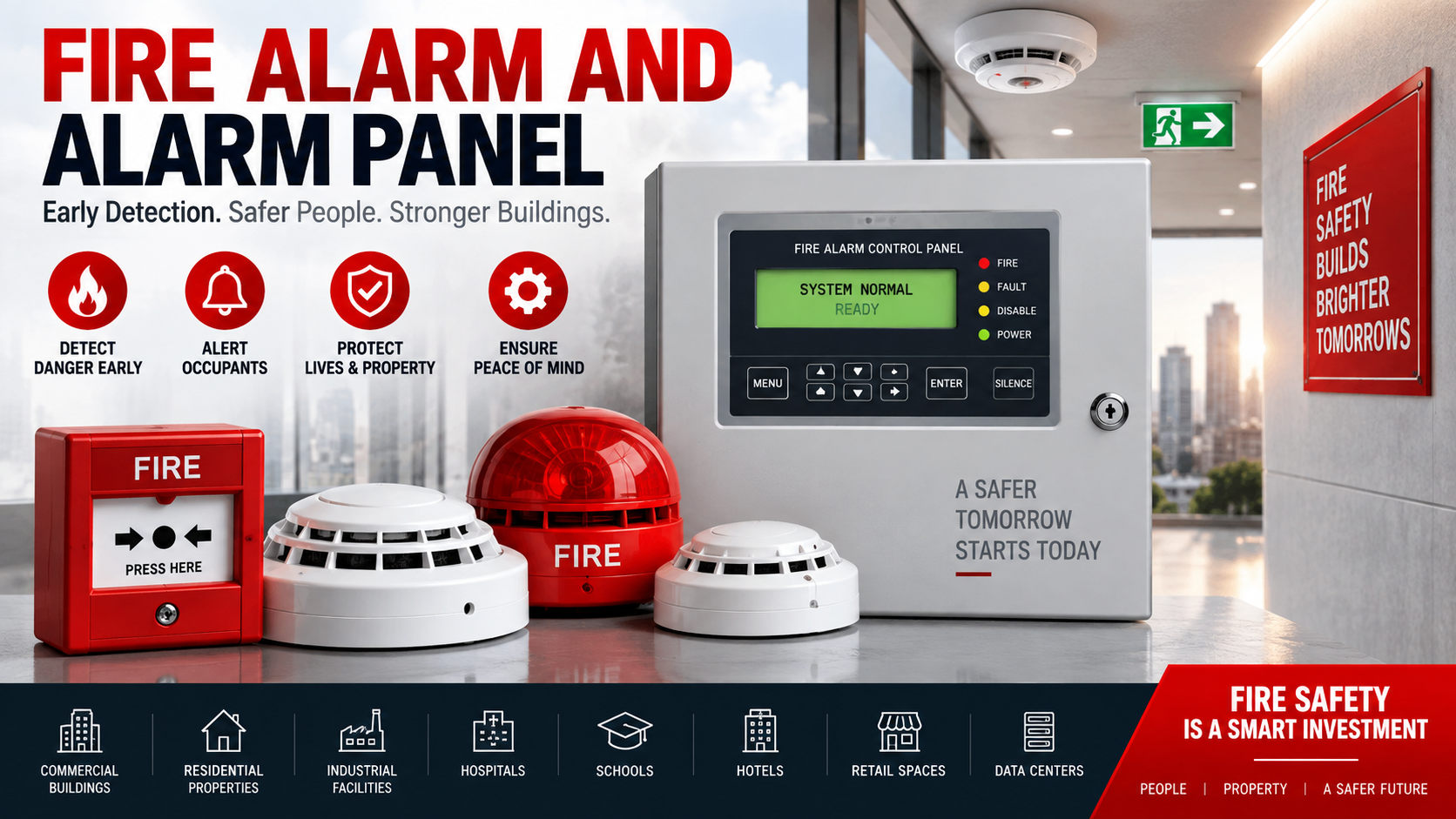
Fire safety is one of the most important considerations for residential, commercial, and industrial properties. A reliable fire alarm system can provide an early warning when smoke, excessive heat, or fire is detected, giving people valuable time to respond and evacuate. At the centre of this safety network is the alarm panel, which receives information from connected detection devices and coordinates the appropriate response.
Modern fire detection technology goes far beyond a simple bell or siren. A properly designed system connects detectors, manual call points, sounders, notification devices, and control equipment into one coordinated safety solution. Understanding how a fire alarm and alarm panel work together can help building owners choose a dependable system for protecting occupants and property.
What Is a Fire Alarm System?
A fire alarm system is a combination of electronic devices designed to detect possible signs of fire and alert people within a building.
Depending on the system configuration, it may detect smoke, heat, flames, or changes in environmental conditions associated with fire.
Typical components include:
- Smoke detectors
- Heat detectors
- Manual call points
- Alarm sounders
- Visual warning devices
- Control panels
- Emergency communication equipment
- Backup power supplies
When a detector senses a potential fire condition, it sends a signal to the main control unit. The system then activates alarms or other programmed safety functions.
Early detection is extremely important because even a small fire can spread rapidly if it is not identified in time.
What Is an Alarm Panel?
An alarm panel acts as the central control point of a fire detection system. It continuously monitors connected detectors, circuits, and notification devices.
When the panel receives a signal from a detector or manual call point, it identifies the event and activates the appropriate response.
Depending on the system design, the panel may:
- Activate sirens and sounders.
- Trigger flashing warning lights.
- Display the location of the detected fire.
- Communicate with monitoring systems.
- Control connected fire-safety equipment.
- Record faults and alarm events.
Modern panels can also monitor device status and warn maintenance teams when a detector, circuit, battery, or communication connection requires attention.
How Fire Alarm and Alarm Panel Systems Work Together
A fire alarm and alarm panel operate as a connected safety network.
Detection devices continuously monitor the surrounding environment. When smoke or abnormal heat is detected, the device sends information to the control panel.
The panel processes the signal and determines the appropriate action.
For example, a typical sequence may involve:
- A smoke detector identifies smoke.
- The detector sends a signal to the alarm panel.
- The panel identifies the affected zone or device.
- Audible and visual alarms activate.
- Building occupants begin evacuation.
- Connected monitoring equipment records the event.
Advanced systems may also integrate with elevators, ventilation systems, fire doors, access-control equipment, or building management systems.
Conventional and Addressable Alarm Panels
Two common types of control systems are conventional and addressable panels.
| Feature | Conventional Panel | Addressable Panel |
| Detection method | Zone based | Individual device identification |
| Fire location | Identifies affected zone | Identifies specific detector |
| Installation | Suitable for simpler buildings | Suitable for complex properties |
| Troubleshooting | Basic fault information | Detailed device information |
| Expansion | More limited | Generally more flexible |
| Application | Small buildings | Medium to large facilities |
A conventional alarm panel divides the property into different zones. If an alarm occurs, the panel identifies the zone where the signal originated.
An addressable system assigns a unique address to individual detection devices, allowing the panel to identify the exact detector that generated the signal.
Why Early Fire Detection Matters
The primary purpose of a fire alarm is to provide warning before conditions become more dangerous.
Early detection can support:
- Faster evacuation
- Quicker emergency response
- Better protection of valuable equipment
- Reduced risk of fire spreading unnoticed
- Improved building safety management
In busy commercial or industrial environments, occupants may not immediately notice smoke or heat in another section of the property. Automatic detection provides continuous monitoring even when areas are temporarily unoccupied.
Important Features of a Modern Alarm Panel
Choosing an alarm panel should involve more than simply comparing the number of zones or devices it supports.
Important features may include:
- Clear LCD or LED status displays
- Battery backup
- Fault monitoring
- Event history
- Device identification
- Multiple detection zones
- Network connectivity
- Audible and visual notification control
- Emergency communication integration
The right features depend on the building size, occupancy type, risk level, and overall fire safety design.
Where Fire Alarm Systems Are Commonly Used
Fire detection systems are suitable for many types of buildings, including:
- Residential apartments
- Hotels
- Hospitals
- Schools
- Shopping centres
- Warehouses
- Factories
- Offices
- Data centres
- Commercial complexes
A small office may require a relatively straightforward system, while a hospital, factory, or large commercial building may need a sophisticated addressable fire alarm network.
Choosing the Right Fire Alarm System
Selecting an appropriate system begins with understanding the property.
Consider the following factors:
- Building size and layout
- Number of floors
- Occupancy level
- Fire risk areas
- Required detector types
- Number of alarm zones
- Future expansion requirements
- Maintenance accessibility
The alarm panel must also have enough capacity to support current devices while allowing reasonable expansion if the building changes in the future.
Professional system design is particularly important for large or high-risk facilities.
Fire Alarm Maintenance and Testing
Installing a fire alarm is only the beginning. Regular inspection and testing are important to ensure the system remains operational.
Maintenance may involve checking:
- Smoke detectors
- Heat detectors
- Manual call points
- Sounders
- Backup batteries
- Panel indicators
- Wiring circuits
- Communication modules
The alarm panel should also be checked for stored faults, damaged circuits, disconnected devices, or battery problems.
Maintenance schedules should follow applicable local fire safety requirements and manufacturer recommendations.
Benefits of a Reliable Fire Detection System
A properly installed fire detection system offers several practical advantages.
It helps provide early warning, supports organised evacuation, improves monitoring of large buildings, and gives facility teams better visibility into system conditions.
An advanced alarm panel can also simplify maintenance because technicians can identify faults and affected devices more efficiently.
For larger facilities, this level of information can significantly improve day-to-day fire safety management.
Frequently Asked Questions About Fire Alarm and Alarm Panel Systems
What is the main purpose of a fire alarm?
A fire alarm detects possible signs of fire and warns occupants so they can respond and evacuate quickly.
What does an alarm panel do?
An alarm panel receives information from connected detectors and controls notification devices such as sirens, lights, and other safety equipment.
What is the difference between conventional and addressable systems?
Conventional systems identify the affected zone, while addressable systems can identify individual detection devices.
Can a fire alarm work during a power failure?
Many systems include backup batteries that allow essential fire detection functions to continue when mains electricity is unavailable.
How often should a fire alarm be tested?
Testing frequency depends on local regulations, the building type, system design, and manufacturer recommendations.
Can smoke detectors connect directly to an alarm panel?
Yes. Compatible detectors are normally connected to the control panel through dedicated circuits, loops, or wireless communication depending on the system.
What happens when the alarm panel detects a fire?
The panel may activate sounders, warning lights, monitoring signals, and other programmed safety functions.
Are wireless fire alarm systems available?
Yes. Wireless systems are available and can be useful where installing extensive cabling is difficult.
Can an alarm panel show the exact fire location?
Addressable systems can normally identify the specific device that generated the alarm, providing more precise location information.
Can fire alarm systems connect with other building systems?
Yes. Depending on the design, they may integrate with ventilation, elevators, access control, fire doors, monitoring services, and building management systems.