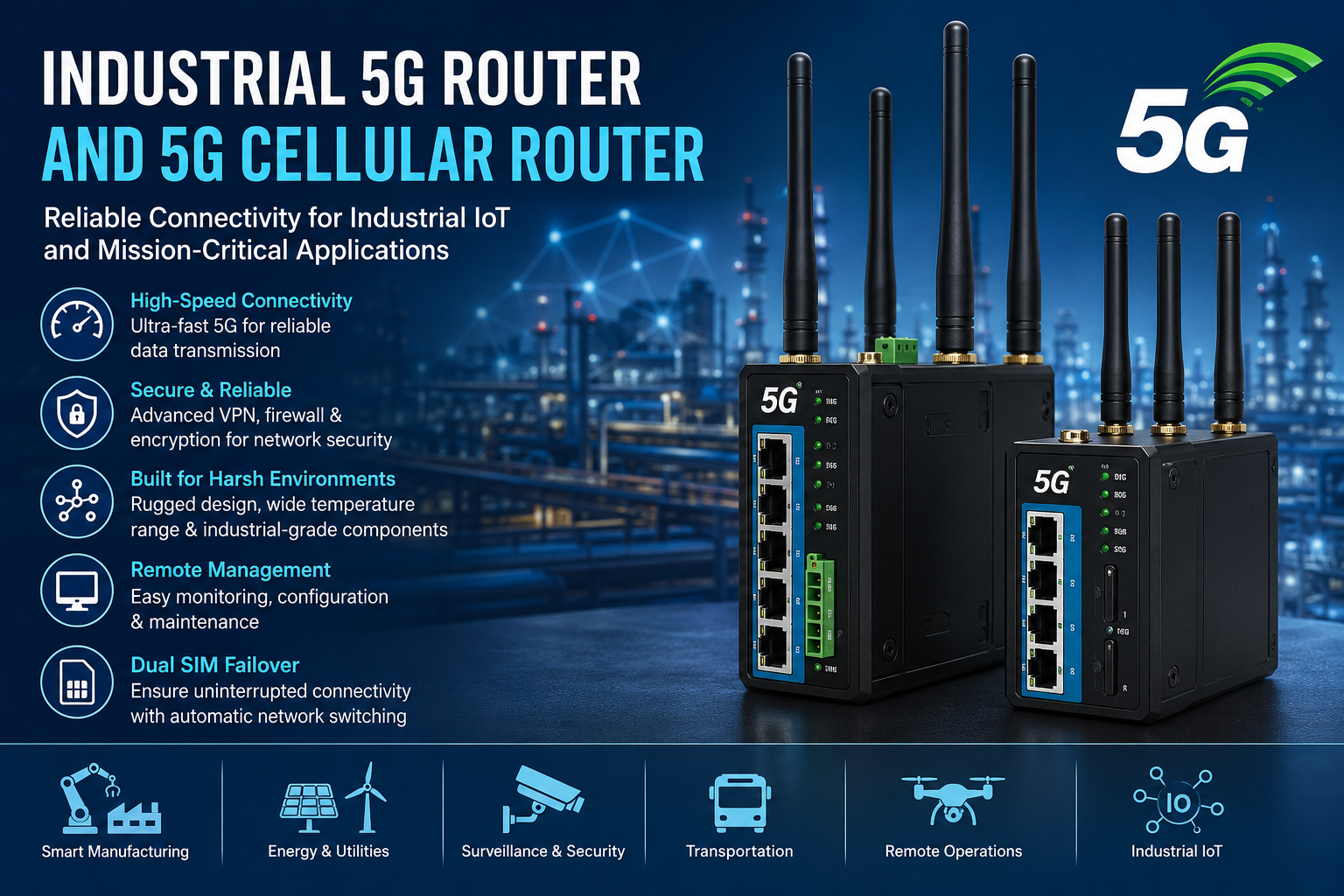
Industrial connectivity is changing rapidly as factories, utilities, transportation systems, warehouses, and remote infrastructure generate more data than ever before. Traditional wired connections and older cellular networks can struggle when organisations need faster communication, lower latency, remote access, and reliable machine-to-machine connectivity.
An industrial 5G router provides a practical bridge between industrial equipment and modern cellular networks. Similarly, a 5G cellular router can deliver high-speed wireless internet to connected devices where fixed broadband is unavailable, impractical, or insufficient.
Understanding how these technologies work can help organisations choose connectivity solutions that support automation, IoT deployment, remote monitoring, and digital transformation.
What Is an Industrial 5G Router?
An industrial 5G router is a networking device designed to connect industrial equipment, machines, sensors, controllers, and computing systems through a 5G mobile network.
Unlike ordinary consumer routers, industrial models are generally designed for demanding operating environments. Depending on the model, they may support rugged enclosures, extended operating temperatures, redundant power options, industrial interfaces, VPN functionality, remote management, and multiple WAN connections.
Typical applications include:
- Smart manufacturing and factory automation
- Industrial IoT networks
- Remote monitoring systems
- Energy and utility infrastructure
- Intelligent transportation
- Warehouses and logistics centres
- Construction and mining operations
- Security and surveillance networks
The objective is not simply faster internet. Industrial connectivity requires stability, security, manageability, and dependable communication between critical devices.
What Is a 5G Cellular Router?
A 5G cellular router uses a SIM or compatible cellular connection to access a 5G network and distribute that connection to other devices through Ethernet, Wi-Fi, or supported industrial interfaces.
It can serve as a primary internet connection or as a backup connection when a wired network fails.
For example, a remote facility without fibre infrastructure could use a cellular router to connect cameras, computers, sensors, and monitoring equipment. Another organisation might retain its fibre connection while using 5G as automatic WAN failover.
This flexibility makes cellular connectivity useful for both permanent and temporary deployments.
Industrial 5G Router vs 5G Cellular Router
Although the terms sometimes overlap, their intended applications can differ.
| Feature | Industrial 5G Router | 5G Cellular Router |
| Primary environment | Industrial and demanding sites | Business, commercial and remote sites |
| Rugged construction | Common | Model dependent |
| Industrial protocols | Often available | Less common |
| Remote management | Typically important | Frequently available |
| VPN support | Common | Common |
| Dual SIM capability | Often available | Available on selected models |
| Main applications | Automation, IoT, utilities | Internet access, backup WAN, remote networking |
The correct choice depends on environmental conditions, network architecture, required interfaces, cybersecurity policies, and operational objectives.
Why 5G Matters for Industrial Connectivity
5G introduces capabilities that can improve how distributed industrial systems communicate.
Higher Data Capacity
Industrial sites increasingly use HD cameras, sensors, automated equipment, edge computers, and analytics platforms. A suitable industrial 5G router can provide the cellular bandwidth required to transfer larger volumes of operational data.
Lower Network Latency
Certain automation and monitoring applications depend on responsive communication. 5G networks can offer lower latency than previous cellular generations, although actual performance depends on network coverage, configuration, congestion, carrier infrastructure, and deployment conditions.
Greater Deployment Flexibility
Running new fibre or Ethernet infrastructure to remote assets can be difficult. Cellular connectivity can provide an alternative for temporary facilities, distributed equipment, mobile assets, and locations where fixed connectivity is unavailable.
Support for IoT Expansion
Industrial IoT environments may include sensors measuring temperature, pressure, vibration, energy consumption, location, or machine condition. A 5G cellular router can help transport this information to edge platforms, control centres, or cloud applications.
Important Features to Consider
Selecting a router based purely on advertised download speed can result in an unsuitable industrial network. Several factors deserve closer attention.
Dual SIM and Network Failover
Dual-SIM functionality can improve resilience by allowing compatible routers to switch between cellular connections when the primary service becomes unavailable.
Ethernet and Serial Interfaces
Industrial applications may require Gigabit Ethernet, RS232, RS485, digital I/O, or other specialised connections. Confirm compatibility with existing machinery before selecting equipment.
VPN and Cybersecurity
Look for appropriate security capabilities such as VPN support, firewall controls, authentication, access restrictions, secure remote administration, and regular firmware updates.
Security should be designed across the complete network rather than relying solely on the router.
Rugged Environmental Design
Temperature, vibration, dust, moisture, electrical conditions, and installation location can affect equipment reliability. An industrial router should be selected according to the actual operating environment and applicable protection requirements.
Centralised Remote Management
Managing dozens or hundreds of distributed routers manually is inefficient. Centralised management can help administrators review device health, configurations, connectivity, firmware, and network performance remotely.
Applications of Industrial 5G Connectivity
The value of 5G becomes clearer when examined through practical applications.
- Smart factories: Machines, sensors, industrial computers, and monitoring platforms can exchange operational information across connected environments.
- Remote utilities: Water facilities, energy assets, substations, and distributed infrastructure can transmit monitoring data to central teams.
- Transportation: Cellular routers can support connected vehicles, passenger information systems, telemetry, and mobile surveillance applications.
- Warehousing: Logistics facilities can connect scanners, cameras, automated systems, and IoT devices.
- Remote surveillance: A 5G cellular router can provide connectivity for IP cameras where fixed broadband is difficult to install.
These applications demonstrate why network reliability is often more important than headline speed alone.
How to Choose the Right 5G Router
Start by defining the application rather than selecting hardware first.
Determine how many devices need connectivity, what interfaces they use, how much data they generate, and whether the connection is mission-critical.
Then evaluate:
- Local 5G and 4G network compatibility
- Supported cellular bands
- SIM and carrier requirements
- Ethernet and industrial interfaces
- Antenna configuration
- VPN and firewall capabilities
- Operating temperature
- Power requirements
- Failover functionality
- Remote device management
- Firmware and security support
- Installation requirements
For remote deployments, also consider whether the router can fall back to 4G when 5G coverage is unavailable.
Security Best Practices for Industrial Routers
Connecting industrial equipment to external networks requires careful cybersecurity planning.
Organisations should change default credentials, disable unnecessary services, restrict administrative access, maintain firmware updates, segment operational networks where appropriate, use encrypted VPN connections, and monitor unusual network activity.
Router security should form part of a broader industrial cybersecurity strategy that includes endpoint protection, access control, network segmentation, monitoring, backups, and incident-response procedures.
Frequently Asked Questions
1. What does an industrial 5G router do?
It connects industrial equipment and networks to compatible 5G cellular infrastructure.
2. Can a 5G router work without fibre broadband?
Yes. A cellular router can use a compatible mobile network as its primary internet connection.
3. Can industrial 5G routers support 4G?
Many models provide 4G/LTE fallback, but specifications should always be verified.
4. What is dual-SIM failover?
It allows compatible routers to use another cellular connection if the preferred connection becomes unavailable.
5. Are industrial routers suitable for factories?
Yes, provided the selected device meets the factory’s environmental, interface, network, and security requirements.
6. Can a 5G cellular router connect CCTV cameras?
Yes. Suitable routers can provide connectivity for network surveillance systems, subject to bandwidth and configuration requirements.
7. Is 5G useful for industrial IoT?
It can be highly useful where applications require wireless connectivity, higher capacity, mobility, or responsive data communication.
8. Does 5G always provide the same speed?
No. Performance varies according to coverage, carrier infrastructure, signal quality, congestion, hardware, and network configuration.
9. Can an industrial router be managed remotely?
Many industrial models support remote configuration and monitoring through secure management platforms.
10. How should businesses select a 5G router?
Compare network compatibility, interfaces, security, environmental ratings, management features, reliability, and long-term technical support.