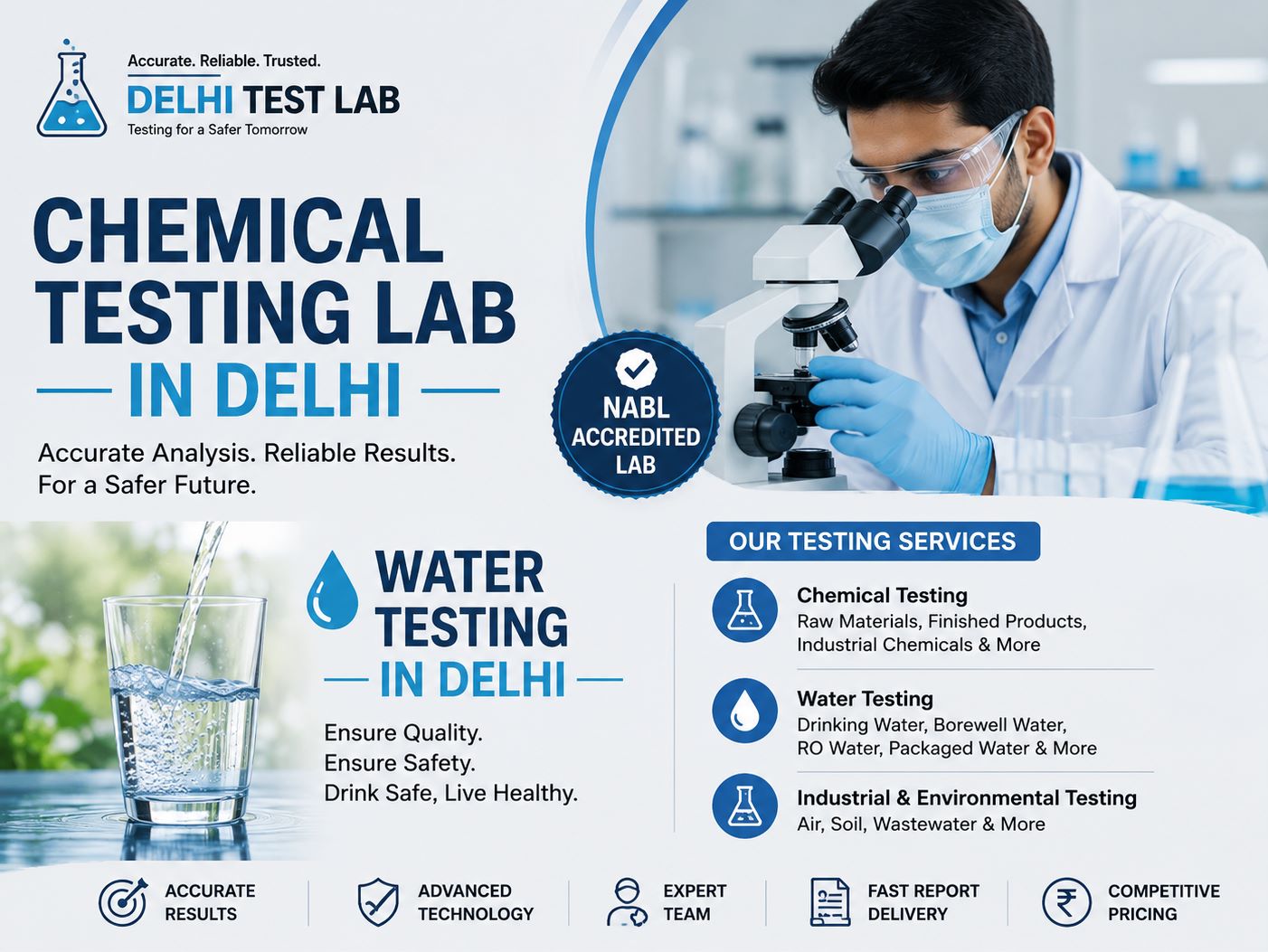
Quality testing plays an important role in determining whether water, chemicals, raw materials and industrial products meet their intended requirements. While physical appearance can reveal obvious defects, many chemical properties and contaminants cannot be identified without scientific analysis.
This is where a professional chemical testing lab in Delhi becomes valuable. Laboratories use established analytical techniques to examine samples and provide measurable information about their chemical characteristics. Similarly, water testing in Delhi helps individuals, industries and institutions understand the physical, chemical and microbiological properties of different water sources.
Understanding how these testing services work can help you select appropriate parameters and obtain more meaningful laboratory results.
Understanding the Role of Chemical Testing
Chemical testing involves analysing a sample to identify or measure selected substances, properties or chemical characteristics.
The purpose of testing varies considerably. A manufacturer may need to verify a raw material, while a construction company may require information about a material used on a project. Another organisation may need wastewater analysis as part of environmental monitoring.
Depending on its facilities and expertise, a chemical testing lab in Delhi may work with:
- Industrial chemicals
- Raw materials
- Water and wastewater
- Metals and alloys
- Soil
- Construction materials
- Paints and coatings
- Petroleum products
- Packaging materials
- Cosmetics
- Food-related materials
Each material requires appropriate analytical procedures rather than a single standard testing approach.
Why Chemical Testing Is Important for Industries
Consistency is critical in manufacturing.
Even when two raw-material batches look identical, differences in their chemical characteristics can potentially influence processing or finished-product performance.
Chemical analysis can support businesses in several ways:
- Verifying incoming raw materials
- Comparing different suppliers
- Monitoring product consistency
- Investigating manufacturing problems
- Supporting research and development
- Evaluating finished products
- Monitoring environmental samples
- Supporting documented quality-control programmes
Using a competent chemical testing lab in Delhi enables organisations to base important quality decisions on analytical information rather than assumptions.
Why Water Testing Requires Laboratory Analysis
Water quality is more complex than its appearance suggests.
Clear and odourless water may still contain dissolved minerals, salts or other substances. Certain microbiological characteristics also cannot be identified simply by looking at the sample.
Professional water testing in Delhi can be used for various water sources, including:
- Drinking water
- Municipal water
- Borewell water
- Groundwater
- RO-treated water
- Industrial process water
- Boiler water
- Cooling water
- Wastewater
- STP-treated water
- ETP-treated water
The parameters selected should depend on where the water comes from and how it will be used.
Important Parameters in Water Testing
Different parameters provide different information about a water sample.
| Parameter | Purpose |
| pH | Determines acidic or alkaline characteristics |
| TDS | Indicates overall dissolved solids |
| Turbidity | Measures suspended particles |
| Total Hardness | Evaluates hardness-related minerals |
| Alkalinity | Measures acid-neutralising capacity |
| Chloride | Determines chloride concentration |
| Fluoride | Determines fluoride concentration |
| Nitrate | Measures nitrate concentration |
| Iron | Identifies iron concentration |
| Microbiological Parameters | Evaluate selected microbial indicators |
Depending on the testing objective, other chemical or microbiological parameters may also be required.
Why TDS Alone Cannot Determine Water Quality
TDS is one of the most commonly discussed water parameters. However, relying only on TDS can create an incomplete picture.
A TDS meter indicates the overall amount of dissolved solids but does not identify every individual substance present.
For example, two water samples may show similar TDS readings while having different chemical compositions.
TDS testing also does not replace microbiological analysis.
Therefore, comprehensive water testing in Delhi should involve parameters selected according to the water source, intended use and reason for testing.
Different Applications Require Different Water Tests
There is no single test package appropriate for every type of water.
Drinking Water Testing
For drinking purposes, testing may include relevant physical, chemical and microbiological characteristics.
Borewell and Groundwater Testing
Groundwater analysis may focus on parameters such as hardness, TDS, fluoride, nitrate, chloride and iron, along with other characteristics where necessary.
Industrial Water Testing
Industries often require water with particular characteristics because water chemistry can influence manufacturing processes and equipment.
Wastewater Testing
Industrial wastewater, STP and ETP samples require a different testing approach. Analysis can help evaluate treatment performance and specified environmental parameters.
This is why the intended use should always be communicated when requesting water testing in Delhi.
How a Chemical Testing Laboratory Analyses Samples
Although exact procedures depend on the material, laboratory testing generally involves several stages.
Sample Collection
A representative sample is collected using an appropriate procedure and container.
Sample Preparation
Depending on the material, preparation may include filtration, digestion, extraction, drying, grinding or dilution.
Analytical Examination
Suitable instruments, reagents and methods are used to analyse the required parameters.
Quality Control
Laboratories may use relevant quality-control procedures to support confidence in analytical results.
Reporting
Results are documented in a laboratory report that generally identifies the sample, parameters, units and observed results.
Why Correct Sample Collection Is Essential
Accurate analysis begins with proper sampling.
Even a highly capable chemical testing lab in Delhi cannot ensure that an incorrectly collected sample accurately represents the original material.
For water samples, basic precautions include:
- Using appropriate sample bottles
- Selecting a representative collection point
- Avoiding contamination
- Labelling samples clearly
- Following preservation instructions
- Transporting samples appropriately
- Delivering time-sensitive samples promptly
Microbiological analysis may require particularly careful sample collection and transportation.
How to Choose the Right Testing Laboratory
Laboratory selection should involve more than simply comparing prices.
Technical Capability
Confirm that the laboratory has experience analysing your particular sample type.
Testing Methods
Ask which test methods or standards will be followed for the required parameters.
Accreditation Scope
When an accredited report is required, check whether the particular parameter and test method fall within the laboratory’s current accreditation scope.
Sampling Support
A professional laboratory should provide clear guidance regarding sample quantity, container requirements and preservation where necessary.
Reporting Quality
The test report should clearly present the sample details, parameters tested, units and analytical results.
Benefits of Regular Chemical and Water Testing
Regular testing can provide several practical advantages.
For businesses, chemical analysis can help:
- Identify material variations
- Maintain quality consistency
- Evaluate suppliers
- Investigate production issues
- Monitor treatment processes
- Support quality documentation
For water users, periodic testing can help detect changes in selected characteristics and evaluate whether treatment systems are producing the intended results.
Frequently Asked Questions
1. What does a chemical testing laboratory do?
A chemical laboratory analyses samples to measure specified chemical properties, substances, concentrations or characteristics.
2. Who requires chemical testing?
Manufacturers, construction companies, institutions, environmental consultants and businesses across many industries may require chemical testing.
3. Why is water testing important?
Testing provides information about physical, chemical and microbiological characteristics that cannot always be detected visually.
4. Can borewell water be tested?
Yes. Water testing in Delhi can include borewell and groundwater analysis for relevant parameters.
5. Is TDS enough to determine water quality?
No. TDS is only one parameter and cannot provide complete chemical or microbiological information.
6. Can RO-treated water be tested?
Yes. RO water can be tested and may also be compared with untreated source water.
7. Can industrial wastewater be analysed?
Yes. Laboratories with appropriate capabilities can analyse industrial effluent, ETP and STP water.
8. How much sample is required for chemical testing?
The required quantity varies according to sample type and testing parameters. Laboratory instructions should be obtained before collection.
9. How long does testing take?
Turnaround time depends on the material, analytical method, number of parameters and laboratory workload.
10. How should I choose a testing laboratory?
Evaluate its technical expertise, testing capabilities, methods, relevant accreditation scope, sampling guidance and report quality.
https://newsgrow.blogspot.com/2026/08/chemical-testing-lab-in-delhi-and-water.html