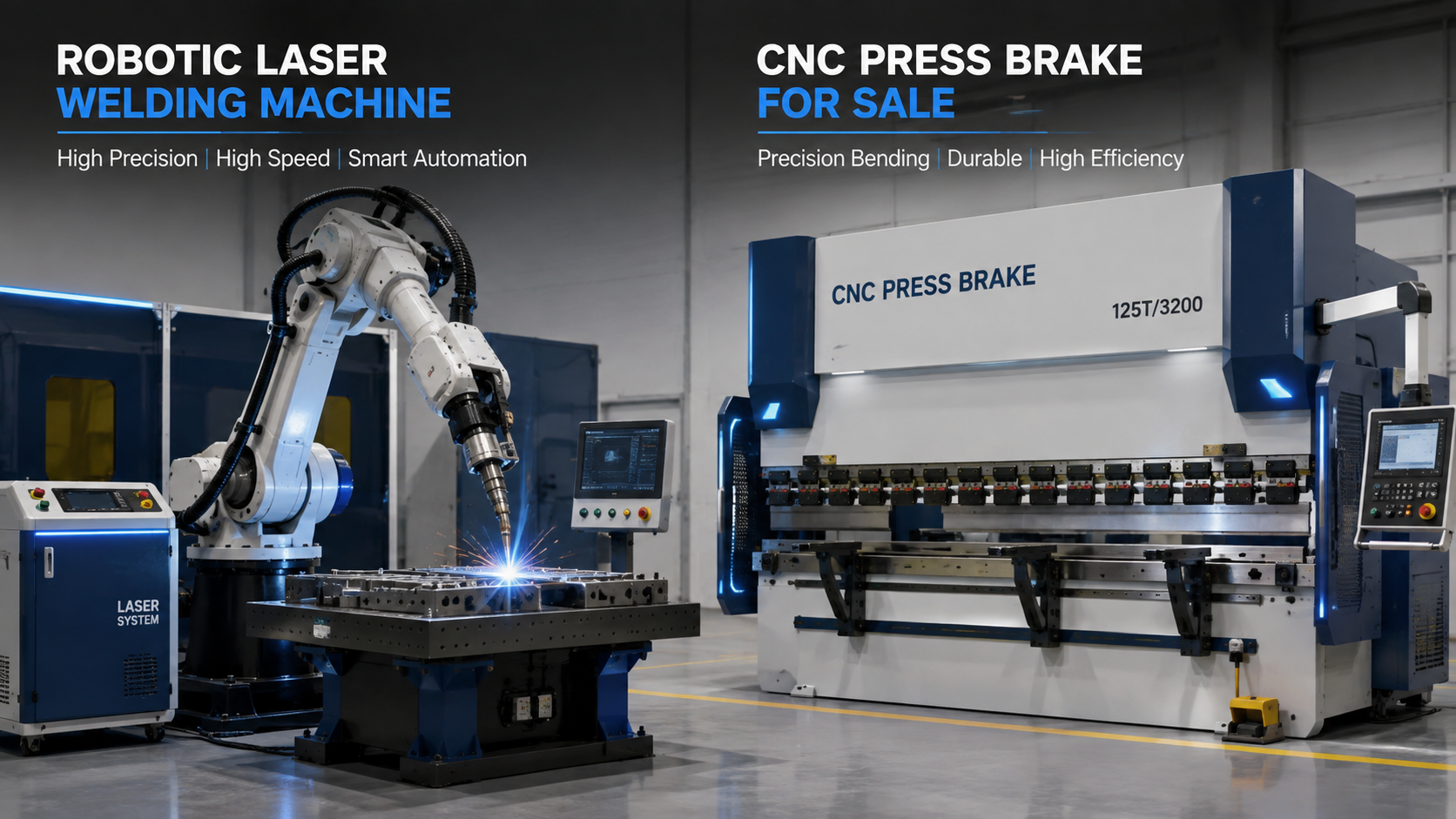
Metal fabrication is becoming increasingly demanding. Manufacturers are expected to produce accurate components faster, maintain consistent weld quality and reduce unnecessary rework, all while controlling production costs. These requirements are encouraging fabrication businesses to invest in advanced automation such as a robotic laser welding machine.
Unlike conventional manual welding, robotic laser welding combines a high-energy laser source with programmable robotic movement. The result is a highly controlled welding process suitable for repetitive components, complex geometries and applications where accuracy and consistency are important.
For fabrication businesses also considering a CNC press brake for sale, understanding how bending and robotic welding technologies can work together is useful when planning a more integrated production environment.
What Is a Robotic Laser Welding Machine?
A robotic laser welding machine is an automated manufacturing system that uses an industrial robot to position and guide a laser welding head along a programmed path.
The laser creates concentrated heat at the joint, melting the required material and forming a weld as the robotic arm follows the specified trajectory.
A typical system may include:
· Industrial robotic arm
· Laser source
· Laser welding head and optics
· Robot controller
· Workholding fixtures
· Safety enclosure and interlocks
· Cooling system
· Fume extraction equipment
· Wire feeding equipment where filler material is required
· Sensors, vision or seam-tracking technology depending on the application
The exact configuration should be selected according to the component material, thickness, geometry, production volume and required weld specification.
Quick Answer: Why Use Robotic Laser Welding?
A robotic laser welding system is primarily used when manufacturers need repeatable weld positioning, controlled heat input, high production consistency and automated processing of repetitive components.
Its suitability, however, depends heavily on joint preparation, component tolerances, fixturing and the material being processed.
How Does Robotic Laser Welding Work?
The process starts with a programmed robotic path based on the geometry of the workpiece. Components are securely positioned in a fixture before the robot moves the laser welding head along the joint.
The general process involves:
1. Loading and positioning the component.
2. Securing it with suitable fixtures.
3. Selecting the programmed welding parameters.
4. Positioning the robotic welding head.
5. Activating the laser at the required joint.
6. Following the programmed welding path.
7. Completing the weld and moving to the next programmed position.
Depending on the system, sensors or machine-vision technology may also be used to identify joints, monitor positioning or compensate for certain variations.
Key Benefits of a Robotic Laser Welding Machine
Consistent Weld Quality
One of the strongest reasons for adopting robotic welding is repeatability. Once parameters and robot paths have been properly developed, the machine can reproduce the same programmed movement across multiple components.
This is particularly valuable for batch and series production.
Precise Heat Application
Laser energy can be concentrated within a relatively small area. This allows manufacturers to control where heat is applied and can help limit the size of the heat-affected region compared with some conventional welding processes.
The actual result will depend on material, thickness, joint design, laser settings and welding speed.
Automation of Repetitive Welding
Repeatedly welding identical components manually can consume considerable skilled labour time. Automation allows operators and welding specialists to focus more attention on setup, programming, inspection, process optimisation and jobs that genuinely require manual expertise.
Access to Complex Weld Paths
Multi-axis industrial robots can approach components from different angles, making robotic laser welding useful for parts containing complicated weld trajectories.
Fixture design and robot reach must still be evaluated carefully before installation.
Reduced Rework Potential
When components are accurately prepared and the process is correctly programmed, repeatable robotic welding can help minimise inconsistencies that may otherwise result in grinding, correction or re-welding.
It is important not to assume that automation automatically eliminates defects. Poor joint preparation or inaccurate fixtures can still produce unacceptable results.
Where Is Robotic Laser Welding Used?
A robotic laser welding machine can be considered for industries requiring accurate and repeatable metal joining.
Common applications include automotive components, electrical enclosures, cabinets, stainless-steel products, fabricated assemblies, machinery components, metal furniture, appliance parts and precision sheet-metal products.
Practical Fabrication Example
Consider a manufacturer producing hundreds of similar sheet-metal enclosures.
The sheet first needs to be cut and then formed into the required geometry. A CNC press brake can create accurate bends, after which the fabricated sections are transferred to the welding station.
A robotic laser system can then weld predetermined joints according to a stored programme.
In this type of workflow, bending accuracy directly influences welding quality. If formed parts vary significantly in dimensions or angles, maintaining consistent joint gaps at the robotic welding station becomes more difficult.
Robotic Laser Welding vs Conventional Welding
| Factor | Robotic Laser Welding | Conventional Manual Welding |
| Operation | Automated/programmed | Primarily operator controlled |
| Repeatability | High when setup is controlled | Depends significantly on operator |
| Heat application | Highly concentrated | Varies with welding process |
| Complex programming | Possible | Not normally required |
| Initial investment | Generally higher | Generally lower |
| Production flexibility | Strong for repeatable jobs | Strong for changing or one-off work |
| Operator requirement | Programming and process expertise | Skilled welding expertise |
| Best suited for | Repeat production and precision work | Repairs, custom jobs and flexible production |
Neither method is universally better.
A fabrication workshop handling prototypes, repair work and constantly changing components may continue to benefit from conventional welding. A manufacturer producing thousands of similar components may have a stronger business case for automation.
Why CNC Press Brakes Matter in an Automated Fabrication Line
Companies searching for a CNC press brake for sale are often looking beyond a single machine. They may be planning an integrated sheet-metal production process.
A typical fabrication sequence might include:
Cutting → Forming → Welding → Finishing → Inspection
The CNC press brake is responsible for producing controlled bends before components reach the welding stage.
Accurate forming matters because robotic welding performs best when workpieces arrive within predictable dimensional tolerances.
Choosing a CNC Press Brake for Sale
Before purchasing a press brake, consider more than tonnage or purchase price.
Important factors include:
· Required bending length
· Pressing force or tonnage
· Material type and thickness
· CNC controller capabilities
· Back-gauge configuration
· Tooling requirements
· Axis configuration
· Repeatability requirements
· Safety features
· Machine footprint
· Training availability
· Technical and after-sales support
· Availability of replacement parts
The correct machine should be matched to actual production requirements rather than simply selecting the largest available specification.
Suggested internal link: Explore our CNC press brake solutions
What to Check Before Buying a Robotic Laser Welding Machine
1. Material Compatibility
Identify exactly what materials will be processed. Stainless steel, carbon steel, aluminium and other metals behave differently during laser welding.
Ask the supplier to evaluate your actual materials rather than relying entirely on general demonstrations.
2. Material Thickness
The required laser power and welding configuration depend partly on the thickness and joint geometry.
Provide suppliers with representative drawings, samples and material specifications before requesting a final machine configuration.
3. Component Geometry
Robot reach, axis movement and welding-head accessibility must be suitable for the actual parts.
A system that performs well on flat demonstration samples may not necessarily be suitable for a complex three-dimensional component.
4. Joint Fit-Up and Tolerances
Laser welding generally benefits from controlled joint preparation.
Before investing, evaluate whether your cutting, bending and fixturing processes can consistently produce components suitable for automated welding.
5. Fixture Design
Fixtures are sometimes underestimated during machine selection.
Reliable fixtures should hold components in the correct position throughout the welding cycle without creating unnecessary loading and unloading difficulties.
Suggested internal link: Learn more about automated welding solutions
6. Production Volume
Automation makes the strongest commercial case when sufficient repeatable work is available.
A workshop should examine annual production quantities, cycle times, setup frequency and product variety before calculating potential returns.
How Much Does a Robotic Laser Welding Machine Cost?
There is no meaningful single price for every robotic laser welding system.
Cost depends on factors such as laser power, robot configuration, welding head, automation level, safety equipment, fixtures, sensors, software, installation and integration requirements.
Rather than comparing quotations purely on purchase price, evaluate the total cost of ownership.
That assessment should include installation, training, consumables, maintenance, energy requirements, spare parts, technical support and expected utilisation.
A lower initial quotation may not represent better value if the system cannot reliably process your actual components.
Questions to Ask a Local Robotic Laser Welding Machine Supplier
For buyers with local search intent, supplier capability can be as important as machine specification.
Ask potential suppliers:
· Can you perform welding trials using our components?
· What materials and thicknesses can the proposed configuration process?
· Is installation included?
· Who provides robot programming training?
· What safety systems are supplied?
· Are local service engineers available?
· Which consumables and spare parts should we keep in stock?
· What is the expected maintenance schedule?
· Can the machine integrate with our existing production equipment?
· Can fixtures be designed for our specific products?
Requesting a sample-production trial is particularly useful. It gives your engineering team an opportunity to evaluate weld appearance, penetration, cycle time, component distortion and overall process suitability before purchasing.
Building an Integrated Sheet-Metal Fabrication Process
The greatest benefit often comes from looking at the complete production line rather than individual machines.
For example, accurate laser cutting produces better blanks. Controlled CNC bending creates more predictable component geometry. Good fixtures maintain positioning, and robotic welding then produces repeatable programmed joints.
In other words, welding automation cannot compensate for every problem created upstream.
Businesses simultaneously evaluating a robotic laser welding machine and a CNC press brake for sale should therefore review their complete material flow.
Suggested internal links: Sheet metal fabrication machinery, CNC bending machines, laser welding systems, and metalworking automation solutions.
Frequently Asked Questions
Is robotic laser welding suitable for small manufacturers?
Potentially, yes. Suitability depends more on production volume, component repeatability, available skills and return on investment than company size alone.
Which metals can be laser welded?
Common industrial applications include various steels, stainless steels and aluminium alloys. Weldability should always be confirmed for the specific material and application.
Does robotic laser welding require skilled operators?
Yes. Automation changes the skills required rather than removing them. Programming, process setup, fixture design, maintenance and quality control remain important.
Can a robotic laser welding machine handle complex components?
Yes, depending on robot reach, component geometry, fixtures and accessibility of the welding joint.
Is laser welding better than MIG or TIG welding?
Not universally. Laser welding can be advantageous for certain high-precision and repeat-production applications, while MIG and TIG remain highly suitable for many fabrication tasks.
Why is fixturing important in robotic welding?
Fixtures maintain consistent component positioning and joint alignment, helping the robot follow the programmed welding path accurately.
Can robotic laser welding reduce distortion?
Its concentrated heat input can help limit thermal effects in suitable applications, but actual distortion depends on component design, material and welding parameters.
What should I look for when searching for a CNC press brake for sale?
Evaluate tonnage, bending length, controller, axes, tooling, safety, accuracy, service support and compatibility with your existing production requirements.
Can a CNC press brake work alongside robotic welding?
Yes. Accurate CNC bending can help create consistent components for downstream robotic welding and automated assembly.
Should I request a machine demonstration before purchasing?
Whenever practical, yes. Testing your own representative components provides more useful information than evaluating only standard demonstration pieces.