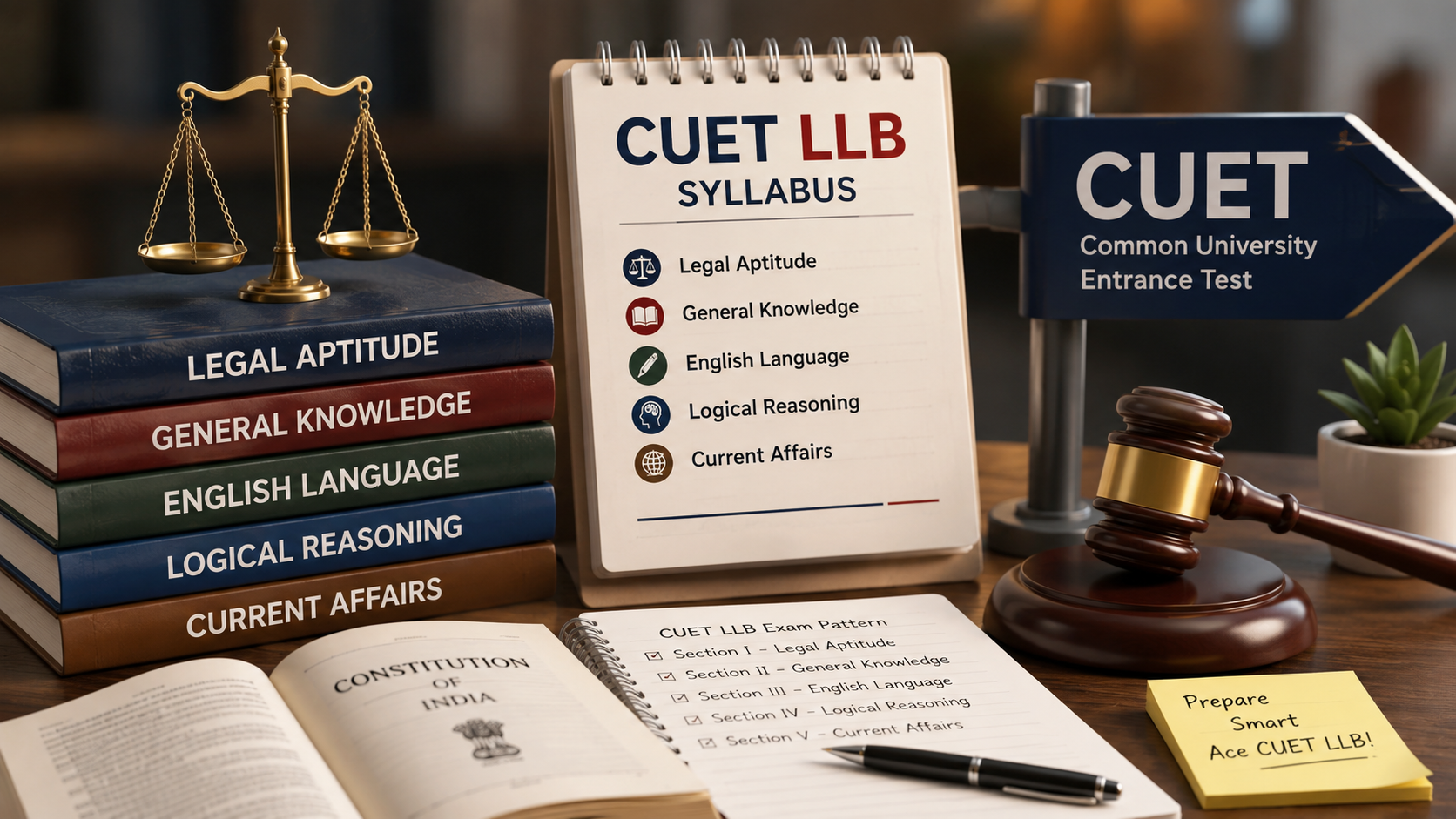
Students planning to pursue law through participating universities need more than a list of topics—they need to know what to study, how much importance to give each area, and which examination requirements apply to their chosen university.
The CUET LLB syllabus can vary in practical relevance depending on whether you are applying for an undergraduate/integrated law programme through CUET UG or a three-year LLB programme offered through CUET PG. Candidates should therefore check the programme-specific eligibility and paper mapping of their preferred university before starting preparation.
This guide explains the syllabus areas, preparation priorities, common mistakes and a practical study strategy for CUET law aspirants.
What Is the CUET LLB Syllabus?
The CUET LLB syllabus refers to the subjects and topics candidates need to prepare for the CUET paper required by the university offering their chosen law programme.
There is an important distinction to understand. CUET UG includes papers such as Legal Studies and the General Aptitude Test, while CUET PG includes General Paper (COQP11), among other paper codes. The correct paper depends on the programme and university requirements.
NTA’s published CUET materials list Legal Studies as an undergraduate domain subject, while the CUET PG General Paper syllabus includes areas such as language comprehension, general knowledge, computer basics and reasoning.
Expert tip: Never prepare solely on the basis of an article, coaching handout or previous year’s assumptions. Check the latest NTA information bulletin and your target university’s admission requirements before finalising your subjects.
What Subjects Should You Prepare for CUET LLB?
The subjects you need to prepare depend primarily on the law course and university you are targeting.
For candidates whose admission requirements involve a general or aptitude-oriented CUET paper, preparation commonly involves areas such as:
· Language and comprehension
· General knowledge and current affairs
· Logical and analytical reasoning
· Quantitative or numerical ability where applicable
· Legal awareness or Legal Studies where required
· Computer fundamentals where included in the relevant paper
For example, NTA’s General Paper (COQP11) syllabus specifies 75 compulsory questions and states that the paper is bilingual in English and Hindi.
English and Language Comprehension
Language ability is particularly important because law demands accurate reading, interpretation and communication.
For COQP11, the officially published syllabus includes areas such as:
· English grammar
· Usage errors
· Jumbled paragraphs
· Sentence correction
· Sentence improvement
· Reading comprehension
· Paragraph completion
· One-word substitution
· Synonyms and antonyms
· Idioms and phrases
Hindi equivalents are also included in the published syllabus.
General Knowledge and Current Affairs
Current affairs preparation should focus on understanding important developments rather than memorising disconnected headlines.
Students can build awareness around national and international events, government initiatives, important institutions, awards, appointments, sports, economics, science and technology, and major legal developments.
For law aspirants, following significant Supreme Court decisions, constitutional developments and important legislation can also improve general legal awareness, even where these topics are not separately prescribed.
Logical and Analytical Reasoning
Reasoning tests a candidate’s ability to process information and reach a logical conclusion.
Preparation may involve topics such as:
· Logical sequences
· Analytical problems
· Relationships
· Coding and decoding
· Statements and conclusions
· Direction-based questions
· Series and patterns
· Classification
· Basic problem solving
Instead of memorising solutions, candidates should learn why a particular reasoning method works.
Is Legal Knowledge Included in the CUET LLB Syllabus?
It depends on the CUET paper and admission requirements prescribed for your programme. Candidates should not automatically assume that every LLB entrance route through CUET uses a dedicated legal aptitude section.
CUET UG has included Legal Studies as a domain subject in NTA’s published subject list. However, whether you need that subject depends on the eligibility and subject combination accepted by your target university.
Students preparing Legal Studies may encounter areas connected with the Indian legal system, constitutional principles, dispute resolution, human rights and other legal concepts according to the applicable NTA syllabus.
This distinction matters because preparing unnecessary subjects can consume valuable study time.
CUET UG vs CUET PG for Law: What Is the Difference?
The two examinations serve different admission levels.
CUET UG is primarily used for admission to undergraduate programmes. Students interested in integrated undergraduate law programmes should check whether their selected university accepts CUET UG and which subjects it requires.
CUET PG, meanwhile, is used for postgraduate-level admissions and may also be used by participating institutions for certain graduate-entry programmes depending on that year’s programme mapping.
For reference, NTA’s CUET PG materials identify COQP11 as General and COQP14 as L.L.M.
Do not confuse the LLM paper with an LLB entrance requirement simply because both relate to legal education.
How Should You Prepare for the CUET LLB Syllabus?
A strong preparation strategy starts with the official syllabus rather than immediately buying multiple books.
Step 1: Identify Your Target Universities
Make a shortlist of universities where you want to apply.
For each institution, record:
Course → Eligibility → CUET paper code → Required subjects → Admission criteria
This simple exercise can prevent one of the biggest CUET preparation mistakes: studying for the wrong paper combination.
Step 2: Download the Official Syllabus
Use the latest syllabus published by the National Testing Agency.
Turn every major syllabus area into a preparation checklist.
For example:
English
Grammar → vocabulary → sentence correction → comprehension → practice questions.
Reasoning
Concept → solved examples → timed questions → error analysis.
Current affairs
Daily reading → weekly revision → monthly notes → quizzes.
Step 3: Start With Concept Building
Do not begin preparation entirely with mock tests.
First understand the fundamental concepts. Once your foundations are reasonably strong, move towards topic-wise questions and then full-length practice.
Step 4: Practise Questions Under Time Limits
Knowing the answer and finding the answer quickly are different skills.
Suppose you can solve 20 reasoning questions accurately but require 35 minutes. Your next objective should be maintaining similar accuracy while gradually reducing the time required.
Timed practice helps develop this ability.
Step 5: Analyse Every Mock Test
Mock-test analysis is often more valuable than simply increasing the number of tests attempted.
After each test, classify mistakes into four categories:
Concept error: You did not understand the topic.
Recall error: You knew the information but could not remember it.
Calculation/reasoning error: Your approach was correct but execution failed.
Time-pressure error: You rushed because too much time was spent elsewhere.
Your next study session should address these weaknesses.
A Practical CUET LLB Preparation Plan
A balanced study routine is generally more sustainable than studying one subject for an entire day.
A student with approximately four hours available could divide the time between language/comprehension, reasoning, general awareness and revision or mock-question practice. The exact allocation should change according to the candidate’s strengths and the official syllabus for the required paper.
For instance, a candidate struggling with comprehension may initially spend additional time on reading passages. Someone already comfortable with English but weak in reasoning should shift more preparation time towards analytical questions.
The goal is adaptive preparation, not an identical timetable for every student.
How to Prepare for Current Affairs for CUET
Current affairs should ideally be studied through a combination of daily learning and systematic revision.
Read one reliable newspaper or current-affairs source rather than jumping between numerous platforms. Make concise notes under categories such as national affairs, international developments, economy, science, awards, sports and significant legal developments.
Weekly revision is essential because current affairs becomes difficult when several months of information accumulate immediately before the examination.
Common Mistakes Students Make While Preparing for CUET LLB
One major mistake is searching for the CUET LLB syllabus and immediately following the first syllabus found online without confirming the relevant paper code.
Other common problems include ignoring official university eligibility requirements, collecting too many preparation books, memorising current affairs without revision, postponing mock tests until the final weeks and repeatedly practising comfortable topics while avoiding weaker areas.
Another mistake is assuming that CUET admission requirements remain identical every year.
Universities can have programme-specific eligibility, subject combinations and admission rules. Always verify the current admission cycle.
Should You Join CUET LLB Coaching?
Coaching is not compulsory for every student. A disciplined candidate with appropriate study material, official syllabus guidance, regular practice and mock-test analysis can prepare independently.
Structured guidance may be useful when a student:
· Has difficulty understanding the syllabus
· Needs a consistent study schedule
· Struggles with reasoning or language fundamentals
· Wants regular mock tests and performance analysis
· Is unsure about university and course selection
Before enrolling in any preparation programme, ask whether the teaching plan follows the latest NTA syllabus and whether faculty provide meaningful doubt resolution and test analysis.
CTA: If you are considering professional CUET preparation, request a syllabus-based counselling session first. A good counsellor should explain your course requirements and preparation gaps before recommending a programme.
How to Choose the Right CUET LLB Preparation Programme
Do not judge a course only by advertising or the total number of classes offered.
Evaluate the quality of the teaching, syllabus coverage, mock-test standard, doubt-solving support, study material and performance tracking.
Most importantly, ask whether the programme is designed around the specific CUET paper required for your target law course.
Local students considering classroom coaching should also factor in travel time. Spending two hours commuting for a two-hour class can significantly reduce the time available for revision and independent practice.
Expert Tips for Better CUET Preparation
Start by treating the official syllabus as your master document. Every book, lecture and practice test should connect back to it.
Focus particularly on accuracy during the early preparation stage. Speed can be developed gradually through timed practice.
For comprehension, develop a regular reading habit. For reasoning, solve questions rather than merely reading solutions. For general awareness, revise repeatedly. And for every mock test, maintain an error notebook containing questions or concepts you got wrong.
During the final preparation phase, this error notebook can become one of your most useful revision resources.
Suggested Internal-Link Opportunities
Relevant pages on an education or coaching website can naturally be linked using anchor text such as CUET preparation courses, CUET exam pattern, CUET eligibility criteria, CUET mock tests, CUET preparation tips, law entrance coaching, and CUET coaching near me.
These internal links can help users move from syllabus research towards preparation resources without making the content overly promotional.
Frequently Asked Questions About CUET LLB Syllabus
What is the CUET LLB syllabus?
The syllabus depends on the CUET paper prescribed by the university for your chosen law programme. It may involve language, general awareness, reasoning, aptitude or Legal Studies depending on the applicable paper.
Is Legal Studies compulsory for CUET LLB?
Not necessarily. Legal Studies is a CUET UG domain subject, but candidates must check whether their target university requires or accepts it for the chosen programme.
Does the CUET LLB exam include current affairs?
General knowledge and current awareness may form part of relevant general/aptitude papers. Follow the latest official syllabus for your specific paper code.
Is mathematics required for CUET LLB?
This depends on the paper required by the university. Where numerical ability is included, candidates should prepare the mathematical topics specified in that paper’s official syllabus.
Can I prepare for CUET LLB without coaching?
Yes. Self-study can work well with the correct syllabus, suitable study resources, regular question practice, revision and mock-test analysis.
How should beginners start CUET LLB preparation?
First shortlist universities and identify the required CUET paper. Download its official syllabus, assess your strengths and weaknesses, and create a topic-wise study schedule.
How important is English for CUET law entrance preparation?
English and comprehension can be important where the applicable paper tests language ability. Strong reading skills are also valuable throughout legal education.
How can I improve my reasoning score?
Learn one concept at a time, solve topic-wise questions and maintain an error log. Once accuracy improves, introduce strict time limits.
How many mock tests should I attempt?
There is no universally ideal number. Quality matters more than volume. Attempt mocks regularly and spend enough time analysing mistakes before taking the next one.
Where can I find the official CUET syllabus?
Candidates should use the official National Testing Agency CUET examination portal and their target university’s admission website rather than relying entirely on third-party syllabus pages.