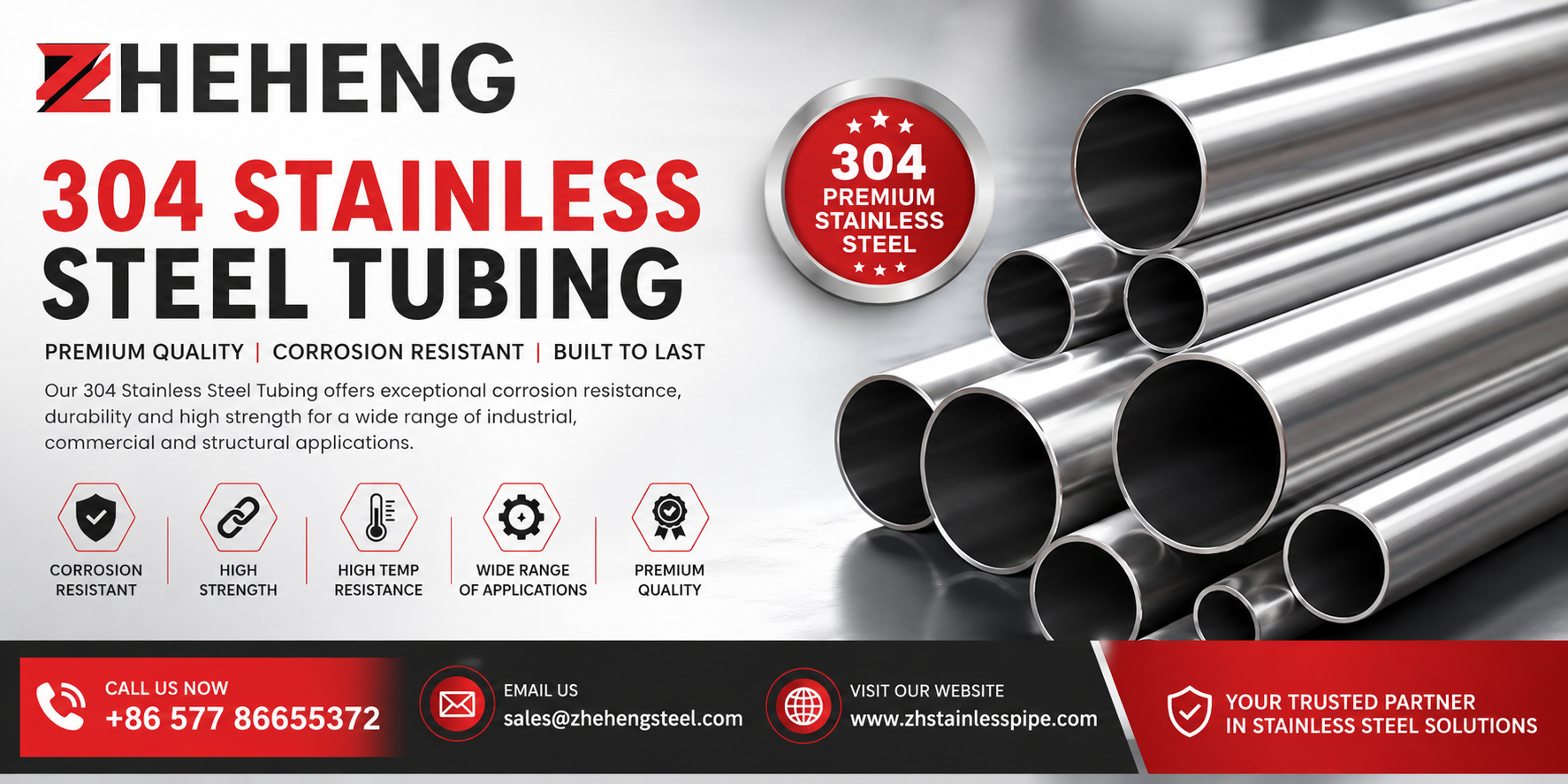
In today’s demanding industrial environment, choosing the right tubing material is essential for achieving durability, corrosion resistance, and long-term performance. 304 Stainless Steel Tubing has become a preferred option across numerous industries because it combines excellent corrosion resistance, strength, formability, and versatility. From food processing and manufacturing to architectural projects and fluid-handling systems, this stainless steel tubing provides a dependable solution for a wide variety of applications.
What Makes 304 Stainless Steel Tubing So Popular?
304 stainless steel is an austenitic stainless steel grade containing chromium and nickel. These elements help provide its characteristic corrosion resistance while also allowing the material to be formed and fabricated efficiently.
One of the biggest advantages of 304 Stainless Steel Tubing is its versatility. It can be manufactured as seamless or welded tubing and can be supplied in different dimensions, wall thicknesses, and surface finishes to meet specific project requirements.
Key Benefits at a Glance
- Excellent resistance to general corrosion
- Good strength and durability
- Excellent formability
- Good weldability
- Attractive and easy-to-maintain surface
- Suitable for indoor and many outdoor applications
- Available in various sizes and configurations
- Appropriate for numerous industrial and commercial uses
Where Is 304 Stainless Steel Tubing Used?
The versatility of this stainless steel grade makes it useful across several industries. Engineers and manufacturers often select it when they need a material that can handle everyday exposure to moisture and corrosive conditions without sacrificing fabrication flexibility.
Food and Beverage Industry
Hygiene and cleanability are critical in food and beverage processing. 304 stainless steel tubing is commonly used in processing equipment, transfer systems, storage components, and other applications where a durable and cleanable material is required.
Industrial and Manufacturing Applications
Manufacturing facilities use stainless steel tubing for equipment, fluid-handling systems, fabrication assemblies, and machinery components. Its combination of strength and corrosion resistance makes it a practical option for many general industrial environments.
Architectural Applications
Beyond industrial applications, polished or finished 304 tubing can provide both functionality and visual appeal. It may be used for:
- Handrails and railings
- Decorative structures
- Commercial interiors
- Furniture frames
- Display systems
- Architectural supports
Seamless or Welded: Which Tubing Should You Choose?
When purchasing 304 stainless steel tubing, one important consideration is the manufacturing method.
| Feature | Seamless Tubing | Welded Tubing |
| Construction | Produced without a longitudinal weld | Manufactured with a welded seam |
| Typical Advantage | Useful where seamless construction is specified | Efficient and versatile for many applications |
| Common Uses | Specialized industrial and pressure applications | Fabrication, general industrial, and architectural uses |
| Selection | Based on pressure, specification, and service | Based on dimensions, specification, and application |
The correct choice depends on operating pressure, temperature, required dimensions, applicable standards, and the intended service environment.
304 vs. 304L Stainless Steel Tubing
Although 304 and 304L are closely related grades, they are not identical. The primary distinction is their carbon content. 304L stainless steel has a lower carbon limit, making it particularly useful for certain welded applications where reducing the risk of sensitization is important.
For projects involving extensive welding, engineers may consider 304L depending on the applicable specifications and operating conditions.
What Should Buyers Check Before Ordering?
Selecting the correct tubing involves more than simply choosing a stainless steel grade. Before purchasing, consider:
- Tube dimensions: Confirm outside diameter, wall thickness, and length.
- Manufacturing type: Determine whether seamless or welded tubing is required.
- Application: Identify whether the tube will handle fluids, gases, chemicals, or structural loads.
- Operating conditions: Consider pressure, temperature, moisture, and chemical exposure.
- Surface finish: Select a finish according to functional, sanitary, or decorative requirements.
- Required standards: Check whether ASTM, ASME, EN, or another specification applies.
- Quality documentation: Request appropriate material certificates and inspection information when required.
Why Material Quality Matters
Even when a project specifies 304 stainless steel, product quality remains important. Dimensions, tolerances, surface condition, manufacturing process, testing, and traceability can all affect the performance of the finished tubing.
Working with an experienced supplier can help buyers obtain tubing that matches the technical requirements of their application rather than selecting a product based solely on price.
Frequently Asked Questions
1. What is 304 Stainless Steel Tubing?
It is tubing manufactured from Type 304 austenitic stainless steel and is widely selected for applications requiring corrosion resistance, durability, and fabrication flexibility.
2. Is 304 stainless steel corrosion resistant?
Yes. It provides good general corrosion resistance, although highly aggressive or chloride-rich environments may require another grade.
3. Is 304 tubing suitable for food processing?
Yes. 304 stainless steel is widely used in food-related equipment because of its corrosion resistance, cleanability, and fabrication characteristics.
4. Can 304 stainless steel tubing be welded?
Yes. 304 stainless steel generally offers good weldability and is commonly fabricated using welding processes.
5. Is 304 tubing available in different sizes?
Yes. It can be produced or supplied in various outside diameters, wall thicknesses, lengths, and finishes depending on the required specification.
6. What is the difference between 304 and 316 stainless steel?
316 generally offers improved resistance to chloride-containing and more aggressive environments, while 304 is a versatile choice for many general-purpose applications.
7. Is seamless tubing better than welded tubing?
Not necessarily. The appropriate option depends on the application, pressure requirements, dimensions, applicable standards, and project specifications.
8. Can 304 tubing be polished?
Yes. Stainless steel tubing can be supplied with polished and other surface finishes for applications where appearance, smoothness, or cleanability is important.
9. Is 304 stainless steel suitable for outdoor use?
It can be suitable for many outdoor applications, but environmental exposure should be evaluated carefully, particularly where salt or chlorides are present.
10. How can I get the right tubing for my project?
Provide the supplier with your required grade, dimensions, wall thickness, length, quantity, finish, standard, and intended application. This information helps determine the most suitable product.
Final Thoughts
When durability, corrosion resistance, versatility, and appearance are important, 304 Stainless Steel Tubing offers a well-balanced material solution. Its broad range of applications and fabrication possibilities makes it a dependable choice for industries ranging from food processing and manufacturing to construction and architectural design.
For high-quality stainless steel tubing tailored to your requirements, ZhstainLessPipe can help you identify a suitable solution. Share your required dimensions, specifications, quantity, and application to explore the right 304 Stainless Steel Tubing option for your project and request a competitive quote today.
 – +86 577 86655372
✉ – sales@zhehengsteel.com
 –
–