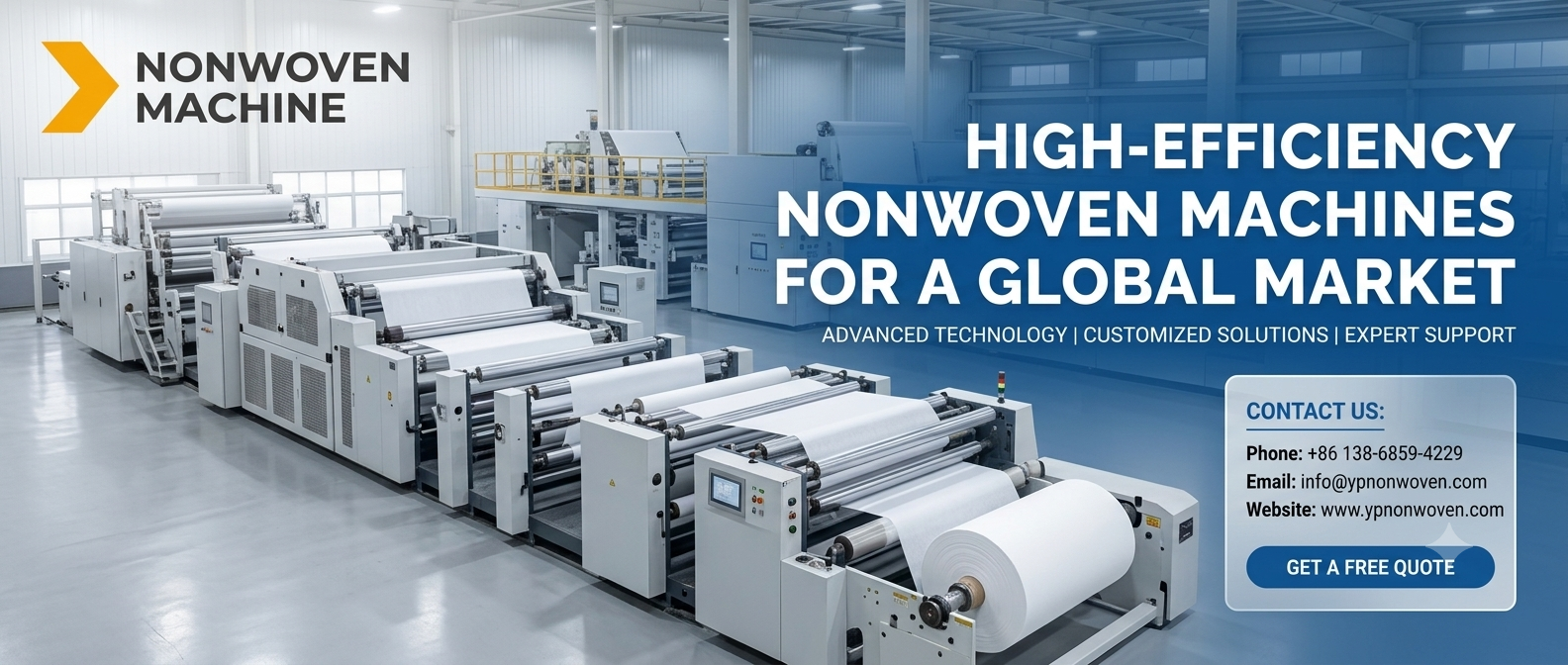
A nonwoven machine is an industrial production system designed to manufacture fabric without traditional weaving or knitting. Instead of interlacing yarns, the technology converts polymers or fibers into a continuous web and bonds them through thermal, mechanical, chemical, or other processes. Today, nonwoven machines are essential for producing materials used in hygiene products, medical supplies, agriculture, packaging, filtration, automotive components, construction, and industrial applications. YPNONWOVEN specializes in nonwoven production equipment, including PP spunbond, spunmelt, and PET spunbond production lines designed for different production capacities and fabric specifications.
What Is a Nonwoven Machine?
A nonwoven machine is a specialized manufacturing system that transforms raw materials such as polypropylene (PP), polyester (PET), recycled polymers, or other suitable fibers into finished nonwoven fabric. Unlike conventional textile machinery, a nonwoven machine does not require yarn preparation, weaving, or knitting. The manufacturing process generally includes raw material feeding, melting or fiber preparation, extrusion or fiber formation, stretching, web formation, bonding, calendaring, winding, and slitting. The exact configuration depends on the type of nonwoven fabric being produced. For example, spunbond equipment produces continuous filaments, while meltblown technology creates extremely fine fibers using high-speed air.
How Does a Nonwoven Machine Work?
Although configurations vary, most polymer-based nonwoven production systems follow a controlled sequence:
- Raw Material Feeding: PP, PET, recycled polymer, or other raw materials are accurately supplied to the production system.
- Melting and Extrusion: Polymer granules are heated and melted inside an extruder before being pushed through a filtration and metering system.
- Fiber Formation: The molten polymer passes through a spinning die or spinneret to form continuous filaments or fine fibers.
- Cooling and Drawing: Airflow cools and stretches the fibers, helping establish the required fiber diameter and physical properties.
- Web Formation: Fibers are distributed across the production width to create a uniform web.
- Bonding: Thermal bonding, mechanical bonding, or another suitable technique consolidates the web into fabric.
- Calendering: Heated rollers can control fabric thickness, surface appearance, strength, and other properties.
- Winding and Slitting: The finished fabric is wound into rolls and can be slit into required widths for downstream applications.
- This automated workflow allows manufacturers to produce large quantities of consistent nonwoven material while controlling fabric weight, width, speed, and other parameters.
Main Types of Nonwoven Machines
Different applications require different technologies. Choosing the correct nonwoven machine therefore begins with understanding the desired fabric characteristics and end use.
1. PP Spunbond Nonwoven Machine
A PP spunbond nonwoven machine converts polypropylene resin into continuous filaments that are stretched, deposited into a web, and thermally bonded. PP spunbond fabric is valued for its lightweight construction, strength, flexibility, chemical resistance, and production efficiency. YPNONWOVEN offers single-beam, double-beam, and three-beam spunbond configurations. Its published equipment specifications include production widths such as 1600 mm, 2400 mm, and 3200 mm, depending on the model.
2. Spunmelt Nonwoven Machine
Spunmelt technology combines spunbond and meltblown processes within an integrated production system. SMS, SMMS, SSMS, and SSMMS configurations can produce multilayer fabrics with combinations of strength, filtration, softness, and barrier performance. These materials are particularly important for hygiene and medical applications. For example, YPNONWOVEN’s SMS production line is designed for fabric weights of approximately 9–80 g/m², with published line speeds up to 350 m/min depending on configuration.
3. PET Spunbond Nonwoven Machine
PET spunbond equipment uses polyester as the primary raw material. PET nonwoven fabrics are suitable for applications where high strength, dimensional stability, temperature resistance, or durability is important. They can be used in filtration, automotive, construction, agriculture, packaging, and industrial products. YPNONWOVEN lists PET spunbond lines in widths of 1600 mm, 2400 mm, and 3200 mm, with model-specific output and speed specifications.
4. Meltblown Nonwoven Machine
Meltblown equipment produces extremely fine fibers by using high-velocity hot air to attenuate molten polymer. The resulting fabric can provide excellent filtration and barrier characteristics. Meltblown technology is commonly integrated with spunbond layers to manufacture composite materials such as SMS and other spunmelt fabrics.
Why Machine Configuration Matters
The number of beams, production width, fiber diameter, fabric weight range, output, automation level, and raw-material compatibility all influence the final production capability. A manufacturer producing lightweight packaging fabric may have very different requirements from a company producing medical or high-barrier hygiene materials.
Key Benefits of a Modern Nonwoven Machine
A well-designed nonwoven machine can provide several operational advantages:
- High production efficiency: Continuous processing supports large-volume manufacturing.
- Consistent fabric quality: Automated controls help maintain stable process parameters.
- Flexible fabric specifications: Production settings can be adjusted for different weights and applications.
- Material efficiency: Advanced systems can support recycled materials and production waste utilization where technically appropriate.
- Automation: PLC-based controls and touch-screen interfaces can simplify operation and process monitoring.
- Scalability: Manufacturers can select production widths and configurations according to current and future demand.
- Wide application range: One production platform can potentially serve multiple markets when correctly configured.
- YPNONWOVEN states that its equipment can be customized according to customer requirements and incorporates automated control systems, while some configurations include co-extrusion capabilities for recycled PP utilization.
Nonwoven Machine Comparison
| Machine Type | Main Material | Key Characteristic | Typical Applications |
| PP Spunbond | Polypropylene | Strong, lightweight continuous filament fabric | Packaging, agriculture, hygiene, industrial |
| Meltblown | PP and other suitable polymers | Fine fibers and filtration capability | Filtration, medical, protective products |
| SMS/SMMS | PP | Multilayer strength and barrier performance | Hygiene, medical, industrial |
| PET Spunbond | Polyester | High strength and durability | Automotive, filtration, construction |
| Needle-Punched | Natural or synthetic fibers | Mechanically bonded thick fabric | Geotextiles, carpets, automotive |
How to Choose the Right Nonwoven Machine
Selecting equipment should be based on the complete business requirement rather than machine price alone. Consider these factors:
- Target product: Define whether you need spunbond, meltblown, SMS, PET, or another nonwoven structure.
- Fabric GSM: Establish the required minimum and maximum fabric weight.
- Production width: Select a width that matches your target market and converting equipment.
- Required capacity: Estimate daily, monthly, and annual production requirements.
- Raw materials: Confirm whether the line supports virgin, recycled, or specialty polymers.
- Automation: Evaluate PLC controls, feeding systems, monitoring, alarms, and process feedback.
- Energy consumption: Compare heating, extrusion, airflow, and auxiliary-system requirements.
- After-sales support: Installation, commissioning, spare parts, training, and technical support can significantly affect long-term operating performance.
- Future expansion: Choose a configuration that can accommodate future product development where possible.
Applications of Nonwoven Fabric
The versatility of fabric produced by a nonwoven machine has made it a fundamental material across many industries. Common applications include:
- Medical gowns, masks, drapes, and protective materials
- Diapers, sanitary products, and hygiene components
- Shopping bags and packaging materials
- Crop covers, nursery products, and agricultural fabrics
- Filtration media
- Automotive interior and insulation components
- Roofing and construction materials
- Geotextiles and soil protection products
- Furniture and home textile components
- The exact application depends on fabric structure, raw material, GSM, strength, filtration performance, softness, air permeability, and other technical characteristics.
Why Work With YPNONWOVEN?
YPNONWOVEN focuses on the development and manufacturing of nonwoven production systems, offering PP spunbond, spunmelt, and PET spunbond solutions. The company states that it provides customized equipment, automated control systems, and technical support for customers requiring complete nonwoven manufacturing solutions. Its published information also reports more than 700 projects and emphasizes international equipment installation and service experience.
For buyers, the advantage of working with an experienced manufacturer is not simply obtaining machinery. Proper line selection, process configuration, installation, commissioning, operator training, spare-parts planning, and technical support can all influence the long-term return on investment.
Frequently Asked Questions About Nonwoven Machine
1. What is a nonwoven machine?
A nonwoven machine is industrial equipment used to manufacture fabric by forming and bonding fibers without traditional weaving or knitting.
2. What raw materials are used in nonwoven machines?
Common materials include polypropylene (PP), polyester (PET), recycled polymers, and selected specialty fibers, depending on machine technology.
3. What is a PP spunbond nonwoven machine?
It is a production system that melts polypropylene, forms continuous filaments, stretches and deposits them into a web, and bonds the web into nonwoven fabric.
4. What is the difference between spunbond and meltblown?
Spunbond generally produces continuous filaments and emphasizes strength and durability, while meltblown creates much finer fibers and is commonly used where filtration or barrier properties are important.
5. What is an SMS nonwoven machine?
An SMS system integrates spunbond, meltblown, and spunbond layers to create a composite fabric combining properties such as strength, filtration, and barrier performance.
6. Can a nonwoven machine produce different GSM fabrics?
Yes. Production capability depends on the machine configuration, raw material, spinning system, process controls, and product specifications. Many modern lines are designed to operate across a defined GSM range.
7. What industries use nonwoven fabric?
Nonwoven materials are widely used in medical, hygiene, agriculture, packaging, filtration, automotive, construction, and industrial applications.
8. Is automation important in a nonwoven production line?
Yes. Automated feeding, temperature control, metering, process monitoring, and PLC systems can improve consistency, reduce manual intervention, and support efficient operation.
9. Can nonwoven machines use recycled materials?
Some systems can process recycled materials when the raw material quality and machine configuration are suitable. Certain YPNONWOVEN configurations include co-extrusion systems designed to support recycled PP utilization.
10. How do I choose the right nonwoven machine?
Start with your target fabric, raw material, GSM range, production width, annual capacity, application, automation requirements, energy considerations, and budget. Then compare machine configurations with technical support and future expansion requirements.
11. How important is after-sales service?
It is extremely important for industrial equipment. Installation, commissioning, operator training, troubleshooting, spare parts, and technical assistance can help reduce production interruptions and improve equipment utilization.
12. Can a nonwoven machine be customized?
Yes. Machine width, production capacity, configuration, automation, raw-material handling, and other parameters can be customized depending on the manufacturer and intended application. YPNONWOVEN specifically states that it provides customized nonwoven production solutions.
Contact – 138-6859-4229
Email ID – info@ypnonwoven.com
Website – https://www.ypnonwoven.com/