Metalworking has evolved from traditional hammer-and-anvil craftsmanship into a highly controlled manufacturing discipline. Today, Forged Elements and Wrought Iron Components are widely used wherever strength, durability, precision, and architectural character must work together. From sophisticated entrance gates and balcony railings to industrial assemblies and custom furniture, these components provide designers and fabricators with enormous creative flexibility.
While decorative appearance is an important consideration, modern metal components must also satisfy demanding requirements involving dimensional accuracy, corrosion resistance, structural stability, installation efficiency, and long service life. Understanding how these products are designed and manufactured therefore becomes essential when selecting components for professional projects.
The Engineering Behind Forged Elements
Forged Elements are created by shaping metal through compressive force. Depending on the manufacturing process, metal may be heated before being pressed, hammered, rolled, or formed into the required geometry.
The principle behind forging is significantly different from simply cutting a component from metal stock. Controlled deformation can refine the internal structure and grain flow of the material, contributing to excellent mechanical performance.
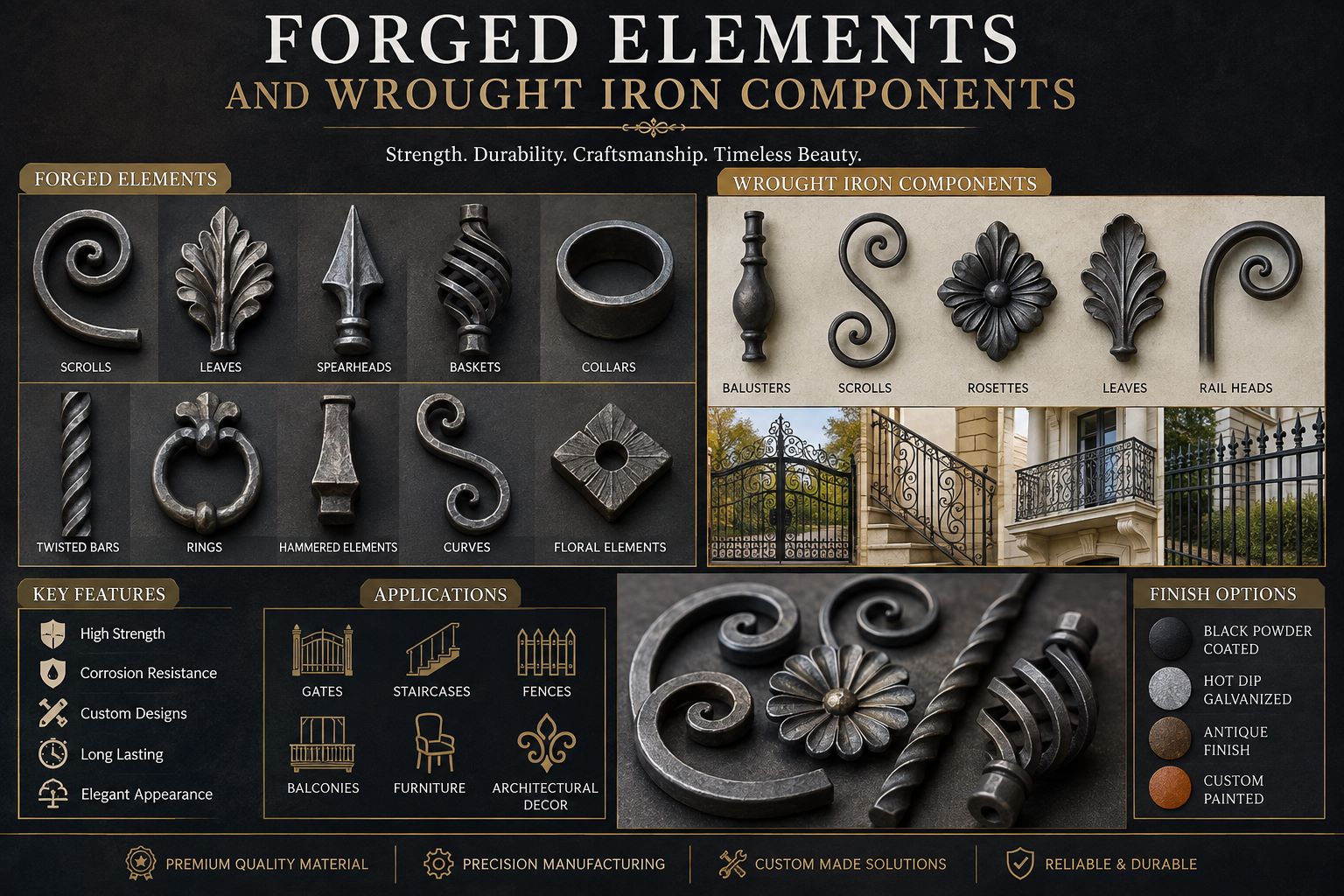
Common examples include:
- Forged bars and rings
- Decorative scrolls
- Collars and sleeves
- Leaves and flowers
- Forged baskets
- Gate ornaments
- Railheads and spear points
- Handrail accessories
- Custom structural pieces
The same manufacturing concept can therefore support both decorative architecture and technically demanding industrial applications.
Why Forging Creates Reliable Metal Components
One of the primary reasons forging remains important is its ability to produce dense and mechanically dependable components.
During controlled forging, pressure changes the shape of the metal while influencing its internal grain orientation. When manufacturing parameters are properly controlled, this can improve resistance to impact, fatigue, and mechanical loading.
Several factors determine final quality:
- Raw material composition
- Forging temperature
- Applied forming pressure
- Die and tooling accuracy
- Cooling conditions
- Heat treatment requirements
- Dimensional tolerances
- Final surface treatment
This explains why professional Forged Elements manufacturing requires considerably more than simply heating and hammering metal.
Wrought Iron Components in Modern Architecture
Wrought Iron Components have a strong connection with traditional architecture and ornamental metal craftsmanship.
Historically, genuine wrought iron was valued because it could be repeatedly heated and worked into elaborate shapes. In contemporary architectural markets, however, the term is frequently used more broadly for ornamental metalwork manufactured from workable steels.
Typical products include:
- Balusters
- Scroll designs
- Decorative panels
- Rosettes
- Leaves
- Floral ornaments
- Baskets
- Railheads
- Gate accessories
- Fence ornaments
- Handrail decorations
These components give fabricators the ability to transform basic metal structures into distinctive architectural features.
Where Forged Elements and Wrought Iron Components Are Used
The versatility of Forged Elements and Wrought Iron Components makes them relevant across residential, commercial, hospitality, landscaping, and industrial projects.
Residential Architecture
Decorative metalwork can enhance staircases, balconies, entrance gates, boundary fences, windows, terraces, and garden structures.
Homeowners often select ornamental metal because it provides visual character while remaining suitable for long-term installations.
Commercial Developments
Hotels, resorts, restaurants, offices, retail properties, and luxury developments frequently incorporate decorative metalwork into entrances, balconies, partitions, staircases, and landscaping.
Industrial Applications
Forging also serves applications where aesthetics are secondary to mechanical performance. Depending on engineering requirements, forged components may be incorporated into machinery, structural assemblies, transportation equipment, agricultural equipment, and industrial systems.
Forged Elements vs Wrought Iron Components
Although these product categories overlap, their emphasis can be different.
| Factor | Forged Elements | Wrought Iron Components |
| Main characteristic | Mechanical strength and formed geometry | Decorative appearance and fabrication flexibility |
| Typical process | Hammering, pressing or die forging | Bending, forming, forging and fabrication |
| Common applications | Engineering and architecture | Architecture and decoration |
| Design complexity | Simple to highly complex | Frequently ornamental |
| Customization | High | Very high |
| Finishing options | Industrial and decorative | Primarily decorative/protective |
| Outdoor suitability | Depends on protection | Depends on protection |
A professionally designed gate, for example, may use forged structural or decorative sections alongside ornamental wrought-style components.
Material Selection Makes a Major Difference
Selecting suitable metal is fundamental to product performance.
Mild steel is commonly selected for architectural metalwork because it provides excellent formability and weldability while remaining economical.
Other projects may require carbon steel, alloy steel, or stainless steel depending on mechanical loads, environmental conditions, corrosion exposure, and engineering specifications.
When choosing materials for Forged Elements, professionals should evaluate:
- Tensile strength
- Toughness
- Weldability
- Formability
- Corrosion resistance
- Temperature exposure
- Required component thickness
- Expected loading
- Service environment
Material selection should always reflect the actual application rather than appearance alone.
Customization Expands Architectural Possibilities
Standard decorative components provide convenience, but customized manufacturing creates considerably greater design freedom.
Architects and fabricators can specify dimensions, profiles, patterns, thicknesses, curves, textures, and surface finishes.
Custom Wrought Iron Components are particularly useful when developing signature architectural designs.
A manufacturer may work from:
- Technical drawings
- CAD files
- Physical samples
- Reference designs
- Architectural specifications
Prototyping can also help verify dimensions and visual proportions before mass production begins.
Surface Finishing Protects the Investment
Untreated ferrous metal can deteriorate when repeatedly exposed to moisture and environmental contaminants. Appropriate surface protection is therefore essential.
Common options include:
- Hot-dip galvanizing
- Powder coating
- Industrial painting
- Electroplating
- Polishing
- Black oxide treatments
- Specialized protective coatings
For outdoor Wrought Iron Components, the coating system should be selected according to local environmental conditions.
Coastal, humid, industrial, and high-rainfall environments can require stronger corrosion protection than controlled indoor environments.
Quality Control Determines Long-Term Performance
Even attractive metalwork can create installation problems when dimensional consistency is poor.
Professional manufacturing therefore requires inspection throughout production rather than only checking completed products.
Important Quality Parameters
Manufacturers should monitor material specifications, dimensions, surface condition, forging consistency, welding quality, tolerances, coating quality, and packaging.
Dimensional Accuracy
Accurate dimensions are particularly important when hundreds or thousands of identical components must fit into prefabricated assemblies.
Final Inspection
Before dispatch, finished components should be inspected for visible defects, dimensional deviations, incomplete coatings, deformation, sharp edges, or other issues that could affect installation or performance.
Benefits for Fabricators and Project Developers
High-quality Forged Elements provide advantages beyond physical strength.
Standardized components can reduce the amount of fabrication required at the workshop. Instead of producing every scroll, basket, collar, or ornament manually, fabricators can integrate ready-made components into larger assemblies.
Important benefits include:
- Faster fabrication
- Consistent appearance
- Reduced production complexity
- Repeatable dimensions
- Easier project scaling
- Greater design flexibility
- Professional finishing possibilities
- Long-term durability
These advantages become especially valuable for large architectural developments requiring repeated designs across multiple locations.
How to Select the Right Supplier
A supplier should be evaluated according to manufacturing capability rather than price alone.
Look for experience in forging, metal forming, tooling, customization, finishing, quality inspection, export packaging, and bulk manufacturing.
Buyers should also confirm material specifications and tolerances before ordering large quantities of Wrought Iron Components.
Samples or prototypes can help verify whether the supplier’s products satisfy both functional and aesthetic expectations.
FAQ About Forged Elements and Wrought Iron Components
What are Forged Elements?
Forged Elements are metal components shaped using controlled compressive forces such as hammering, pressing, or die forming.
What are Wrought Iron Components used for?
They are commonly used in gates, railings, balconies, staircases, fences, furniture, windows, and decorative architectural structures.
Are modern wrought iron products made from genuine wrought iron?
Not always. Many contemporary wrought-style products are manufactured from mild steel because traditional wrought iron is less commonly available.
Why is forging beneficial?
Proper forging can provide excellent mechanical strength, toughness, fatigue resistance, and structural reliability.
Can decorative components be customized?
Yes. Manufacturers can produce customized sizes, shapes, patterns, textures, thicknesses, and ornamental designs.
Are these components suitable for outdoor installations?
Yes, provided appropriate corrosion-resistant coatings and regular maintenance are used.
What finish works well for exterior metalwork?
Galvanizing followed by a suitable coating system can provide effective protection for many outdoor applications.
Can Forged Elements be welded?
Many forged steel components can be welded, but the material grade and welding procedure must be considered.
How can buyers evaluate product quality?
Check material specifications, dimensions, surface condition, manufacturing consistency, coating quality, samples, and supplier quality procedures.
Can these components be produced in bulk?
Yes. Modern forging and forming equipment allows standardized components to be manufactured efficiently for large-volume projects.
https://gosarkarijobs.com/why-wrought-iron-components-are-redefining-modern-decorative-iron-work/
https://shopnets.com/a-complete-guide-to-wrought-iron-components-for-beautiful-decorative-iron-work/
https://newsgrow.blogspot.com/2026/08/wrought-iron-components-see-renewed.html
https://newsgrow.blogspot.com/2026/08/from-functional-railings-to-statement.html