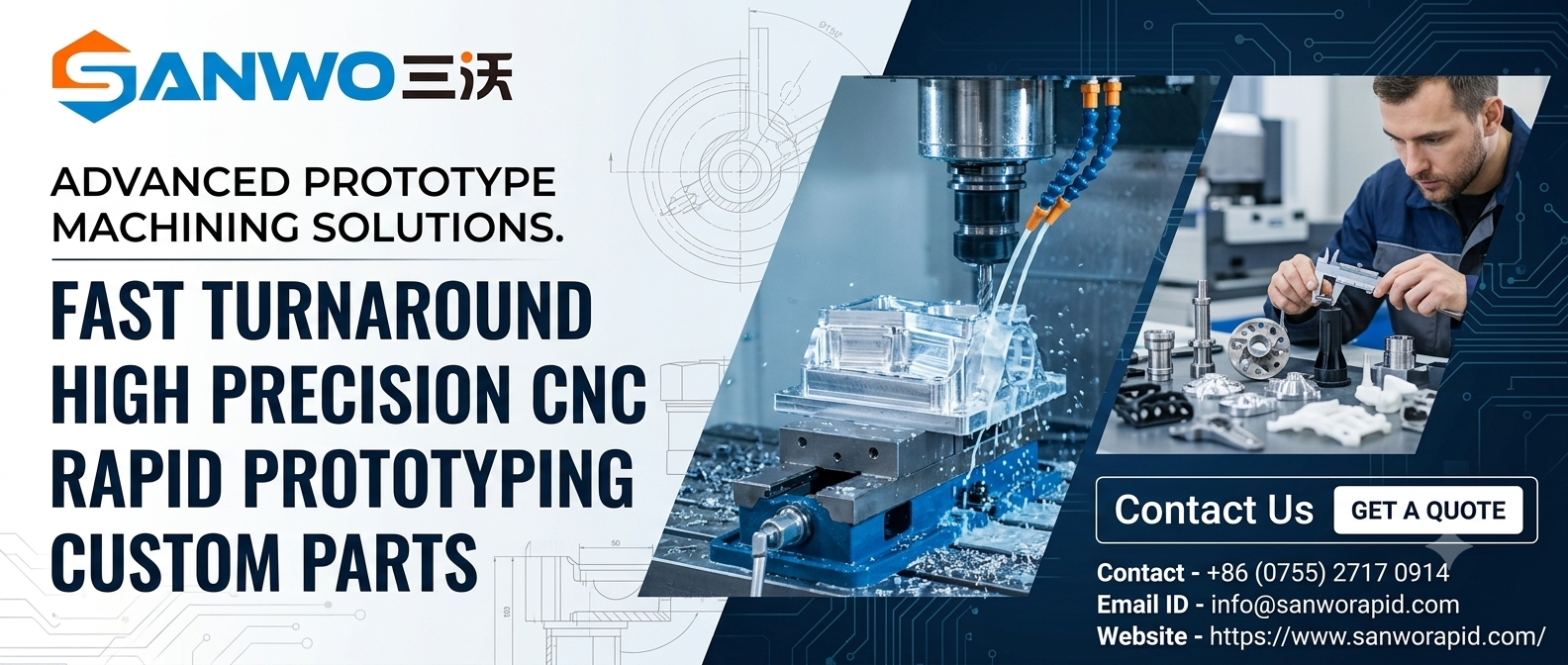
Bringing a new product from concept to market requires more than an innovative idea. Engineers and product designers need reliable prototypes to test dimensions, materials, functionality, and assembly before moving into full-scale production. Prototype machining has become a preferred solution for creating accurate, functional parts without the high upfront tooling costs associated with some traditional manufacturing methods. For businesses working on new products, choosing an experienced manufacturing partner such as SanwoRapid can help turn digital designs into precise physical components.
What Is Prototype Machining?
Prototype machining is a manufacturing process used to create physical prototypes directly from materials such as aluminum, stainless steel, brass, copper, plastics, and other engineering materials. CNC milling, CNC turning, drilling, boring, and other machining operations remove material from a solid workpiece until the required geometry is achieved.
Unlike visual prototypes that focus mainly on appearance, machined prototypes can closely replicate the strength, dimensional accuracy, surface characteristics, and mechanical performance required from a functional component.
This makes the process particularly useful for engineers who need to test a product under realistic operating conditions before committing to mass production.
Why Is Prototype Machining Important?
Product development often involves several design iterations. A component may look correct in CAD software but behave differently once manufactured. Problems involving tolerances, assembly, weight, strength, or component interference may only become obvious when a physical part is available.
Prototype machining provides an opportunity to identify these issues early.
Some of its major advantages include:
- High dimensional accuracy
- Functional material selection
- Tight-tolerance manufacturing
- Rapid design validation
- Low-volume production capability
- Excellent surface-finish options
- Reduced dependence on expensive tooling
- Better evaluation of assembly and fit
For example, an engineering team designing an aluminum housing can machine several prototype versions, test each design, and make adjustments before investing in production tooling.
How Does the Prototype Machining Process Work?
Although the exact workflow depends on the component, most projects follow several key stages.
1. CAD Design and Engineering Review
The process begins with a 3D CAD model or technical drawing. Engineers review the geometry, dimensions, tolerances, material specifications, threads, holes, and other critical features.
A manufacturing review at this stage can identify features that may be difficult or expensive to machine.
2. Material Selection
The material should be selected according to the component’s intended application. Aluminum is commonly used for lightweight prototypes, while stainless steel may be better suited to applications requiring greater strength and corrosion resistance.
Engineering plastics can also be considered when low weight, electrical insulation, or specific friction characteristics are important.
3. CNC Programming
CAM software is used to generate machining toolpaths. Cutting speeds, feeds, tooling, workholding, and machining sequences are considered to achieve the required results.
4. CNC Machining
The selected material is secured inside a CNC machine, where automated cutting tools remove material according to the programmed instructions.
Depending on the design, the component may require milling, turning, drilling, threading, or multiple machining operations.
5. Inspection and Finishing
After machining, critical dimensions can be inspected against the engineering drawing. Additional processes such as anodizing, polishing, bead blasting, painting, or powder coating may then be applied.
Prototype Machining vs. Other Prototyping Methods
Choosing a prototyping technology depends on the project’s goals, material requirements, quantity, and budget.
| Prototyping Method | Key Strength | Best Suited For |
| Prototype Machining | Accuracy and functional materials | Functional engineering prototypes |
| 3D Printing | Speed and geometric flexibility | Concept and visual models |
| Vacuum Casting | Production-like plastic parts | Small batches and appearance testing |
| Rapid Injection Molding | Production-quality molded parts | Functional plastic validation |
| Sheet Metal Prototyping | Realistic metal components | Enclosures, brackets, and formed parts |
Prototype machining is particularly valuable when the prototype needs to withstand mechanical testing or accurately fit with other components.
Materials Commonly Used for Machined Prototypes
Material selection can significantly affect both machining performance and prototype functionality.
Aluminum
Aluminum is one of the most widely used materials for prototypes because it offers a useful combination of low weight, strength, corrosion resistance, and machinability.
Stainless Steel
Stainless steel is suitable for applications where durability, strength, and corrosion resistance are important.
Brass and Copper
These materials can be useful for electrical components, thermal applications, fittings, and specialized mechanical parts.
Engineering Plastics
Materials such as ABS, nylon, POM, polycarbonate, and PEEK can provide alternatives when lightweight construction, insulation, chemical resistance, or low friction is required.
Applications of Prototype Machining
Prototype machining supports product development across numerous industries.
Common applications include:
- Automotive components
- Aerospace parts
- Robotics components
- Consumer electronics
- Medical equipment
- Industrial machinery
- Automation systems
- Custom fixtures
- Mechanical assemblies
- Functional testing components
Consider a robotics company developing a new robotic joint. A machined aluminum prototype can be produced and assembled with other components to test movement, alignment, load performance, and mechanical interference. If a problem is identified, the CAD design can be modified and another prototype manufactured.
This iterative approach can significantly improve the final product before production begins.
How to Reduce Prototype Machining Costs
Prototype manufacturing does not have to be unnecessarily expensive. Several design and production decisions can help control costs.
Focus on Critical Tolerances
Not every dimension requires an extremely tight tolerance. Applying tight tolerances only where they are functionally necessary can reduce machining time and inspection requirements.
Choose Machinable Materials
Material selection can influence cutting speed, tooling requirements, and overall production time. Discussing material alternatives with a machining specialist can sometimes reduce costs without compromising performance.
Simplify Unnecessary Features
Deep pockets, extremely thin walls, difficult internal geometries, and unnecessary complex features can increase machining difficulty. Designing with manufacturability in mind can make production more efficient.
Consider Batch Quantity
Producing several identical prototypes at once may improve manufacturing efficiency compared with ordering individual parts separately.
What Makes a Good Prototype Machining Partner?
Price is only one factor when selecting a prototype machining supplier. Engineering experience, communication, inspection capability, material availability, finishing options, and production consistency can have a significant effect on project success.
A capable supplier should be able to review technical requirements, identify potential manufacturing challenges, provide material recommendations, and maintain quality throughout production.
SanwoRapid provides prototype machining services designed to support product developers and engineering teams through different stages of product development. From CNC machining and material selection to finishing and inspection, working with an experienced supplier can help reduce development risks and improve prototype quality.
Frequently Asked Questions About Prototype Machining
1. What is prototype machining?
Prototype machining is the process of producing physical prototype parts from solid metal or plastic materials using CNC machining and related manufacturing processes.
2. What is prototype machining used for?
It is commonly used for functional testing, design validation, assembly testing, dimensional verification, engineering evaluation, and low-volume manufacturing.
3. Is CNC machining suitable for prototypes?
Yes. CNC machining is highly suitable for prototypes that require accurate dimensions, functional materials, tight tolerances, and realistic mechanical performance.
4. Which materials are suitable for prototype machining?
Common materials include aluminum, stainless steel, brass, copper, titanium, ABS, nylon, POM, polycarbonate, and other engineering plastics.
5. How accurate can machined prototypes be?
Accuracy depends on the CNC equipment, material, geometry, tooling, machining strategy, and specified tolerances. Critical dimensions should be clearly identified in the technical documentation.
6. How long does prototype machining take?
Lead times vary according to part complexity, material, quantity, finishing, inspection requirements, and production capacity. Simple components generally require less machining time than complex multi-operation parts.
7. Can machined prototypes be surface finished?
Yes. Depending on the material and application, options can include anodizing, bead blasting, polishing, painting, powder coating, and plating.
8. Is prototype machining suitable for small production runs?
Yes. CNC machining can be practical for both prototypes and low-volume production when specialized tooling is not economically justified.
9. What files are required for prototype machining?
A 3D CAD model is typically required. Engineering drawings containing tolerances, material specifications, surface finishes, threads, and other critical requirements may also be necessary.
10. Can prototype machining create complex components?
Yes. Modern CNC milling and multi-axis machining equipment can manufacture complex contours, pockets, holes, slots, threads, angled surfaces, and other detailed features.
Contact – +86 (0755) 2717 0914
Email ID – info@sanworapid.com
Website – https://www.sanworapid.com/