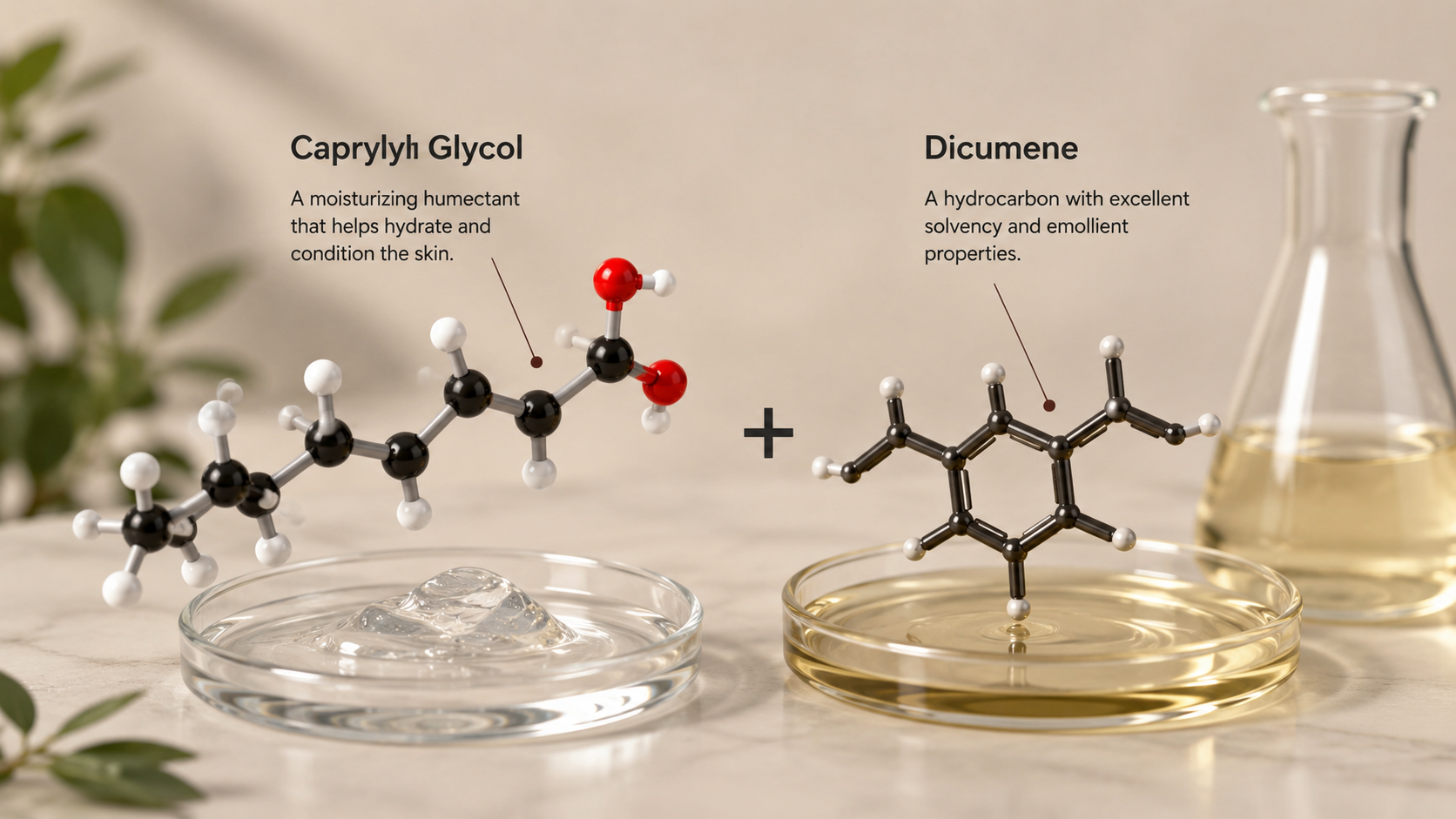
Specialty chemicals have become essential to modern manufacturing because even small quantities of the right ingredient can significantly influence product quality, stability, processing, and performance. Caprylyl Glycol and Dicumene are two examples of specialized chemicals serving very different industries.
While Caprylyl Glycol is widely associated with cosmetics, skincare, and personal-care formulations, Dicumene is primarily connected with polymers, plastics, and flame-retardant systems. Understanding their individual characteristics is important for manufacturers, formulators, distributors, and businesses sourcing specialty chemical ingredients.
Understanding Caprylyl Glycol
Caprylyl Glycol is a multifunctional cosmetic ingredient valued for its ability to support moisture retention, improve formulation characteristics, and enhance preservation systems.
Chemically classified as a glycol, it has characteristics that make it suitable for numerous personal-care applications. Instead of performing only one function, it can contribute to several aspects of a formulation.
This versatility is particularly important as cosmetic manufacturers increasingly look for efficient ingredient systems that provide both functional and sensory benefits.
Why Caprylyl Glycol Is Important in Modern Cosmetics
Modern consumers expect cosmetic products to deliver more than basic functionality. A moisturizer, for example, should hydrate effectively while offering pleasant texture, good spreadability, stability, and reliable shelf performance.
Caprylyl Glycol can contribute to these objectives.
Its important formulation benefits include:
- Supporting moisture retention
- Providing skin-conditioning properties
- Improving formulation texture
- Supporting antimicrobial preservation
- Complementing conventional preservatives
- Helping maintain overall formulation quality
These properties make the ingredient particularly useful when manufacturers are developing sophisticated personal-care products.
Caprylyl Glycol as a Humectant
One important function of Caprylyl Glycol is its humectant activity.
Humectants are ingredients used in personal-care products to help attract and retain moisture. Maintaining adequate moisture levels can improve how skin feels after applying a cosmetic formulation.
Supporting Better Skin Feel
Consumers frequently evaluate skincare products based on their sensory experience.
Products that leave skin feeling excessively dry, sticky, or uncomfortable may receive poor consumer acceptance even when their functional ingredients are effective.
By contributing moisturizing and conditioning characteristics, Caprylyl Glycol can help formulators develop products with a softer and more comfortable after-feel.
Caprylyl Glycol and Cosmetic Preservation
Preserving cosmetic formulations against unwanted microbial growth is an important part of product development.
Water-containing products can potentially create environments where microorganisms may develop if an appropriate preservation strategy is not implemented.
Caprylyl Glycol is frequently incorporated as a preservative-supporting ingredient.
Preservative Booster Rather Than Simple Preservative
The distinction is important.
Instead of assuming that Caprylyl Glycol alone will adequately preserve every formulation, manufacturers typically evaluate how it interacts with other preservation components.
Why Preservation Testing Remains Essential
A finished cosmetic product should undergo suitable microbiological and stability evaluation.
Factors influencing preservation effectiveness include:
- Water activity
- Product pH
- Packaging system
- Other formulation ingredients
- Manufacturing conditions
- Intended product use
- Storage environment
Therefore, ingredient selection should always form part of a complete formulation strategy.
Common Applications of Caprylyl Glycol
Because of its multifunctional nature, Caprylyl Glycol can be incorporated into many cosmetic and personal-care categories.
Typical applications include:
- Facial moisturizers
- Body lotions
- Cosmetic creams
- Facial serums
- Cleansing products
- Shampoos
- Hair conditioners
- Deodorants
- Sunscreen formulations
- Makeup products
- Body-care formulations
Actual concentration and compatibility depend on the specific formulation and desired performance.
Understanding Dicumene
Dicumene belongs to a completely different area of specialty chemistry.
The material is chemically identified as 2,3-dimethyl-2,3-diphenylbutane and has CAS number 1889-67-4. It is particularly relevant to polymer processing and flame-retardant technologies.
Unlike Caprylyl Glycol, Dicumene is not primarily a cosmetic formulation ingredient. Its importance lies mainly in industrial polymer applications.
Role of Dicumene in Polymer Technology
Plastic manufacturers constantly work to improve properties such as thermal behavior, durability, processing performance, mechanical characteristics, and resistance to ignition.
Specialty additives allow manufacturers to modify polymer performance without completely redesigning the base material.
Dicumene can be used as a synergistic additive within certain flame-retardant systems.
Understanding Flame-Retardant Synergy
A synergist is generally used to improve or complement the effectiveness of another component.
In suitable polymer formulations, Dicumene can interact with the overall additive system and help optimize flame-retardant performance.
This approach may allow formulators to develop more efficient additive packages for specific polymer applications.
Major Polymer Applications of Dicumene
Dicumene has relevance across different thermoplastic materials and polymer-processing applications.
Potential applications include:
- Polypropylene
- Polyethylene
- Polystyrene
- High-impact polystyrene
- Expandable polystyrene
- ABS polymers
- SAN materials
- Polymer masterbatches
- Modified plastic compounds
The exact formulation depends heavily on polymer chemistry, processing temperature, required performance, and other additives.
Dicumene in Polymer Modification
Another interesting area involves polymer modification.
During industrial processing, chemical additives can influence molecular interactions and help manufacturers obtain desired material characteristics.
Dicumene may be associated with applications involving radical initiation, grafting, cross-linking, and specialized polymer modification.
Why Polymer Modification Matters
Manufacturers modify polymers to obtain characteristics that ordinary resin may not provide.
Modification can potentially influence:
- Mechanical properties
- Processing behavior
- Compatibility between materials
- Thermal performance
- Functional characteristics
This makes specialty additives increasingly important in advanced plastics manufacturing.
Caprylyl Glycol vs Dicumene
| Factor | Caprylyl Glycol | Dicumene |
| Main industry | Cosmetics | Polymer industry |
| Primary role | Multifunctional formulation ingredient | Specialty polymer additive |
| Major benefit | Moisturizing and preservation support | Flame-retardant synergy |
| Typical materials | Creams, serums, shampoos | PP, PE, PS, ABS |
| Application focus | Personal care | Industrial plastics |
| Formulation purpose | Stability and sensory performance | Polymer performance |
| Typical buyer | Cosmetic manufacturer | Plastic compounder |
Although both are specialty chemicals, their applications should therefore be evaluated independently.
Importance of Chemical Purity and Consistency
Industrial buyers should consider more than simply chemical name and price when purchasing Caprylyl Glycol or Dicumene.
Quality consistency can influence manufacturing results significantly.
Important purchasing parameters include:
- Purity specifications
- Certificate of Analysis
- Safety Data Sheet
- Batch consistency
- Packaging standards
- Storage requirements
- Technical documentation
- Regulatory compliance
- Application support
- Reliable supply capability
Working with knowledgeable suppliers can reduce sourcing risks and improve production consistency.
Frequently Asked Questions
What is Caprylyl Glycol?
Caprylyl Glycol is a multifunctional ingredient commonly incorporated into cosmetic and personal-care formulations.
Why is Caprylyl Glycol used in skincare?
It provides moisturizing and conditioning characteristics while supporting formulation stability and preservation strategies.
Is Caprylyl Glycol a humectant?
Yes. It possesses humectant properties that can help support moisture retention in cosmetic formulations.
Does Caprylyl Glycol support preservatives?
Yes. It is commonly used as a preservative booster alongside suitable preservation systems.
Which products can contain Caprylyl Glycol?
Creams, lotions, serums, cleansers, shampoos, conditioners, deodorants, and various cosmetic formulations may contain it.
What is Dicumene?
Dicumene is 2,3-dimethyl-2,3-diphenylbutane, a specialty organic chemical mainly associated with polymer applications.
What is Dicumene used for?
It is used primarily in polymer processing, flame-retardant systems, masterbatches, and certain polymer-modification applications.
Is Dicumene used with polypropylene?
Yes. Polypropylene is one of the polymer materials where Dicumene-based additive technology may be applied.
Is Dicumene a flame-retardant synergist?
Yes. One of its notable industrial functions is supporting the performance of suitable flame-retardant systems.
Are Caprylyl Glycol and Dicumene interchangeable?
No. They have completely different chemical functions, target industries, and formulation purposes.
What should buyers check before purchasing these chemicals?
Buyers should review purity, specifications, documentation, packaging, consistency, storage recommendations, and supplier technical capabilities.
Growing Demand for Functional Specialty Chemicals
Manufacturing industries increasingly prefer ingredients that provide targeted functionality and greater formulation efficiency.
For cosmetic manufacturers, multifunctional materials such as Caprylyl Glycol can help address moisture management, sensory quality, and preservation requirements. For polymer manufacturers, additives such as Dicumene can support specialized material engineering and flame-retardant technologies.
As product-performance requirements become increasingly sophisticated, understanding how individual specialty chemicals behave within complete formulations will become even more important.
https://newsgrow.blogspot.com/2026/08/ethylhexylglycerin-emerges-as-key.html