Walk through any beauty or personal care aisle and one thing becomes immediately clear: packaging has become part of the product experience. Consumers expect a shampoo bottle to open easily, a lotion to dispense cleanly, and a skincare product to deliver an appropriate amount without unnecessary mess or waste.
Behind this everyday convenience are carefully engineered components such as the disc cap and cosmetic pump. These dispensing solutions perform very different functions, yet both help brands improve usability, product protection, shelf presentation, and consumer satisfaction.
For cosmetic companies developing new products, understanding dispensing technology can be just as important as selecting the bottle itself.
Packaging Is Now Part of the Beauty Experience
Consumers interact with packaging before they actually use the formulation. If the dispenser leaks, becomes clogged, releases excessive product, or requires too much effort, the entire product can feel poorly designed.
Effective dispensing packaging should combine functionality with visual appeal. Important considerations include product viscosity, dosage, bottle shape, closure compatibility, portability, hygiene, durability, and sustainability.
This is where selecting between a disc cap and cosmetic pump becomes a strategic packaging decision rather than simply a matter of appearance.
Why the Disc Cap Has Become an Everyday Essential
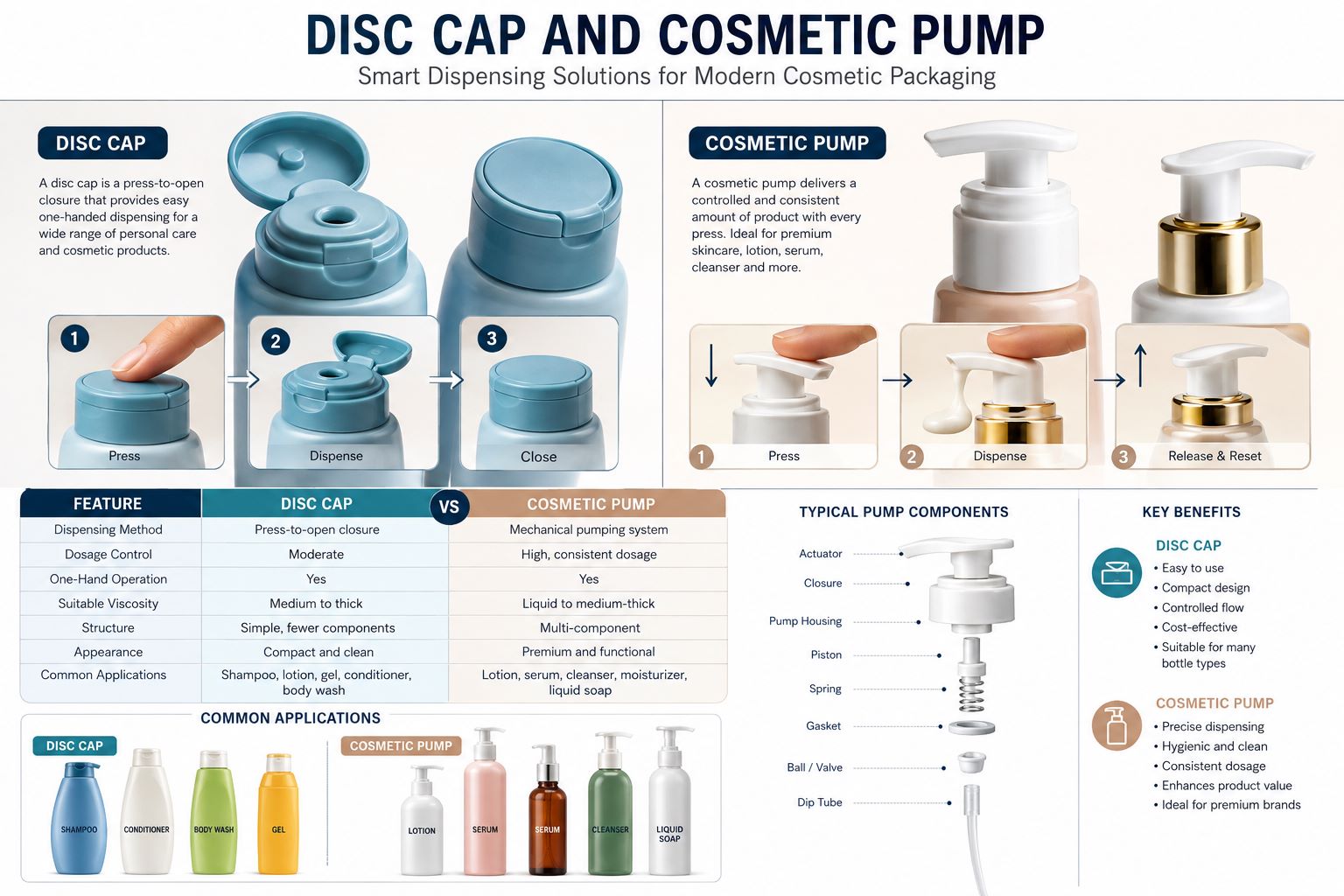
The disc cap is commonly recognized by its circular press-down top. Pressing one side causes the opposite side to rise, exposing a small dispensing opening.
Consumers can then tilt or squeeze the bottle to release the formulation. Once finished, another press closes the opening.
This simple mechanism eliminates the need to completely remove a closure, making it useful for products that are opened and closed frequently.
Where Disc Caps Perform Best
A disc cap is commonly considered for:
- Shampoo
- Conditioner
- Shower gel
- Body lotion
- Facial cleanser
- Hair gel
- Massage lotion
- Personal care oils
- Hand and body products
The actual suitability depends on the formulation and bottle combination.
Small Design Details Can Make a Big Difference
A disc closure may appear simple, but its performance depends on precision.
The dispensing opening, sealing structure, disc movement, neck dimensions, thread design, and material characteristics must work together.
The Importance of the Dispensing Orifice
The size of the opening influences product flow significantly.
A larger opening may be appropriate for thicker formulations, while lower-viscosity products may require greater flow control.
If manufacturers ignore this relationship, consumers may have to squeeze the bottle excessively or may accidentally dispense more product than required.
Bottle Flexibility Also Matters
Many disc cap packages rely partly on squeezing pressure. Therefore, bottle-wall flexibility should be evaluated together with the closure.
A rigid bottle combined with a thick formulation can create a completely different dispensing experience from a flexible bottle containing shampoo.
Cosmetic Pumps Bring Precision to Product Dispensing
While disc closures depend largely on gravity or bottle pressure, a cosmetic pump uses a mechanical system to move formulation from the container to the consumer.
Pressing the actuator operates internal components that draw and dispense the product.
This mechanism makes pumps popular for products where controlled application is particularly valuable.
What Happens Every Time You Press a Pump?
Inside a typical cosmetic pump is a coordinated system that may contain a piston, spring, valve, chamber, housing, gasket, actuator, and dip tube.
When the actuator moves downward, pressure within the system pushes product toward the dispensing outlet. When the actuator returns, the mechanism helps draw another quantity from the container.
Why Priming Happens
A newly filled pump often contains air rather than product inside its internal pathway.
Several initial presses may therefore be required to draw the formulation through the dip tube and into the chamber.
After priming, the pump should provide reliable dispensing when properly matched with the formulation.
Disc Cap vs Cosmetic Pump at a Glance
| Factor | Disc Cap | Cosmetic Pump |
| Dispensing action | Press, tilt or squeeze | Press actuator |
| Mechanism | Simple closure | Mechanical system |
| Dosage control | User controlled | More consistent |
| Components | Fewer | More |
| Typical positioning | Everyday convenience | Controlled/premium |
| Common formulation | Shampoo, gel, conditioner | Lotion, cleanser, moisturizer |
| Bottle requirement | Often squeezable | Often rigid/semi-rigid |
| Packaging complexity | Lower | Higher |
| One-hand use | Convenient | Very convenient |
| Customization | High | High |
The right choice depends on how the formulation needs to reach the consumer.
Viscosity Should Guide Packaging Decisions
One of the most common packaging mistakes is selecting a dispenser before understanding the formulation’s flow characteristics.
Viscosity influences how quickly and easily a cosmetic formulation moves.
A lightweight cleansing lotion may flow readily, while a concentrated conditioner or body cream may require greater dispensing force.
With a disc cap, brands should consider orifice dimensions and squeeze characteristics. For a cosmetic pump, pump chamber capacity, suction ability, dip-tube design, and valve performance become important.
Testing with the actual formulation is therefore essential.
Controlled Dispensing Can Reduce Product Waste
Consumers rarely want more cosmetic product than they actually need.
Excessive dispensing wastes formulation and can make application inconvenient. Too little output creates the opposite problem, forcing consumers to operate the package repeatedly.
A properly specified cosmetic pump can provide controlled output with each complete stroke.
A disc cap offers a different type of control, allowing consumers to determine quantity through squeezing duration and pressure.
Both systems can support efficient consumption when correctly engineered.
Hygiene and Convenience Influence Consumer Choice
Modern consumers increasingly value packaging that is easy to handle and keeps application relatively clean.
Pumps minimize the need to touch the formulation stored inside the container. Disc closures remain attached to the bottle, eliminating the inconvenience of repeatedly handling a separate cap.
Convenience Becomes Brand Experience
Small interactions can shape repeat purchasing.
A disc cap that opens smoothly or a cosmetic pump that consistently dispenses product can create a sense of quality without consumers consciously thinking about the engineering involved.
Poor dispensing can create exactly the opposite impression.
Testing Is Essential Before Mass Production
A beautiful prototype does not automatically guarantee successful commercial packaging.
Brands should test complete packaging systems under conditions that reflect manufacturing, transportation, storage, and consumer use.
Key Tests to Consider
- Leakage testing
- Drop resistance
- Closure fitting
- Pump priming
- Dispensing output
- Repeated-use performance
- Chemical compatibility
- Storage stability
- Transportation simulation
- Opening and closing durability
These evaluations help identify problems before thousands of units reach the market.
Custom Packaging Can Build Stronger Recognition
Both dispensing formats provide opportunities for visual differentiation.
Brands can explore customized colors, surface finishes, closure profiles, actuator designs, decorative treatments, and bottle combinations.
A colorful disc cap can complement a youthful haircare range, while a minimalist cosmetic pump can support the sophisticated appearance of premium skincare packaging.
Function should always remain the priority, but good design allows performance and branding to work together.
Sustainability Is Redesigning Cosmetic Dispensing
Beauty companies are under growing pressure to reduce packaging waste and improve material efficiency.
As a result, manufacturers are exploring lightweight closures, recyclable materials, reduced component counts, refillable containers, and simplified dispensing structures.
The relatively simple construction of a disc cap can offer opportunities for material optimization.
Pump development is also evolving. Manufacturers are working toward designs that reduce material complexity and improve compatibility with recycling systems.
Sustainability should ultimately be assessed across the complete package, including the bottle, closure, label, decoration, transportation, and end-of-life possibilities.
Frequently Asked Questions
1. What exactly is a disc cap?
A disc cap is a dispensing closure opened by pressing one side of a movable top disc.
2. Which products work with disc caps?
They are frequently used for shampoos, conditioners, lotions, gels, cleansers, and other personal care formulations.
3. What makes a cosmetic pump different?
A cosmetic pump uses internal mechanical components to draw product from the container and dispense it through an actuator.
4. Are cosmetic pumps only for luxury products?
No. Pumps are used across mass-market, professional, hospitality, pharmaceutical-style, and premium cosmetic packaging categories.
5. Can a disc cap leak?
Any closure can potentially leak if bottle compatibility, sealing, manufacturing tolerances, or transportation conditions are inadequate.
6. Why does viscosity matter?
Viscosity determines how easily a formulation flows and therefore influences the required dispensing mechanism and opening specifications.
7. Can pumps dispense thick lotions?
Yes, but the cosmetic pump must be specifically designed and tested for the formulation’s viscosity.
8. Which option has fewer components?
A disc cap generally contains fewer functional components than a conventional pump system.
9. Can these dispensers match brand colors?
Yes. Cosmetic packaging suppliers commonly provide various color, finish, size, and customization possibilities.
10. Why should samples be tested before ordering?
Sample testing helps confirm compatibility, leakage resistance, dispensing quality, usability, and overall packaging performance.
https://newsgrow.blogspot.com/2026/08/cream-jar-and-cosmetic-jar.html
https://gosarkarijobs.com/disc-cap-and-cosmetic-pump-a-deep-guide-to-modern-cosmetic-packaging/