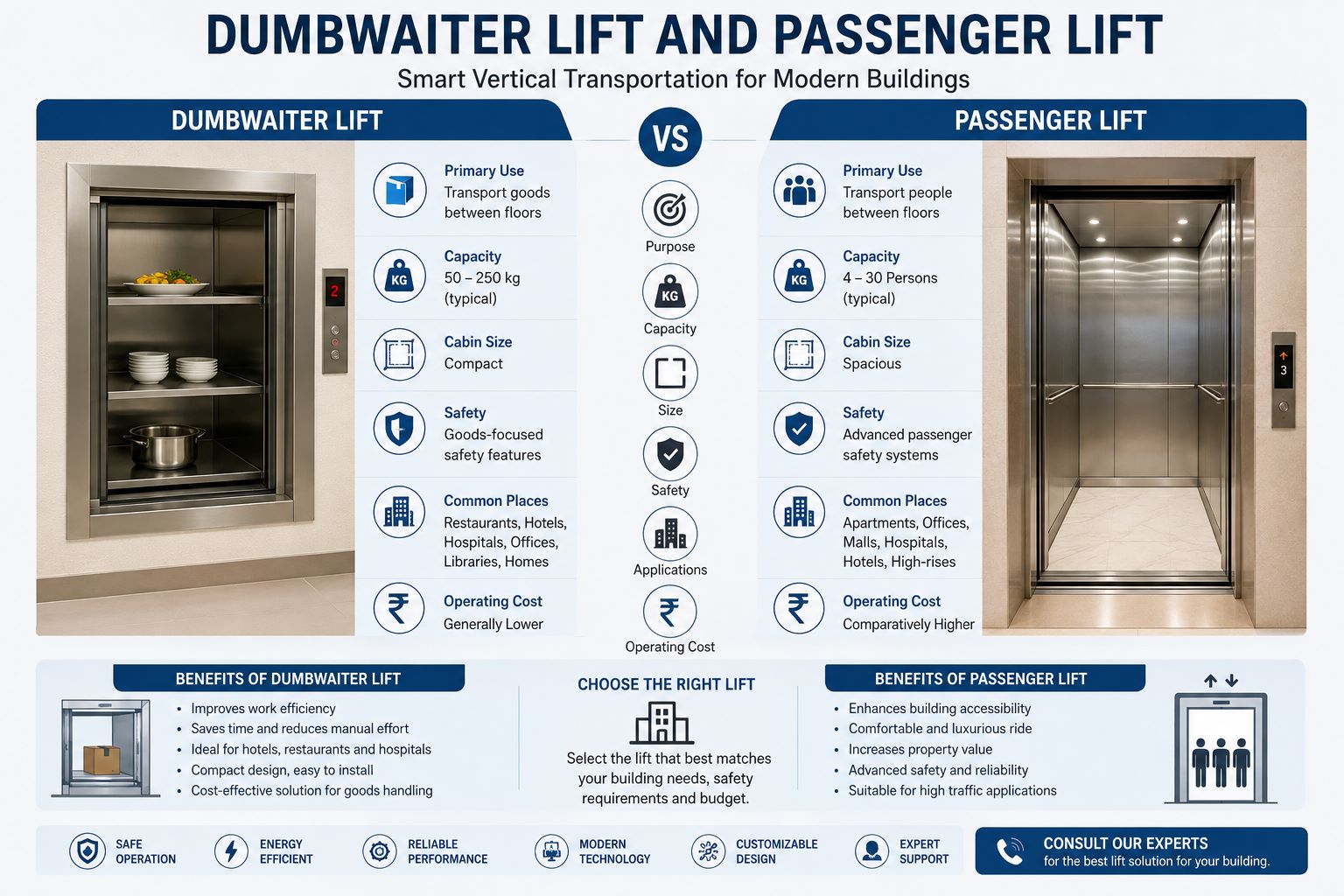
Modern buildings depend on efficient vertical movement. In a restaurant, employees may need to move prepared meals from the kitchen to another floor. In an apartment or commercial building, people need safe and comfortable transportation between levels. Although both requirements involve vertical movement, they require completely different elevator systems.
A dumbwaiter lift is developed primarily for transporting materials and goods, whereas a passenger lift is engineered specifically for people. Their capacities, cabin structures, controls, safety mechanisms, dimensions, and installation requirements differ considerably. Understanding these differences is essential before planning a lift for any property.
Understanding the Purpose of a Dumbwaiter Lift
A dumbwaiter lift is a small service elevator used for moving goods between floors without requiring employees to carry them manually.
It is particularly valuable in buildings where materials are transported repeatedly throughout the day. Restaurants can use dumbwaiters for food and utensils, hospitals for supplies, hotels for housekeeping materials, and offices for documents.
Common applications include:
- Restaurants and commercial kitchens
- Hotels and hospitality properties
- Hospitals and clinics
- Offices and institutions
- Libraries
- Warehouses
- Retail establishments
- Residential villas
- Laboratories
- Industrial facilities
Because the cabin is designed around materials rather than people, a dumbwaiter can often provide an efficient vertical transportation solution within relatively limited space.
How a Dumbwaiter Lift Improves Daily Operations
The real value of a dumbwaiter lift becomes clearer when considering workflow.
Imagine a restaurant operating across three floors. Without a service lift, employees may continuously carry dishes, beverages, ingredients, and utensils through staircases. This consumes time and can create unnecessary congestion.
A dumbwaiter creates a dedicated transportation route.
The operator loads the cabin, closes the landing door, selects the required floor, and sends the material to its destination. The receiving employee can then unload it without travelling between floors.
This process can:
- Reduce unnecessary staff movement.
- Improve material transportation speed.
- Minimize manual carrying.
- Support organized workflows.
- Reduce staircase congestion.
- Improve productivity during busy periods.
The benefits become particularly noticeable in businesses where hundreds of small movements occur every day.
Construction and Technology Behind Dumbwaiter Lifts
A dumbwaiter may look simple, but reliable operation requires several coordinated mechanical and electrical components.
The system typically consists of a cabin, guide rails, motor, controller, landing doors, suspension equipment, electrical panel, switches, and safety mechanisms.
Cabin Design
Cabin dimensions should reflect the goods being transported.
For food-service environments, stainless steel is frequently preferred because it offers durability and easier cleaning. Other applications may require customized shelves, loading heights, or cabin configurations.
Control System
Modern controllers coordinate movement between floors. Call-and-send buttons installed at landing points allow users to select destinations without entering the lift.
Door Interlocking
Interlocking mechanisms help prevent a landing door from being opened when the cabin is not positioned safely at that floor.
These seemingly small features are important for dependable daily operation.
Understanding the Passenger Lift
A passenger lift is fundamentally different because its primary responsibility is transporting people.
Passenger elevators are designed around safety, accessibility, comfort, capacity, speed, and traffic requirements. They are found almost everywhere in modern multi-storey construction.
Typical installations include:
- Residential apartments
- Corporate offices
- Shopping centres
- Hotels
- Hospitals
- Schools and institutions
- Public buildings
- Airports
- Mixed-use developments
- High-rise towers
Unlike a goods-focused elevator, passenger lift planning must consider how people enter, travel, communicate during emergencies, and safely leave the cabin.
How Passenger Lift Technology Works
A passenger lift can operate using different drive technologies depending on building requirements.
Traction elevators are widely used in modern developments. In these systems, the cabin and counterweight work with ropes or belts and a motor-driven traction mechanism.
Hydraulic systems use hydraulic power to raise and lower the elevator and can be suitable for certain low-rise projects.
The controller acts as the intelligence behind the elevator. It processes landing calls, selects travel directions, controls doors, manages acceleration and deceleration, and determines where the cabin should stop.
More advanced installations can coordinate multiple elevators to improve traffic management during busy periods.
Safety Is Central to Passenger Lift Design
Because a passenger lift carries people, safety cannot be treated as an optional feature.
Depending on the elevator specification and applicable standards, important systems can include:
- Emergency alarms
- Automatic rescue systems
- Door sensors
- Interlocks
- Speed monitoring
- Overload detection
- Emergency lighting
- Communication systems
- Safety brakes
- Floor-leveling systems
- Backup power arrangements
- Fire-related operating modes
Why Floor Leveling Matters
Accurate leveling means the elevator cabin stops correctly in relation to the landing floor. Poor leveling can create a step between the cabin and landing, increasing inconvenience and potential tripping risk.
Safety therefore depends on the complete elevator system rather than a single component.
Dumbwaiter Lift vs Passenger Lift: Detailed Comparison
| Comparison | Dumbwaiter Lift | Passenger Lift |
| Main Function | Moving goods | Moving people |
| Cabin | Compact and functional | Larger and passenger-oriented |
| Capacity | Based on material loads | Based on passenger requirements |
| Human Travel | Not intended for passengers | Specifically designed for passengers |
| Interior | Utility-focused | Comfort and appearance focused |
| Installation Area | Usually smaller | Generally requires more space |
| Controls | Simple call/send operation | Advanced passenger controls |
| Applications | Food, files, supplies, goods | Residential and commercial mobility |
| Safety Design | Goods transportation focused | Extensive human safety provisions |
| Accessibility | Loading convenience | Passenger accessibility |
A dumbwaiter lift should never be treated as an inexpensive substitute for a passenger elevator. Each system must be used for its intended purpose.
Choosing the Correct Lift for Your Building
The right elevator cannot be selected simply by comparing prices. Technical requirements must be evaluated first.
Important considerations include:
- Number of floors
- Total travel height
- Available shaft space
- Intended application
- Required load capacity
- Frequency of operation
- Number of users
- Required travel speed
- Door dimensions
- Loading requirements
- Power availability
- Building structure
- Maintenance access
For a dumbwaiter lift, consider the dimensions and weight of the goods normally transported.
For a passenger lift, traffic analysis becomes more important. A busy commercial building may require considerably different capacity and speed than a small residential property.
Why Capacity Planning Is Important
Undersizing a lift can create operational problems, while unnecessarily oversizing one may increase project costs and energy requirements.
For dumbwaiters, capacity should correspond to the heaviest realistic load rather than an occasional unrealistic estimate.
Passenger elevator capacity should account for building occupancy and expected traffic patterns. Peak periods such as office opening hours, lunch periods, hotel check-ins, or residential evening traffic can influence lift requirements.
Professional planning therefore considers both maximum load and actual usage patterns.
Maintenance and Long-Term Performance
Installation is only the beginning of an elevator’s operational life.
Preventive maintenance helps identify wear and performance problems before they result in significant downtime.
Routine inspections may cover:
- Door mechanisms
- Electrical connections
- Motors
- Controllers
- Safety switches
- Guide systems
- Brakes
- Leveling accuracy
- Emergency equipment
- Operating buttons
Whether the property uses a dumbwaiter lift or a passenger lift, maintenance quality can significantly influence reliability and service life.
Energy Efficiency and Modern Elevator Design
Modern elevator engineering increasingly focuses on reducing unnecessary energy consumption.
Energy-efficient motors, LED lighting, intelligent standby functions, variable-frequency drives, optimized controllers, and efficient drive systems can contribute to better performance.
Correct lift selection itself supports efficiency. An elevator properly matched to the building’s traffic and capacity requirements avoids unnecessary equipment and energy use.
Frequently Asked Questions
1. What is the main purpose of a dumbwaiter lift?
It transports goods such as food, documents, utensils, medicines, laundry, and supplies vertically between floors.
2. Can a person use a dumbwaiter?
No. A dumbwaiter designed exclusively for goods should never be used to transport people.
3. Where is a passenger lift commonly installed?
Passenger elevators are commonly installed in apartments, offices, hotels, hospitals, malls, institutions, and commercial buildings.
4. Are dumbwaiters useful in restaurants?
Yes. They can efficiently move food, dishes, ingredients, beverages, and kitchen supplies between floors.
5. How is passenger lift capacity selected?
Capacity is determined by building occupancy, traffic demand, available space, floors served, and expected passenger usage.
6. Does a dumbwaiter require maintenance?
Yes. Regular inspection of doors, motors, controls, switches, guide systems, and safety components supports reliable operation.
7. Can dumbwaiters be customized?
Yes. Cabin dimensions, finishes, shelves, loading heights, capacities, and door arrangements can vary by application.
8. Which is more complex to design?
Passenger lifts generally involve more comprehensive safety, accessibility, traffic, comfort, and emergency requirements.
9. Can lifts be installed in existing properties?
Often yes, but structural feasibility, shaft space, electrical requirements, access, and applicable regulations must first be evaluated.
10. How long can a lift operate?
Service life depends on equipment quality, usage intensity, installation conditions, maintenance practices, and timely component replacement.
https://gosarkarijobs.com/how-escalator-companies-and-cargo-lifts-are-transforming-modern-buildings/
https://newsgrow.blogspot.com/2026/08/vertical-transportation-enters-new-era.html
https://bhoomijanatural.info/the-hidden-engineering-behind-moving-walkways-and-elevator-parts/
https://shopnets.com/infrastructure-growth-puts-moving-walkway-and-elevator-parts-in-focus/
https://blogstream.net/smart-mobility-systems-transform-how-modern-buildings-move-people/
https://newsgrow.blogspot.com/2026/08/new-era-of-passenger-mobility-brings.html