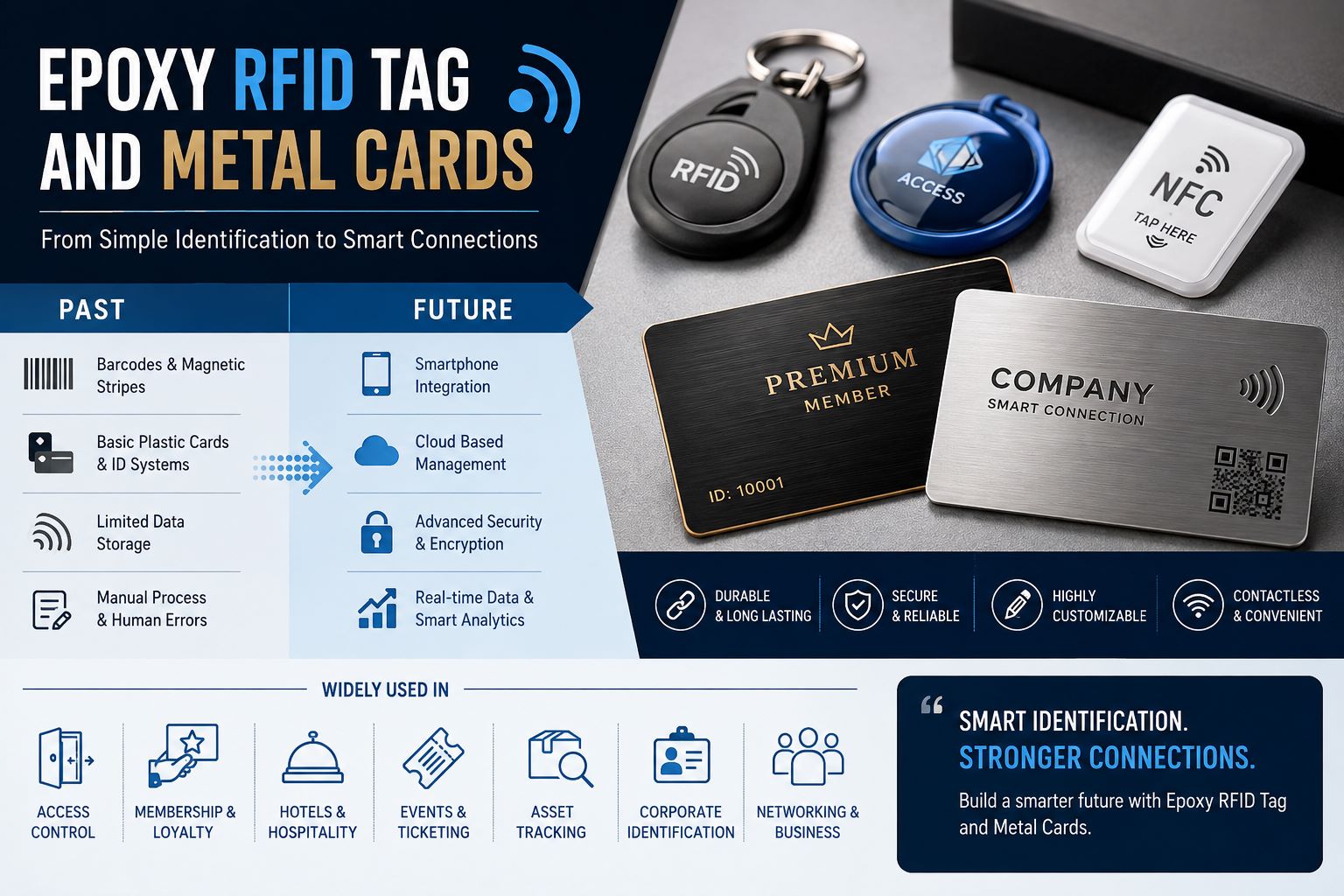
The way people identify, access, connect, and exchange information has changed considerably over the years. Printed passes, paper business cards, handwritten records, and magnetic cards once handled most identification needs. Today, contactless technology is creating faster and more convenient interactions. Products such as the Epoxy RFID tag and metal cards represent this shift from traditional physical identification toward connected digital experiences.
While RFID tags are commonly associated with identification and access, premium cards focus heavily on presentation and professional branding. Modern technology is gradually bringing these two areas together through RFID, NFC, QR codes, digital profiles, and cloud-connected platforms.
Before Smart Identification Became Common
For decades, identification depended largely on visible information. A person checked a printed card, an employee entered a number manually, or a barcode scanner retrieved basic stored information.
These methods worked, but they often required physical contact or manual processes.
Traditional systems included:
- Paper identification cards
- Printed membership cards
- Magnetic stripe cards
- Barcoded labels
- Plastic key tags
- Conventional business cards
As organizations became larger and operations more digital, they needed quicker ways to identify people and assets. This demand encouraged wider adoption of radio frequency identification.
The Journey of the Epoxy RFID Tag
Early RFID technology focused mainly on functionality rather than design. Tags were primarily expected to transmit an identification number that a compatible reader could recognize.
As RFID adoption expanded, manufacturers started developing tags for different environments, shapes, and user requirements.
The Epoxy RFID tag emerged as an attractive solution for applications where appearance and durability were both important. Its electronic component could provide contactless functionality, while the epoxy-covered exterior offered protection and customization opportunities.
Why Epoxy RFID Tags Became Popular
Organizations increasingly wanted identification products that did not look purely industrial.
An Epoxy RFID tag can be customized with visual elements such as branding, numbering, text, graphics, or QR codes, depending on product specifications.
Its compact form also makes it suitable for everyday applications including keychains, memberships, access systems, and loyalty programs.
The Shift From Identification to Interaction
The biggest change has been the role of the tag itself.
Earlier RFID applications largely answered one question: “What item or person is this?”
Modern applications can initiate a wider digital process. A tag interaction might support access verification, attendance recording, customer identification, equipment tracking, or retrieval of a digital record.
That development has transformed RFID from a simple identification technology into an important component of automation.
How Metal Cards Entered the Premium Market
The development of metal cards followed a different path.
Traditional business cards were designed to communicate basic information such as a person’s name, company, designation, telephone number, and address. Paper was convenient and economical, but businesses seeking a premium impression began experimenting with alternative materials.
Metal provided something noticeably different.
Its weight, texture, strength, and finish made the card feel more substantial. As manufacturing techniques improved, businesses gained access to customized engraving, precision cutting, distinctive finishes, and sophisticated surface treatments.
As a result, metal cards moved beyond exclusive luxury applications and entered mainstream professional branding.
Why Businesses Choose Metal Cards Today
A business card is often one of the first physical representations of a company that a potential customer receives.
Premium metal cards can create a distinctive impression while offering significantly different tactile characteristics from standard paper cards.
They are commonly considered for:
- Executive business networking
- VIP membership programs
- Premium customer programs
- Luxury brand promotions
- Corporate identification
- Special invitations
- NFC-enabled networking
The objective is increasingly not just to provide contact details but to create a memorable interaction.
Comparing Epoxy RFID Tags and Metal Cards
| Area | Epoxy RFID Tag | Metal Cards |
| Main Focus | Contactless identification | Premium presentation |
| Common Uses | Access, loyalty, attendance, tracking | Networking, membership, branding |
| Technology | RFID/NFC | NFC or QR integration possible |
| Custom Branding | Yes | Yes |
| Durability | Designed for frequent handling | Strong physical construction |
| Digital Integration | High | Growing rapidly |
| User Experience | Quick contactless interaction | Premium physical and digital interaction |
Choosing between them should therefore depend on the intended application rather than appearance alone.
Today’s Smart Identification Environment
Modern organizations increasingly expect physical identification products to work with digital systems.
For example, an Epoxy RFID tag used by an employee could interact with an access management platform. A membership tag might retrieve an account record. A tag attached to an asset could support inventory management.
At the same time, digitally enabled metal cards can connect a physical networking experience with online information.
Instead of relying exclusively on information printed permanently on the surface, an NFC or QR-enabled card can direct users toward digital content.
This physical-to-digital connection is becoming one of the most important developments across the identification industry.
What the Future Holds for Epoxy RFID Tags
The next generation of RFID products is likely to become increasingly connected to larger digital ecosystems.
Greater Integration With Smart Systems
Future Epoxy RFID tag applications could work alongside cloud software, Internet of Things platforms, mobile applications, automated access systems, and real-time management dashboards.
Businesses may increasingly use RFID-generated information to understand how assets, employees, equipment, or authorized visitors interact with physical environments.
Potential Future Developments
Several areas could influence future RFID adoption:
- Improved chip efficiency
- Enhanced authentication methods
- Better mobile compatibility
- Cloud-based management
- Automated asset monitoring
- More flexible customization
- Integration with IoT infrastructure
Security and privacy will remain important considerations whenever identification information connects to digital platforms.
The Future Direction of Metal Cards
Premium cards are also becoming smarter.
The future of metal cards may involve combining sophisticated physical design with convenient digital functionality. NFC technology can potentially turn a card into a gateway to a digital profile.
A professional could tap the card against a compatible smartphone and provide access to selected contact information, a website, portfolio, booking page, catalogue, or professional profile.
The advantage is flexibility. Digital information can potentially change while the physical card remains the same, depending on how the underlying platform is configured.
Personalization Will Drive Future Demand
Mass-produced identification products are gradually giving way to more customized experiences.
Businesses increasingly want products reflecting their brand identity. This creates opportunities for personalized colors, shapes, printing, engraving, finishes, numbering, and digital destinations.
An Epoxy RFID tag could represent a brand while providing functional access. Similarly, metal cards could combine a distinctive physical design with an interactive digital destination.
This combination of personalization and technology is likely to remain an important market direction.
Frequently Asked Questions
What is an Epoxy RFID tag?
An Epoxy RFID tag combines RFID functionality with a protective epoxy-covered exterior suitable for identification and contactless applications.
What is RFID used for?
RFID is commonly used for identification, access management, inventory, attendance, asset tracking, membership, and other automated processes.
Why is epoxy used on RFID tags?
Epoxy provides surface protection while creating a smooth appearance suitable for customized branding and frequent handling.
Can epoxy RFID tags include company logos?
Yes. Many customized tags can feature logos, text, graphics, numbering, or other branding elements.
What are metal cards commonly used for?
Metal cards are commonly used for premium business cards, memberships, networking, invitations, identification, and luxury branding.
Can metal cards support NFC?
Some specially designed cards can incorporate NFC technology, although compatibility depends on card construction and technical design.
Are RFID and NFC identical?
No. NFC belongs to the broader family of RFID technologies and typically operates over a very short communication distance.
Can an RFID tag be used for access control?
Yes. Compatible RFID tags and readers are widely used as components within electronic access management systems.
Can metal cards replace traditional business cards?
They can provide a premium alternative, particularly where durability, differentiation, and brand presentation are priorities.
What is the future of smart identification?
Future systems will increasingly combine RFID, NFC, mobile devices, cloud platforms, automation, IoT, and digital identity technologies.