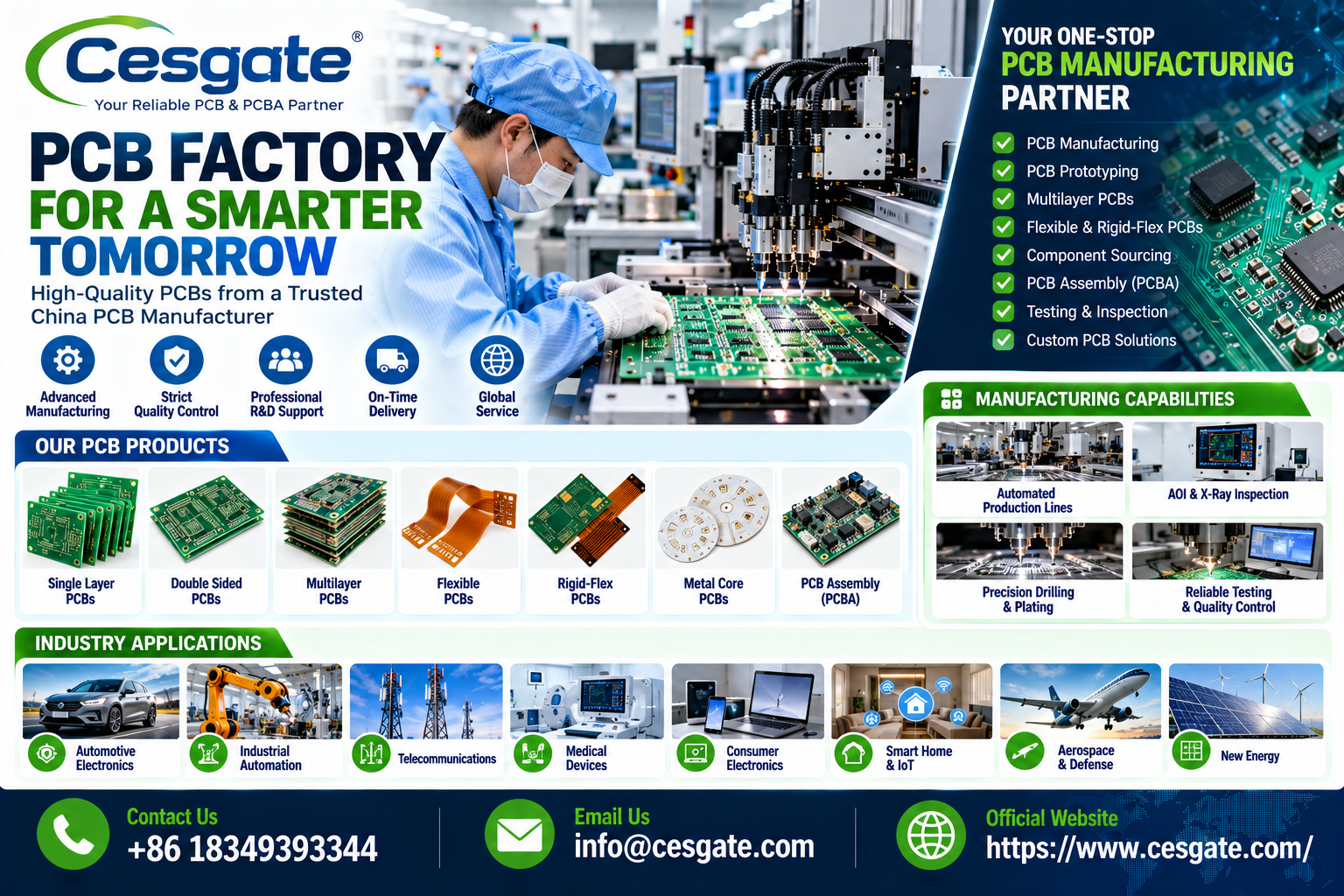
Printed circuit board manufacturing plays an essential role in supporting modern electronics, from smart home devices and industrial controllers to communication equipment and automotive systems.
As electronic products become more compact and technically demanding, attention is shifting towards the engineering capabilities and manufacturing consistency of circuit board suppliers.
A professional pcb factory must manage complex fabrication processes, material requirements, dimensional accuracy, and electrical performance to produce boards that meet customer specifications.
Meanwhile, a reliable china pcb manufacturer can provide access to specialised fabrication capabilities, multilayer board production, and customised manufacturing solutions.
For electronics companies and product developers, understanding the technical processes behind circuit board fabrication is essential when evaluating manufacturing partners.
Why PCB Factory Capabilities Matter
A printed circuit board is more than a surface used to connect electronic components.
Its internal copper pathways, insulating materials, drilled holes, and protective finishes influence electrical performance and product reliability.
Manufacturing defects can affect conductivity, signal integrity, and mechanical durability.
For example, insufficient copper plating inside drilled holes may compromise electrical connections between circuit layers.
Similarly, unsuitable material selection can create problems under demanding operating conditions.
A manufacturing facility must therefore maintain appropriate process controls throughout fabrication.
What Is a PCB Factory?
A pcb factory is a manufacturing facility that produces printed circuit boards from approved electronic design files and material specifications.
The fabrication process generally includes preparing copper-clad materials, transferring circuit patterns, etching unwanted copper, drilling holes, applying conductive plating, and adding protective surface finishes.
Depending on its capabilities, a factory may produce single-sided, double-sided, multilayer, rigid, or flexible circuit boards.
However, not every manufacturing facility supports every technology.
Customers should confirm technical capabilities before submitting complex designs.
Understanding a China PCB Manufacturer
A china pcb manufacturer is a company operating in China that provides printed circuit board fabrication and related manufacturing services.
These manufacturers may support different production requirements, ranging from simple electronic boards to complex multilayer designs.
Available capabilities can include controlled-impedance fabrication, specialised board materials, fine-line circuit patterns, and advanced drilling processes.
However, manufacturing quality depends on the individual supplier’s equipment, technical expertise, inspection procedures, and process controls.
Businesses should evaluate suppliers using technical evidence rather than assuming that all manufacturers offer identical capabilities.
Why PCB Material Selection Is Important
Circuit board materials influence mechanical strength, insulation performance, thermal behaviour, and signal transmission.
FR-4 is commonly used in conventional rigid PCB applications.
However, certain products may require specialised laminates with different electrical or thermal properties.
For example, high-frequency circuits may benefit from materials selected for suitable dielectric characteristics.
Industrial applications may also require additional attention to operating temperature and dimensional stability.
Engineers should define material requirements according to the product’s intended operating conditions.
Selecting unsuitable materials can compromise performance even when the circuit pattern is manufactured correctly.
Understanding Multilayer PCB Construction
Multilayer printed circuit boards contain conductive copper layers separated by insulating materials.
These layers are arranged to support circuit routing, power distribution, and electrical performance.
Manufacturing requires accurate alignment and suitable lamination controls.
Layer misalignment can affect drilled connections and reduce manufacturing reliability.
The selected stack-up also influences electrical characteristics.
Engineers should confirm layer arrangements, material thicknesses, and relevant electrical requirements before fabrication.
Important PCB Fabrication Processes
| Manufacturing Process | Main Purpose | Quality Consideration |
| Material Preparation | Prepare suitable laminate panels | Material consistency |
| Circuit Imaging | Transfer conductive patterns | Pattern accuracy |
| Etching | Remove unwanted copper | Conductor dimensions |
| Drilling | Create required holes | Position and diameter |
| Copper Plating | Establish conductive connections | Plating integrity |
| Lamination | Bond multilayer structures | Layer alignment |
| Surface Finishing | Protect exposed copper surfaces | Finish suitability |
Each stage contributes to the final board’s functionality and manufacturing quality.
Why Controlled Impedance Matters
Certain electronic products transmit signals that require carefully managed electrical characteristics.
Controlled impedance refers to maintaining specified impedance values along relevant circuit traces.
This can be particularly important for high-speed digital and radio-frequency applications.
PCB manufacturers may need to control conductor width, spacing, dielectric thickness, and material properties.
Impedance testing can help evaluate whether fabricated boards meet relevant design requirements.
However, the required testing approach depends on the product specifications.
Customers should communicate controlled-impedance requirements clearly when requesting manufacturing quotations.
How Thermal Requirements Influence PCB Design
Electronic components generate heat during operation.
The PCB structure can influence how heat moves through an electronic assembly.
Depending on the application, designers may use copper areas, thermal vias, or specialised substrate materials to support heat management.
However, these features must be designed according to actual thermal and electrical requirements.
Manufacturing teams should confirm whether the selected board construction supports the intended design.
For power electronics and industrial equipment, inadequate thermal planning may contribute to reliability problems.
Collaboration between product designers and fabrication engineers helps address these concerns.
PCB Surface Finishes and Their Applications
Surface finishes protect exposed copper and provide suitable surfaces for subsequent soldering.
Common options include hot air solder levelling, electroless nickel immersion gold, and selected organic protective coatings.
Each finish has different characteristics involving flatness, storage conditions, process compatibility, and cost.
For example, certain fine-pitch applications may require careful consideration of surface flatness.
No single finish is ideal for every circuit board.
Manufacturers should recommend finishes according to assembly requirements, component specifications, and customer preferences.
How Businesses Can Evaluate PCB Factory Quality
Manufacturing capability should be supported by appropriate quality management procedures.
Buyers can review inspection methods, material records, electrical testing capabilities, and documented acceptance criteria.
Relevant industry standards may help define workmanship requirements, depending on the application.
However, customers should verify certification claims directly with suppliers.
Important considerations include:
- Manufacturing equipment and supported technologies.
- Board thickness and copper weight capabilities.
- Drilling accuracy and minimum feature dimensions.
- Inspection and electrical testing procedures.
- Material documentation and traceability.
- Engineering communication and quotation transparency.
An appropriate supplier should demonstrate that its processes match the customer’s technical specifications.
Frequently Asked Questions (FAQs)
1. What does a PCB factory manufacture?
A PCB factory manufactures printed circuit boards containing conductive pathways and insulating layers used to support electronic circuits.
2. What services does a China PCB manufacturer provide?
Depending on capabilities, services may include PCB fabrication, multilayer construction, specialised materials, surface finishing, inspection, and electrical testing.
3. What is the difference between single-layer and multilayer PCB manufacturing?
Single-layer boards use one conductive circuit layer, while multilayer boards contain several conductive layers separated by insulating materials.
4. Why is PCB material selection important?
Material selection affects electrical insulation, thermal characteristics, mechanical stability, and overall circuit board performance.
5. How can buyers choose a reliable PCB manufacturer?
Buyers should assess fabrication capabilities, engineering support, quality controls, material specifications, inspection methods, and production documentation.
Media Contact
Department: PCB Manufacturing and Technical Enquiries
Business Enquiries: PCB Factory, China PCB Manufacturer, Multilayer PCB, Custom PCB Fabrication, Circuit Board Production, and Electronics Manufacturing Solutions.
Phone: +86 18349393344
Email: info@cesgate.com
Official Website: https://www.cesgate.com/