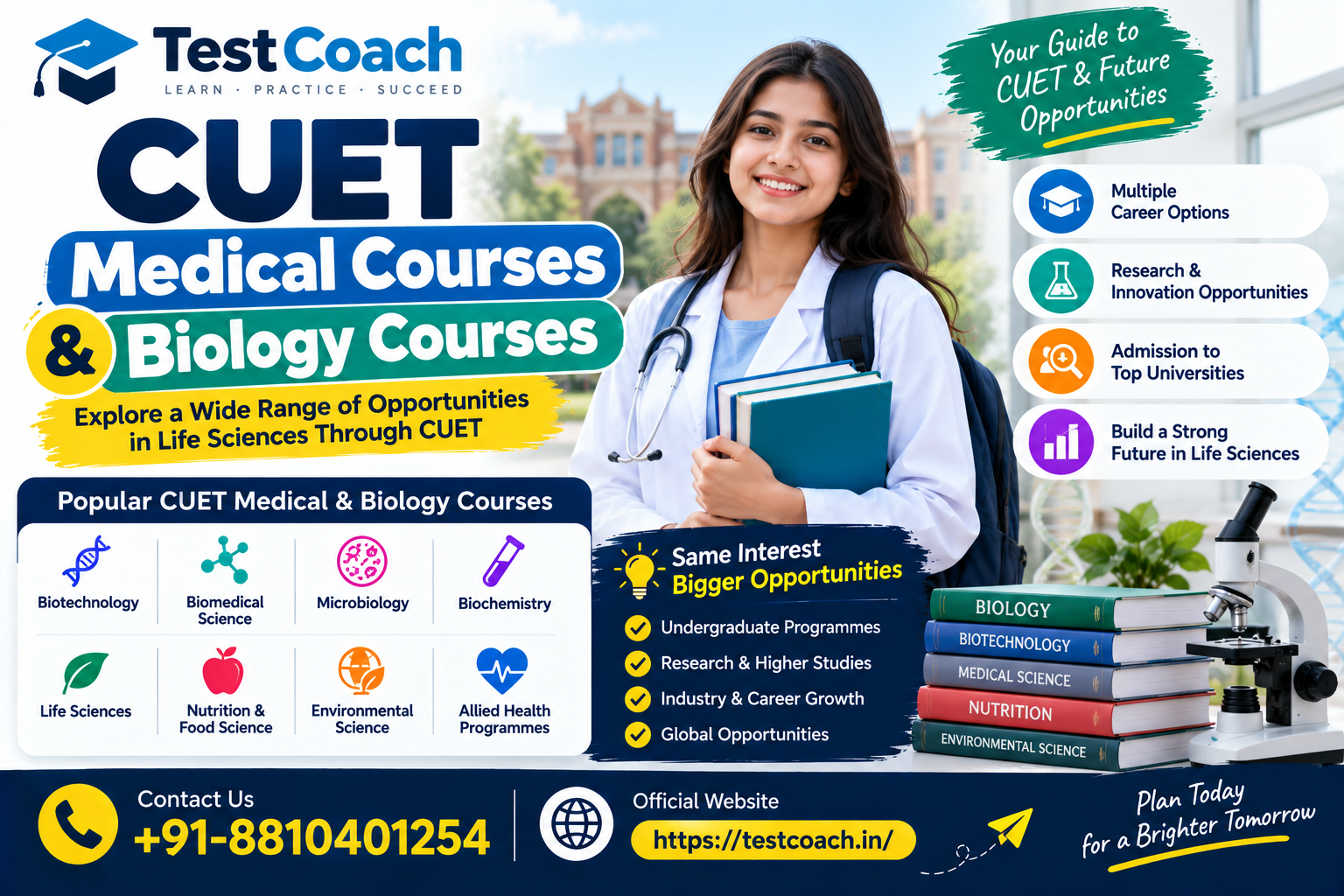
As students explore higher education opportunities in healthcare, biological sciences, and medical research, interest in CUET Medical Courses and CUET Biology Courses continues to shape undergraduate admission planning. The Common University Entrance Test (CUET-UG) provides a pathway to selected undergraduate science and healthcare-related programs at participating universities, helping students explore careers beyond conventional medical degrees.
With growing interest in biotechnology, biomedical research, microbiology, nutrition, and life sciences, students are increasingly examining how CUET can support their academic ambitions.
However, understanding eligibility requirements, university-specific admission policies, and career opportunities remains essential before selecting a course.
Understanding CUET Medical Courses and Their Academic Scope
CUET Medical Courses generally refer to healthcare-related and allied science undergraduate programs for which participating universities may consider CUET-UG scores.
Unlike traditional medical degrees such as MBBS and BDS, which require NEET-UG for admission in India, CUET offers opportunities in several biological and health science disciplines.
Students interested in healthcare without pursuing a conventional medical degree can explore programs involving laboratory science, biotechnology, biomedical studies, and nutrition.
Popular options may include:
- B.Sc. Biotechnology
- B.Sc. Biomedical Science
- B.Sc. Microbiology
- B.Sc. Biochemistry
- B.Sc. Life Sciences
- B.Sc. Nutrition and Dietetics
- B.Sc. Biological Sciences
- Selected allied health programs, depending on university eligibility rules
Course availability and admission criteria vary among institutions.
CUET Biology Courses Expand Opportunities in Life Sciences
CUET Biology Courses provide potential academic pathways for students interested in understanding living organisms, biological processes, genetics, human physiology, and environmental systems.
Biology-based undergraduate programs develop scientific knowledge and practical laboratory skills relevant to research institutions, healthcare organizations, biotechnology companies, and pharmaceutical industries.
Students who have completed Class 12 with relevant science subjects may explore suitable programs according to individual university requirements.
Important disciplines include:
Biotechnology: Focuses on biological technology, genetic applications, molecular biology, and bioprocessing.
Microbiology: Examines microorganisms and their applications in medicine, food science, agriculture, and environmental research.
Biochemistry: Explores chemical processes within living organisms, including metabolism, enzymes, and molecular interactions.
Zoology: Covers animal biology, physiology, genetics, biodiversity, and ecological relationships.
Botany: Studies plant structure, development, classification, physiology, and environmental interactions.
Biomedical Science: Introduces biological principles relevant to human health, disease mechanisms, and laboratory investigation.
These programs can prepare students for specialized postgraduate education and scientific careers.
Why Students Are Exploring Biology-Based Healthcare Careers
Healthcare involves more than clinical diagnosis and treatment. Research laboratories, diagnostic services, pharmaceutical development, and biotechnology organizations also depend on professionals trained in biological sciences.
This broader professional landscape makes CUET Medical Courses relevant for students seeking alternative opportunities within healthcare-related fields.
Biology-based degrees may support careers in:
- Medical and biomedical research
- Clinical and diagnostic laboratories
- Pharmaceutical research and development
- Biotechnology manufacturing
- Food quality testing and analysis
- Environmental and biological research
- Academic teaching and scientific education
Some careers require postgraduate qualifications, professional certification, or additional specialized training.
Eligibility and Admission Requirements for CUET Biology Courses
Students planning to pursue CUET Biology Courses should carefully review the admission requirements of their preferred universities.
Eligibility commonly depends on Class 12 subjects, minimum academic qualifications, university-specific combinations, and applicable entrance examination scores.
Before applying, students should:
- Identify universities offering their preferred undergraduate programs.
- Verify required CUET-UG subjects and eligibility conditions.
- Review course-specific admission procedures.
- Check examination registration and counseling schedules.
- Prepare documentation according to institutional guidelines.
Biology, Chemistry, Physics, and other relevant subjects may be important for particular programs. However, the required combination differs by course and institution.
Admission through CUET is not automatically available for every medical or allied health program.
Effective Preparation Strategies for CUET Medical Courses
Preparation for CUET Medical Courses requires conceptual clarity, consistent revision, and familiarity with the examination structure.
Students should focus on prescribed subject syllabi while practicing analytical and application-based questions.
A practical preparation strategy includes reviewing NCERT concepts where applicable, preparing chapter-wise notes, attempting mock examinations, and analyzing incorrect answers.
Students preparing for biology-related programs should strengthen their understanding of genetics, reproduction, ecology, biotechnology, physiology, and cellular processes according to the applicable examination syllabus.
Time management also plays an important role. Regular practice can improve accuracy and help students become comfortable with examination conditions.
Career Prospects After CUET Biology Courses
Graduates of CUET Biology Courses may pursue employment or advanced education depending on their specialization.
Biotechnology graduates can explore laboratory and bioprocessing roles, while microbiology students may pursue opportunities in quality assurance, research support, and microbiological testing.
Biochemistry graduates can develop expertise in molecular science, biochemical analysis, and laboratory research.
Students interested in advanced scientific careers may continue with M.Sc., research-oriented postgraduate programs, or doctoral studies.
Professional opportunities depend on qualifications, practical experience, institutional requirements, and the skills developed throughout undergraduate education.
Importance of Making an Informed Course Selection
Selecting an appropriate degree requires more than comparing course names.
Students should evaluate university recognition, laboratory infrastructure, curriculum relevance, practical training opportunities, faculty expertise, and future educational pathways.
Families should also distinguish between programs leading toward regulated clinical professions and those designed for scientific or research careers.
CUET Medical Courses can support meaningful healthcare-related ambitions, but they should not be confused with direct admission pathways to MBBS or BDS.
Frequently Asked Questions (FAQs)
1. What are CUET Medical Courses?
They are healthcare-related or biological science undergraduate programs that may accept CUET-UG scores at participating universities.
2. Can students pursue MBBS through CUET?
No. MBBS admission in India requires NEET-UG under applicable admission regulations.
3. What are popular CUET Biology Courses?
Popular options include biotechnology, microbiology, biochemistry, zoology, botany, biomedical science, and life sciences.
4. Is Biology compulsory for every CUET medical-related program?
Not necessarily. Subject eligibility depends on the selected course and university.
5. Can PCB students apply for CUET?
Yes. Students with Physics, Chemistry, and Biology backgrounds can apply for eligible programs according to university requirements.
6. Are CUET Biology Courses suitable for research careers?
Yes. Relevant degrees can provide a foundation for research careers, particularly when followed by advanced qualifications and practical training.
7. Does CUET guarantee admission to medical-related courses?
No. Admission depends on university participation, eligibility, merit, seat availability, and counseling procedures.
8. Can students pursue biotechnology after Class 12?
Yes. Eligible students can apply to universities offering biotechnology undergraduate programs through their accepted admission pathways.
9. What careers are available after biological science degrees?
Graduates may explore laboratory research, biotechnology, pharmaceutical operations, quality testing, and further academic study.
10. How should students prepare for CUET Biology?
Students should review the applicable syllabus, strengthen fundamental concepts, solve practice questions, and attempt regular mock tests.
Media Contact
Department: Education and Academic Guidance
Media Inquiries: Through official organizational communication channels
Location: India
Email: support@testcoach.in
Contact: +91-8810401254
Official Website: https://testcoach.in/