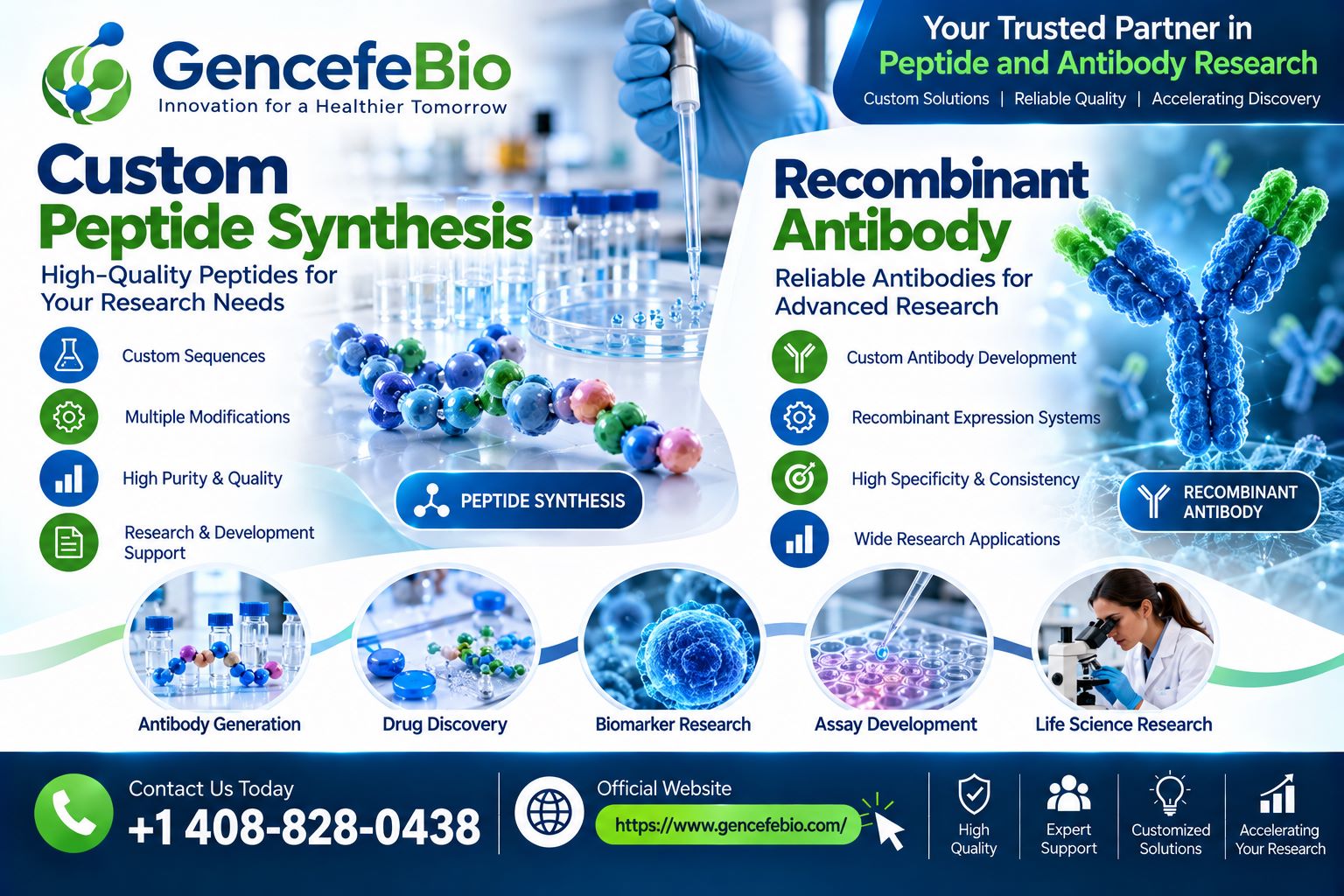
As biotechnology, pharmaceutical research, and life science laboratories continue exploring advanced molecular technologies, demand for reliable research materials remains important. Custom peptide synthesis supports scientists developing sequence-specific peptides for research applications, while recombinant antibody technology provides tools for protein detection, molecular analysis, and experimental development.
From molecular biology and immunology to drug discovery and protein research, these technologies contribute to modern laboratory workflows.
Researchers increasingly consider sequence accuracy, molecular purity, antibody specificity, and quality-control documentation when selecting materials for scientific experiments.
Growing Importance of Custom Peptide Synthesis in Biotechnology
Peptides are short chains of amino acids that perform numerous biological functions. They are widely studied in molecular signaling, protein interactions, immunological research, and biochemical investigations.
Custom peptide synthesis is the laboratory production of peptides based on specifically requested amino acid sequences.
Unlike purchasing standard catalog peptides, researchers can request sequences designed for particular experiments.
Common research applications include:
- Drug discovery and early-stage research.
- Protein interaction studies.
- Antigen and epitope investigations.
- Biomarker-related research.
- Enzyme activity studies.
- Molecular biology experiments.
The selection of appropriate peptides can influence assay development and the interpretation of research results.
What Is Custom Peptide Synthesis?
Custom peptide synthesis refers to the controlled chemical production of peptides according to a specified amino acid sequence.
One widely used production method is solid-phase peptide synthesis, commonly known as SPPS.
In this method, amino acids are added sequentially to a growing peptide chain attached to a solid support.
After assembly, the peptide is cleaved, processed, and purified according to the requested specifications.
Important Customization Options
Peptide Sequence: Researchers can specify amino acid sequences for particular studies.
Peptide Length: Production feasibility depends partly on sequence length and complexity.
Chemical Modifications: Certain peptides may incorporate phosphorylation, acetylation, biotinylation, or fluorescent labels.
Purity Requirements: Different research applications require different peptide purity levels.
Quantity Requirements: Production scale depends on experimental demand and manufacturing capabilities.
Complex sequences may require additional development and analytical evaluation.
Understanding Recombinant Antibody Technology
A recombinant antibody is an antibody produced through recombinant DNA technology using a defined genetic sequence.
Unlike conventional antibody production, which often relies on repeated biological immunization or cell-line-based processes, recombinant approaches enable selected antibody sequences to be expressed in suitable host cells.
These antibodies may be designed or produced in different formats, including full-length immunoglobulins and antibody fragments.
Recombinant technology allows researchers to work with defined molecular sequences and may improve consistency when production and quality controls are properly managed.
Common Applications
- Immunological research.
- Protein detection.
- Cell biology investigations.
- ELISA-based experiments.
- Flow cytometry.
- Immunofluorescence studies.
- Selected diagnostic research applications.
Antibody suitability must be validated for the intended experimental method.
Key Benefits of Custom Peptide Synthesis
1. Sequence-Specific Development
Researchers can obtain peptides corresponding to selected regions of proteins or other experimental targets.
2. Flexible Research Design
Peptides can be designed for specialized biochemical and molecular investigations.
3. Chemical Modification Options
Specified modifications may support labeling, conjugation, or particular experimental functions.
4. Analytical Characterization
Suitable testing helps confirm peptide identity and assess purity.
5. Application-Specific Production
Researchers can specify relevant quantities, purity targets, and handling requirements.
These benefits depend on production feasibility and the supplier’s technical capabilities.
Why Recombinant Antibodies Matter in Modern Research
Recombinant antibody production allows researchers to use defined antibody sequences in suitable expression systems.
This can support continuity in certain research workflows and reduce dependence on variable biological sources.
However, sequence consistency alone does not guarantee equivalent performance across every application.
Expression conditions, purification procedures, formulation, and validation methods remain important.
Researchers should evaluate antibody specificity, sensitivity, cross-reactivity, and suitability for the intended experimental system.
Custom Peptide Synthesis vs Recombinant Antibody: Key Differences
Although both technologies support biotechnology research, their functions differ.
| Feature | Custom Peptide Synthesis | Recombinant Antibody |
| Product | Chemically synthesized peptide | Expressed antibody or antibody fragment |
| Main technology | Chemical peptide synthesis | Recombinant DNA expression |
| Common purpose | Sequence-specific research material | Molecular recognition and detection |
| Quality evaluation | Identity, purity, composition | Identity, binding performance, purity |
| Research applications | Protein studies, assays, peptide research | Immunology, protein detection, cell analysis |
These technologies can also complement each other in immunological research.
For example, a synthesized peptide may be used in experiments investigating the binding characteristics of an antibody.
Quality Control in Peptide and Antibody Research
Scientific laboratories require materials with appropriate analytical documentation.
For synthesized peptides, commonly used characterization techniques include high-performance liquid chromatography and mass spectrometry.
These methods help assess purity and molecular identity.
For recombinant antibody products, relevant evaluations may involve:
- Protein identity and integrity.
- Purity and aggregation.
- Binding specificity.
- Binding activity under defined assay conditions.
- Concentration and formulation.
- Storage stability where applicable.
The precise testing requirements depend on research use and product specifications.
How to Choose a Biotechnology Research Material Supplier
Selecting suitable research materials involves more than comparing prices.
Researchers should evaluate technical capabilities, documentation, available modifications, analytical testing, and delivery requirements.
For custom peptide synthesis, buyers should provide the target sequence, required modifications, purity expectations, quantity, and intended application.
For a recombinant antibody, important details include the antigen target, antibody format, host expression system, specificity data, and validation information.
Research-use-only materials should not be assumed suitable for clinical diagnosis or therapeutic administration.
Frequently Asked Questions (FAQs)
1. What is custom peptide synthesis?
It is the laboratory production of a peptide according to a specific amino acid sequence requested for research or other suitable applications.
2. What is a recombinant antibody?
It is an antibody produced using recombinant DNA technology, typically from a defined antibody sequence expressed in suitable host cells.
3. What is solid-phase peptide synthesis?
SPPS is a chemical synthesis method in which amino acids are sequentially assembled into a peptide chain attached to a solid support.
4. Can custom peptides include chemical modifications?
Yes. Depending on feasibility, peptides may include modifications such as biotinylation, acetylation, phosphorylation, or fluorescent labeling.
5. What is the difference between recombinant and conventional antibodies?
Recombinant antibodies are produced from defined genetic sequences, while conventional approaches commonly involve immunization and biological antibody-producing systems.
6. How is peptide purity tested?
High-performance liquid chromatography is commonly used to assess peptide purity, often alongside mass spectrometry for identity confirmation.
7. Where are recombinant antibodies used?
They are used in immunological research, protein detection, ELISA, flow cytometry, immunofluorescence, and other suitable laboratory applications.
8. Can peptides be used in antibody research?
Yes. Suitable peptides can serve as antigens, assay components, or research materials for studying antibody interactions.
9. What affects peptide synthesis cost?
Cost depends on sequence length, complexity, modifications, requested purity, quantity, and production requirements.
10. What should researchers verify before ordering biotechnology materials?
They should review molecular specifications, analytical data, research compatibility, storage requirements, available documentation, and supplier capabilities.
Media Contact
Industry: Biotechnology, Life Sciences & Molecular Research
Product Enquiries: Custom Peptide Synthesis, Recombinant Antibodies & Research Materials
Contact Number: +1 408-828-0438
Email: gene@gencefebio.com
Official Website: https://www.gencefebio.com/