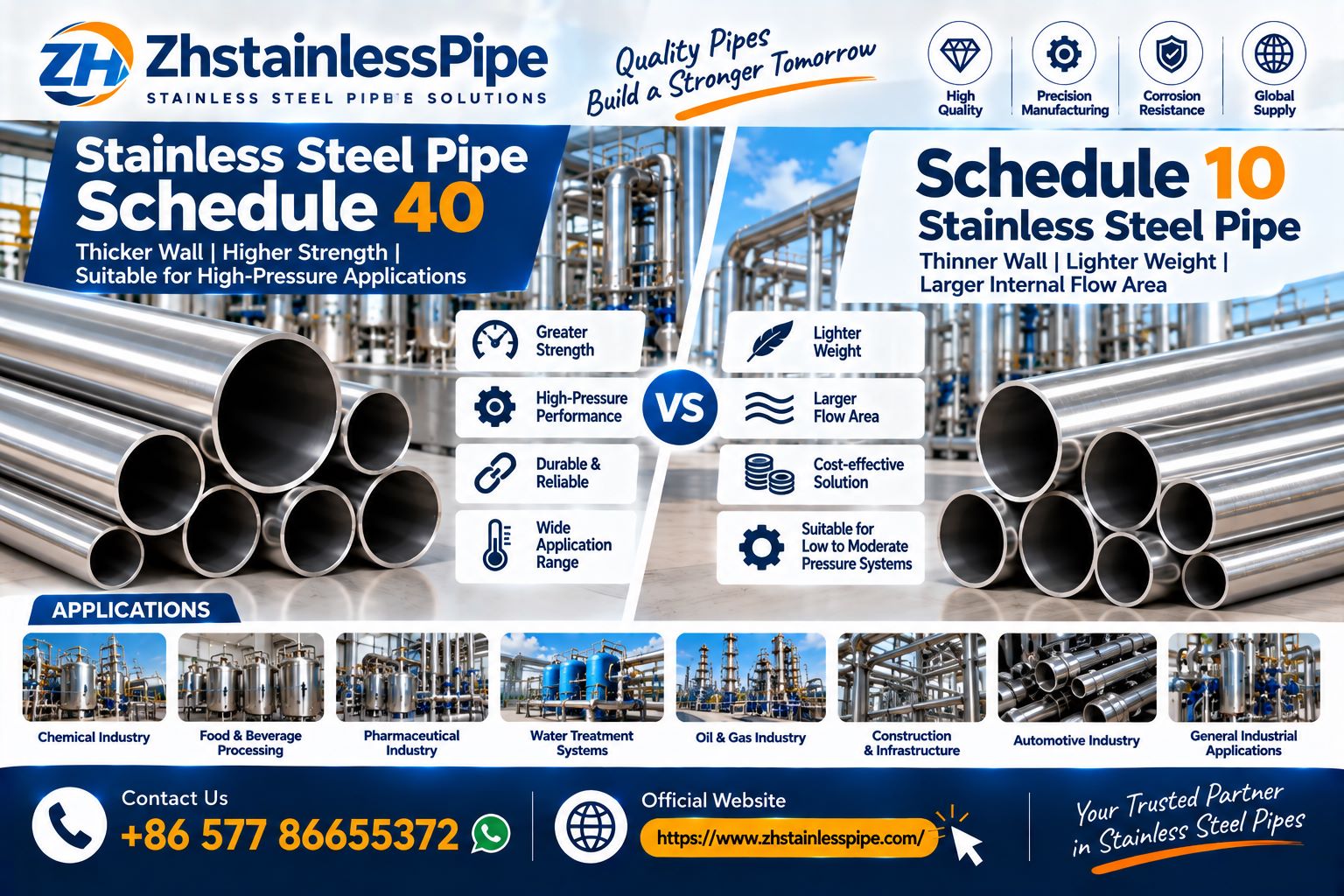
As industrial infrastructure, manufacturing facilities, and fluid-processing systems demand reliable piping materials, selecting the correct stainless steel pipe specification has become an important engineering consideration. Stainless Steel Pipe Schedule 40 is commonly considered for applications requiring a relatively thicker pipe wall, while Schedule 10 Stainless Steel Pipe provides a lighter-wall alternative for suitable industrial installations.
From chemical processing and water treatment to food manufacturing and mechanical engineering, stainless steel piping supports a wide range of operational requirements.
Engineers and procurement professionals must understand differences in pipe dimensions, wall thickness, material grades, pressure design, and installation requirements before selecting a suitable piping solution.
Growing Importance of Stainless Steel Pipe Schedule 40
Stainless Steel Pipe Schedule 40 refers to stainless steel pipe manufactured with wall dimensions corresponding to the applicable Schedule 40 designation.
For stainless steel piping, the designation Schedule 40S is commonly used under ASME B36.19M, while Schedule 40 is also associated with the broader pipe dimension system.
The exact wall thickness depends on the nominal pipe size and applicable dimensional standard.
Schedule 40 or 40S piping is frequently considered for:
- Industrial fluid-transfer systems.
- Water distribution equipment.
- Chemical processing installations.
- Mechanical piping networks.
- Manufacturing facilities.
- Commercial and industrial infrastructure.
Engineers should evaluate the complete piping system rather than selecting products based on schedule designation alone.
What Is Stainless Steel Pipe Schedule 40?
Stainless Steel Pipe Schedule 40 describes a pipe wall-thickness category used in standard pipe sizing systems.
A schedule number does not directly specify pressure capacity. Instead, it identifies wall dimensions associated with the pipe’s nominal size.
The actual allowable pressure depends on several factors, including material strength, operating temperature, corrosion allowance, pipe dimensions, and the applicable engineering code.
Important Characteristics
Wall Thickness: Schedule 40S commonly provides a thicker wall than Schedule 10S for the same nominal pipe size.
Mechanical Suitability: The increased wall thickness may benefit applications requiring additional mechanical robustness.
Material Options: Stainless steel grades such as 304, 304L, 316, and 316L may be available.
Application Flexibility: Different manufacturing methods, dimensions, and finishes support various industrial requirements.
The final product should be selected according to the applicable design specifications.
Understanding Schedule 10 Stainless Steel Pipe
Schedule 10 Stainless Steel Pipe refers to piping manufactured with relatively thin walls compared with many heavier-wall schedule options.
In stainless steel piping, the Schedule 10S designation is commonly used.
Because it generally contains less metal for the same nominal diameter and material, Schedule 10S pipe may offer lower weight and material usage.
Typical applications can include:
- Suitable low-pressure piping systems.
- Water treatment equipment.
- Selected food-processing installations.
- Industrial drainage systems.
- Compatible process-fluid transfer.
- Mechanical and utility piping.
However, a thin-wall pipe should not automatically be classified as suitable only for low-pressure use. Its allowable operating conditions must be established through proper engineering design.
Stainless Steel Pipe Schedule 40 vs Schedule 10: Key Differences
The following comparison highlights common distinctions.
| Feature | Schedule 40 / 40S Pipe | Schedule 10 / 10S Pipe |
| Wall thickness | Generally thicker | Generally thinner |
| Weight | Usually heavier at the same size | Usually lighter at the same size |
| Material consumption | Generally higher | Generally lower |
| Internal diameter | Often smaller at the same outside diameter | Often larger at the same outside diameter |
| Pressure capability | Must be calculated for the application | Must be calculated for the application |
| Installation considerations | Greater material weight | Reduced handling weight |
Actual dimensions must be confirmed using the relevant pipe specification.
Benefits of Stainless Steel Pipe Schedule 40
1. Greater Wall Thickness
A thicker pipe wall may provide additional mechanical robustness in suitable applications.
2. Industrial Versatility
Schedule 40S pipes can be considered for various utility and process-piping systems.
3. Material Grade Selection
Buyers can select suitable stainless steel grades according to corrosion resistance and mechanical requirements.
4. Fabrication Options
Depending on specification, pipes can be cut, welded, and assembled using appropriate procedures.
5. Long-Term Service Planning
Correctly specified piping can support dependable operation when combined with suitable installation, inspection, and maintenance practices.
Advantages of Schedule 10 Stainless Steel Pipe
The lighter-wall construction of Schedule 10 Stainless Steel Pipe can offer practical advantages in suitable installations.
Reduced weight may simplify handling and support design decisions where equipment loads matter.
For the same nominal pipe size and outside diameter, a thinner wall can provide a larger internal flow area.
It may also reduce the quantity of stainless steel material required.
These benefits must be considered alongside applicable pressure, temperature, corrosion, and fabrication requirements.
Common Stainless Steel Grades Used in Industrial Pipes
Grade 304
A widely used austenitic stainless steel providing good corrosion resistance in many general industrial environments.
Grade 304L
A low-carbon variation frequently considered for welded fabrication.
Grade 316
Contains molybdenum, which can improve resistance to certain corrosive conditions compared with grade 304.
Grade 316L
A low-carbon grade commonly considered for welded components and selected corrosion-sensitive applications.
Material selection should reflect the actual fluid chemistry and operating environment.
How to Select the Correct Stainless Steel Pipe Schedule
Industrial buyers should evaluate multiple factors before finalizing a pipe specification.
- Operating Pressure: Determine design pressure and applicable engineering requirements.
- Temperature Range: Consider how operating temperature affects allowable material stress.
- Pipe Diameter: Confirm nominal size, outside diameter, and wall thickness.
- Fluid Compatibility: Select a suitable stainless steel grade for the transferred medium.
- Manufacturing Method: Evaluate welded or seamless pipe requirements.
- Installation Conditions: Consider support spacing, handling, joining methods, and mechanical loads.
- Applicable Standards: Confirm dimensional and material specifications.
Relevant specifications may include ASME B36.19M for stainless steel pipe dimensions and ASTM A312 for certain austenitic stainless steel pipe products.
Manufacturing Quality and Inspection Requirements
Industrial stainless steel pipes should undergo appropriate quality-control procedures.
Depending on the required specification, these may include dimensional inspection, material identification, mechanical testing, weld examination, and pressure-related testing.
Buyers should request appropriate material test certificates and verify that pipe markings correspond to the ordered grade and dimensions.
Quality documentation can help establish traceability and support technical acceptance.
Frequently Asked Questions (FAQs)
1. What is Stainless Steel Pipe Schedule 40?
It refers to a standard wall-thickness designation for stainless steel pipes. Schedule 40S is commonly used for stainless steel under ASME B36.19M.
2. What is Schedule 10 Stainless Steel Pipe?
It refers to a thinner-wall pipe category, commonly designated Schedule 10S in stainless steel piping specifications.
3. Which pipe has a thicker wall, Schedule 40 or Schedule 10?
For the same nominal pipe size, Schedule 40S generally has a thicker wall than Schedule 10S.
4. Is Schedule 40 suitable for high-pressure systems?
It may be suitable for certain pressure applications, but allowable pressure must be established through engineering calculations and applicable codes.
5. Is Schedule 10 stainless steel pipe suitable for industrial use?
Yes. It can be used in industrial systems where its dimensions and mechanical characteristics satisfy the design requirements.
6. What is the difference between Schedule 40 and Schedule 40S?
The designations relate to different dimensional standards, and wall thicknesses may differ for certain pipe sizes.
7. Which stainless steel grades are commonly available?
Common grades include 304, 304L, 316, and 316L, depending on product specifications.
8. Can Schedule 10 stainless steel pipes be welded?
Yes, provided the pipe material and joining procedure are suitable for the intended application.
9. Does a thicker pipe always provide better performance?
No. Performance depends on operating conditions, material grade, installation quality, and engineering requirements.
10. What should buyers check before ordering stainless steel pipes?
Buyers should verify grade, schedule, dimensions, manufacturing specification, operating requirements, testing documentation, and delivery conditions.
Media Contact
Industry: Stainless Steel Manufacturing, Industrial Piping & Metal Products
Product Enquiries: Schedule 40 Stainless Steel Pipes, Schedule 10 Stainless Steel Pipes & Customized Tubing
Service Region: Domestic & International Industrial Markets
Contact Number: +86 577 86655372
Email: sales@zhehengsteel.com
Official Website: https://www.zhstainlesspipe.com/