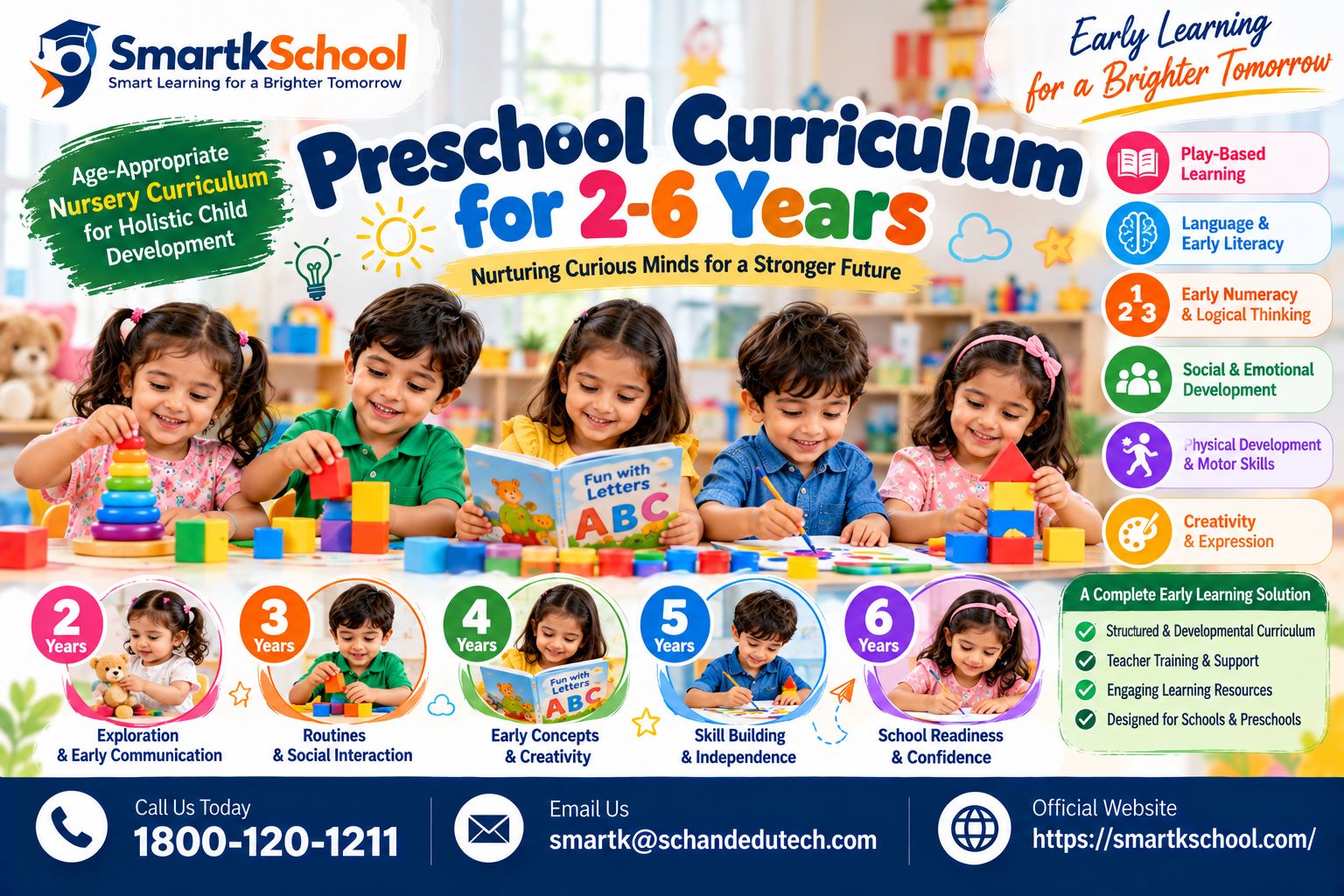
Early childhood education is becoming more intentional as schools and parents recognise that children between the ages of two and six require learning experiences designed around their developmental stage. A well-structured preschool curriculum for 2-6 years should support communication, motor development, creativity, social-emotional growth and school readiness without placing unnecessary academic pressure on young learners.
Within this age group, a thoughtfully designed nursery curriculum plays an especially important role because it introduces children to routines, language, movement, social interaction and early concepts through play-based experiences.
Why a Preschool Curriculum for 2-6 Years Matters
Children develop rapidly between ages two and six, but development does not happen at the same pace for every child.
A strong preschool curriculum for 2-6 years should therefore be structured enough to provide clear learning goals while remaining flexible enough to adapt to individual needs.
The curriculum should support multiple developmental areas, including:
- Language and communication
- Early literacy
- Early numeracy
- Fine motor development
- Gross motor development
- Social-emotional skills
- Creativity
- Environmental awareness
- Self-help and life skills
The objective is to prepare children for future learning while protecting the joy and curiosity that naturally define early childhood.
Learning Needs Change with Age
A two-year-old and a six-year-old do not learn in the same way.
Younger children may need more sensory play, movement, repetition and simple routines.
Older preschoolers can gradually handle more structured activities, longer conversations and more complex problem-solving.
An effective preschool curriculum for 2-6 years should therefore progress in stages rather than applying the same expectations across all age groups.
For example:
- Ages 2-3: sensory exploration, language exposure, movement and routines
- Ages 3-4: social play, early concepts, stories and fine motor skills
- Ages 4-5: early literacy, numeracy, problem-solving and creativity
- Ages 5-6: stronger school readiness, communication, independence and concept application
What Is a Nursery Curriculum?
A nursery curriculum is the early-stage framework used for younger preschool children.
It usually focuses less on formal academics and more on:
- Listening and speaking
- Recognising familiar objects
- Colours and shapes
- Rhymes
- Movement
- Social interaction
- Fine motor activities
- Daily routines
The nursery stage should help children become comfortable in a classroom environment.
For many children, this is their first regular learning experience outside the home.
Play-Based Learning Should Be the Core
Play remains one of the most effective methods for teaching young children.
A high-quality preschool curriculum for 2-6 years should use both guided and free play.
Examples include:
- Building blocks
- Pretend kitchens
- Toy vehicles
- Puzzles
- Water play
- Sand play
- Puppets
- Role play
These activities support language, imagination, coordination and problem-solving naturally.
A strong nursery curriculum uses play intentionally rather than treating it as a break from learning.
Language Development in the Early Years
Language skills grow rapidly during preschool.
Children need daily opportunities to hear and use words.
Useful activities include:
- Storytelling
- Picture conversations
- Rhymes
- Songs
- Puppet play
- Show-and-tell
- Group discussion
For younger nursery children, the focus should be on listening, naming, repeating and expressing simple needs.
For older children, the curriculum can gradually introduce richer vocabulary, sequencing and early phonological awareness.
Early Literacy Without Pressure
Literacy readiness is important, but it should be age-appropriate.
A good preschool curriculum for 2-6 years may gradually introduce:
- Sound recognition
- Letter familiarity
- Picture books
- Story sequencing
- Tracing
- Pencil control
- Pre-writing patterns
Formal writing should not dominate the early years.
Children first need strong language, coordination and interest in books.
Early Numeracy Through Everyday Experiences
Young children can understand mathematical ideas through real objects.
A nursery curriculum can introduce:
- Counting
- Sorting
- Matching
- Shapes
- Big and small
- More and less
- Simple patterns
Older preschoolers can gradually work with more complex sequencing, number recognition and practical problem-solving.
Blocks, beads, toys and classroom objects make mathematical learning concrete.
Social and Emotional Development
Preschool is also where children learn how to function in a group.
A well-designed preschool curriculum for 2-6 years should support children in learning to:
- Share
- Take turns
- Listen
- Express feelings
- Follow routines
- Cooperate
- Ask for help
- Resolve simple conflicts
These skills are essential for future classroom success.
Physical Development Is Essential
Young children need regular physical movement.
Gross motor development can be supported through:
- Running
- Jumping
- Balancing
- Dancing
- Throwing
- Catching
Fine motor development can be encouraged through:
- Drawing
- Clay
- Threading
- Peg activities
- Cutting
- Puzzles
- Building blocks
A balanced nursery curriculum should include movement every day.
Creativity and Expression
Creativity should be built into the regular curriculum.
Activities may include:
- Painting
- Music
- Dance
- Craft
- Drama
- Role play
- Free drawing
- Construction
Creative activities help children express emotions and develop imagination.
They also improve confidence and fine motor control.
Life Skills and Independence
One of the most valuable parts of a preschool curriculum for 2-6 years is helping children become more independent.
Age-appropriate life skills can include:
- Putting away toys
- Washing hands
- Carrying personal items
- Eating independently
- Following classroom routines
- Taking care of materials
These everyday tasks build responsibility and confidence.
Teacher Role in Nursery and Preschool
Teachers in early childhood settings should act as guides, observers and facilitators.
They should understand how to:
- Adapt activities
- Encourage participation
- Observe progress
- Support shy children
- Manage group routines
- Communicate positively
The same nursery curriculum can produce very different outcomes depending on how effectively it is implemented.
Parent Involvement Strengthens Learning
Parents can support preschool development without turning the home into another classroom.
Simple activities are enough:
- Reading stories
- Talking about the day
- Counting household items
- Drawing
- Singing rhymes
- Encouraging independent routines
A strong preschool curriculum for 2-6 years should help parents understand what children are learning and how to support it naturally.
Assessment Should Be Observational
Formal examinations are not suitable for very young children.
Teachers can assess progress through observation of:
- Communication
- Participation
- Social interaction
- Motor skills
- Independence
- Concept understanding
This approach gives a more realistic picture of development.
Technology Should Remain Secondary
Digital tools can support selected activities, but young children need real-world experiences first.
The curriculum should prioritise:
- Physical play
- Human conversation
- Art
- Manipulative materials
- Outdoor activity
- Group interaction
Screens should not replace these experiences.
Frequently Asked Questions
What should a preschool curriculum for 2-6 years include?
It should include language, numeracy, physical development, creativity, social-emotional learning and life skills.
Is the same curriculum suitable for ages 2 and 6?
No. A preschool curriculum for 2-6 years should progress according to developmental stages and age-related abilities.
What is included in a nursery curriculum?
A nursery curriculum typically focuses on language, movement, routines, sensory activities, play, colours, shapes and early social skills.
Should nursery children learn writing?
Pre-writing activities are useful, but formal writing should not be pushed too early.
Why is play important?
Play supports problem-solving, communication, creativity, coordination and social development.
How should preschool children be assessed?
Observation-based assessment is generally more appropriate than formal testing.
How can parents support learning at home?
Reading, talking, singing, drawing and encouraging independence are simple and effective.
Should preschool children use technology?
Technology can be used in moderation, but hands-on and social learning should remain central.
What are the main goals for ages 5-6?
School readiness, communication, independence, early literacy, numeracy and problem-solving become increasingly important.
How can schools choose the right curriculum?
Schools should look for age-appropriate progression, teacher guidance, balanced development and flexibility.
The Future of Early Childhood Curriculum
Early education is moving toward more personalised and developmentally responsive learning.
The future preschool curriculum for 2-6 years is likely to place greater emphasis on:
- Play-based learning
- Social-emotional development
- Teacher training
- Parent collaboration
- Observation-based assessment
- Life skills
- School readiness
The nursery curriculum will also continue shifting away from premature academics and toward meaningful early experiences.
Media Contact
Media & Education Enquiries
Contact: 1800-120-1211
Email: smartk@schandedutech.com
Official Website: https://smartkschool.com/