Building brand recognition is no longer limited to online advertisements, social media campaigns or large promotional displays. Businesses are increasingly discovering the value of placing their identity on practical products that people interact with naturally.
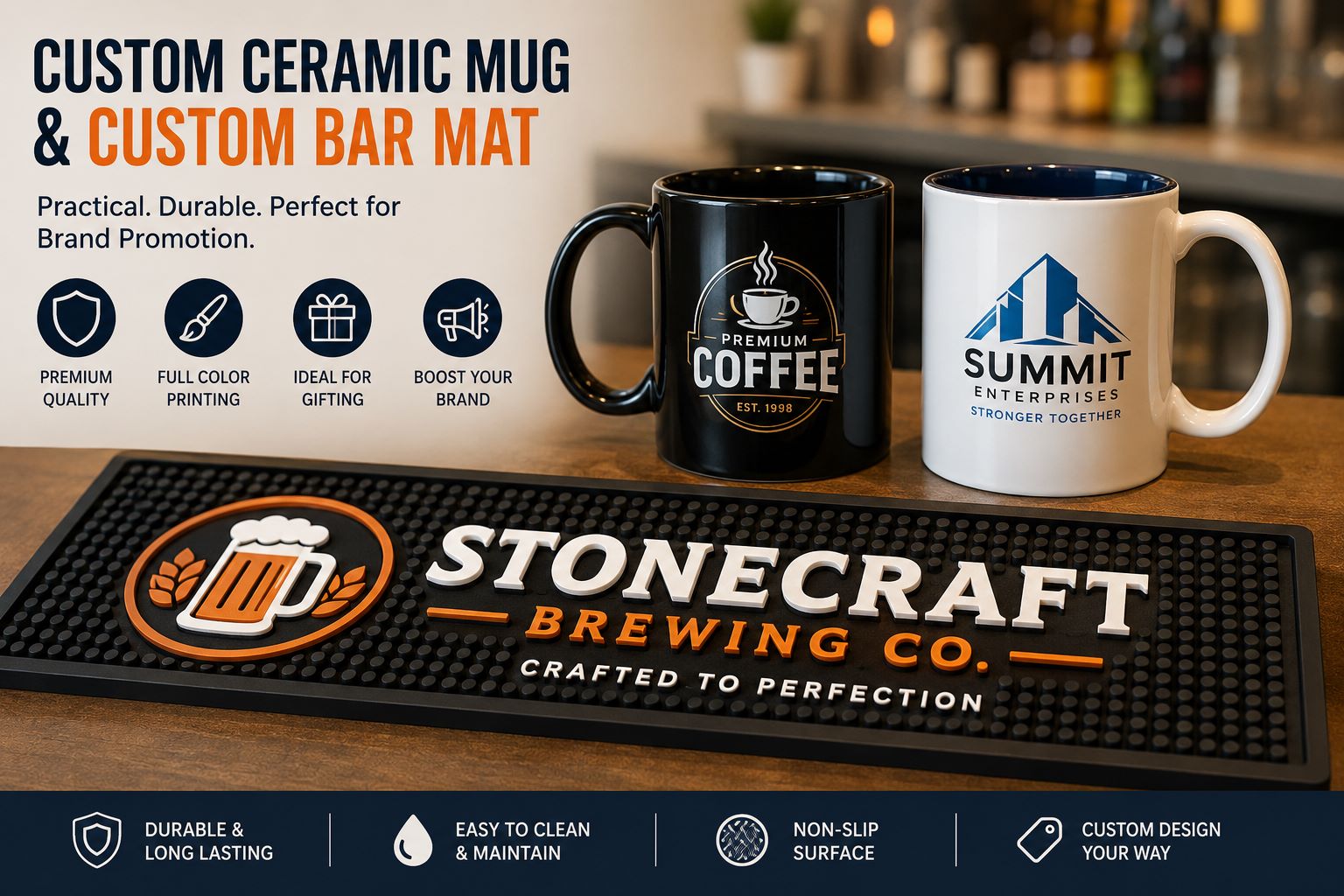
Among these products, the custom ceramic mug and custom bar mat offer two interesting approaches to physical branding. One enters personal spaces such as offices, kitchens and coffee tables, while the other creates visibility within restaurants, cafés, hotels and beverage-serving environments.
Their effectiveness comes from a simple idea: when promotional products are genuinely useful, people have a reason to keep seeing and interacting with the brand.
Why Practical Promotional Products Deserve More Attention
There is a major difference between receiving an advertisement and receiving something useful.
Traditional advertising communicates a message directly. Promotional merchandise can work more subtly by incorporating a brand into an everyday object.
Consider a mug used every morning at work. The user may see its logo hundreds of times over the product’s lifespan. Other colleagues and visitors may notice it as well.
The same principle applies to a branded mat positioned on a hospitality counter. Customers may encounter the branding while ordering, waiting for a drink or speaking with staff.
This repeated exposure helps explain why businesses continue to explore functional merchandise as part of broader marketing strategies.
Why the Custom Ceramic Mug Remains Relevant
Few promotional products are as familiar as the custom ceramic mug, but familiarity should not be confused with ineffectiveness.
Its strength is precisely that people already understand how to use it.
Tea, coffee and other hot beverages are common parts of workplace and home routines. A mug therefore does not need to introduce a new behaviour to become useful.
Businesses can customise ceramic mugs with:
- Company logos and brand colours
- Employee or customer names
- Illustrations and patterns
- Event artwork
- Short messages and slogans
- Anniversary designs
- Product graphics
- Photographic images
The possibilities make ceramic mugs suitable for different audiences without fundamentally changing the product.
Good Customisation Is About More Than Printing a Logo
One common mistake with promotional merchandise is trying to use every available centimetre for advertising.
A custom ceramic mug covered with telephone numbers, URLs, slogans and oversized logos may communicate plenty of information, but it may not be something a recipient wants on their desk.
Successful customisation requires balance.
For corporate gifts, subtle branding can create a more sophisticated appearance. For consumer merchandise, creative illustrations or distinctive patterns may make the product more desirable.
The mug itself should also complement the artwork. Shape, capacity, handle comfort, surface colour and finish can influence the final result.
Packaging becomes particularly important when the mug is intended as a gift rather than an everyday commercial item.
Custom Mugs Can Serve More Than One Marketing Purpose
One reason mugs remain attractive to marketers is their flexibility.
A company could order them for employee onboarding and later create a completely different design for a customer event.
A café might serve drinks in branded ceramic mugs while also selling another version as merchandise.
Custom mugs are commonly considered for:
- Trade shows
- Business conferences
- Customer appreciation
- Corporate celebrations
- Employee recognition
- Retail merchandise
- Educational institutions
- Community events
This flexibility allows the same product category to support internal branding, customer marketing and commercial merchandise.
Custom Bar Mats Bring Branding to the Point of Service
While mugs usually create a personal interaction, the custom bar mat has a more location-specific role.
It is typically placed on a counter where beverages are prepared or served. The mat provides space for bottles and glasses while helping manage moisture from normal serving activities.
Adding branding turns this operational accessory into part of the business’s visual environment.
A restaurant could incorporate its own identity into the mat, while a beverage manufacturer might supply branded versions to commercial partners.
Either way, the branding appears in a location where customers are already paying attention.
Why Counter Space Is Valuable for Hospitality Branding
Walk into almost any busy café or restaurant and the counter quickly becomes a focal point.
Customers look towards it when ordering, collecting drinks, making payments and interacting with staff.
A custom bar mat uses this existing attention rather than requiring an additional advertising display.
This can help businesses maintain a cleaner environment while still introducing recognisable visual elements.
The approach is particularly relevant to hospitality brands attempting to create consistency throughout their physical spaces.
Menus, uniforms, drinkware, signs and counter accessories can all reinforce the same identity without each element becoming a separate advertisement.
Bar Mats Are No Longer Relevant Only to Traditional Bars
The term “bar mat” can create the impression that the product is useful only in pubs. In practice, beverage preparation takes place across a much wider range of businesses.
Potential users include:
- Coffee shops
- Restaurants
- Hotels and resorts
- Catering companies
- Beverage counters
- Breweries
- Food festivals
- Exhibition stands
- Event venues
A custom bar mat can therefore be adapted to different hospitality concepts.
A coffee business might choose a minimalist design matching its interior, while an event organiser could create mats specifically for a temporary branded serving area.
The product remains similar, but the branding strategy changes according to the environment.
Functionality Should Always Come Before Promotion
There is little benefit in creating attractive merchandise if it performs poorly.
For ceramic mugs, buyers should consider factors such as ceramic quality, handle comfort, capacity and suitability for the intended application.
For bar mats, practical considerations include material, surface texture, grip, dimensions and cleaning requirements.
A promotional product represents the organisation whose branding appears on it. Poor quality can therefore create an impression very different from the one the business intended.
Businesses planning bulk purchases should evaluate samples whenever possible rather than making decisions entirely from digital images.
Custom Ceramic Mug vs Custom Bar Mat
Although both products offer branding potential, they interact with audiences differently.
| Factor | Custom Ceramic Mug | Custom Bar Mat |
| Primary purpose | Drinking beverages | Supporting beverage service |
| Main environment | Office, home, café | Hospitality counter |
| Personalisation | Extensive | Mainly brand-focused |
| Corporate gifting | Excellent | Limited |
| Hospitality use | Strong | Excellent |
| Customer merchandise | Excellent | Specialist |
| Brand visibility | Individual and repeated | Location-based and repeated |
A business interested primarily in gifting might favour mugs, while hospitality brands looking for counter-level visibility could gain more relevance from customised mats.
For some companies, using both may provide the strongest result.
How Matching Products Can Create a Stronger Brand Experience
Consistency is one of the foundations of recognisable branding.
Imagine a café where customers see the same logo and visual style on ceramic mugs, counter mats, takeaway packaging and menus. None of these items needs to carry an aggressive advertising message. Together, however, they create a distinctive environment.
A custom ceramic mug could feature the primary brand design, while a matching custom bar mat uses the same typography and colour palette.
Hotels and restaurants can adopt a similar approach across different customer touchpoints.
Even businesses without physical premises can create coordinated promotional collections for events, campaigns or corporate gifting.
What Businesses Should Check Before Ordering
Custom products require additional planning compared with standard merchandise.
Before confirming a bulk order, buyers should review:
- Product materials and specifications
- Available dimensions and capacities
- Minimum order quantities
- Artwork requirements
- Printing or customisation methods
- Colour reproduction
- Sample availability
- Packaging options
- Production lead time
- Delivery arrangements
Artwork approval deserves particular attention.
A logo that appears correctly positioned on a flat digital template may look different once applied to a curved ceramic surface or incorporated into a textured mat.
Reviewing a proof or physical sample can reduce the possibility of unexpected results.
Frequently Asked Questions
What is a custom ceramic mug?
It is a ceramic drinking mug personalised with a logo, name, photograph, illustration or other artwork.
Are customised ceramic mugs suitable for businesses?
Yes. They can be used for corporate gifts, employee merchandise, events, hospitality and customer promotions.
Can ceramic mugs feature full-colour designs?
Many production methods support colourful artwork, although exact capabilities depend on the supplier and customisation technique.
Can custom mugs be sold as merchandise?
Yes. Cafés, organisations and brands can create their own mug collections for retail sale.
What is a custom bar mat?
It is a functional beverage-counter mat customised with a company logo, product identity or other branding.
Where can custom bar mats be used?
They can be used in cafés, hotels, restaurants, beverage counters, breweries and event-serving areas.
Are custom bar mats suitable for coffee shops?
Yes. Any business with a beverage preparation or serving counter may potentially use them.
What makes a good bar mat design?
Clear branding, suitable dimensions, practical surface construction and easy-to-recognise artwork are important considerations.
Can ceramic mugs and bar mats use matching artwork?
Yes. Matching visual elements can help create a consistent physical brand identity.
Is checking a sample important?
For larger customised orders, examining a sample or approving a detailed proof can help prevent design and production problems.
https://newsgrow.blogspot.com/2026/09/custom-enamel-badge-and-enamel-key.html
https://newsgrow.blogspot.com/2026/09/custom-ceramic-mug-and-custom-bar-mat.html