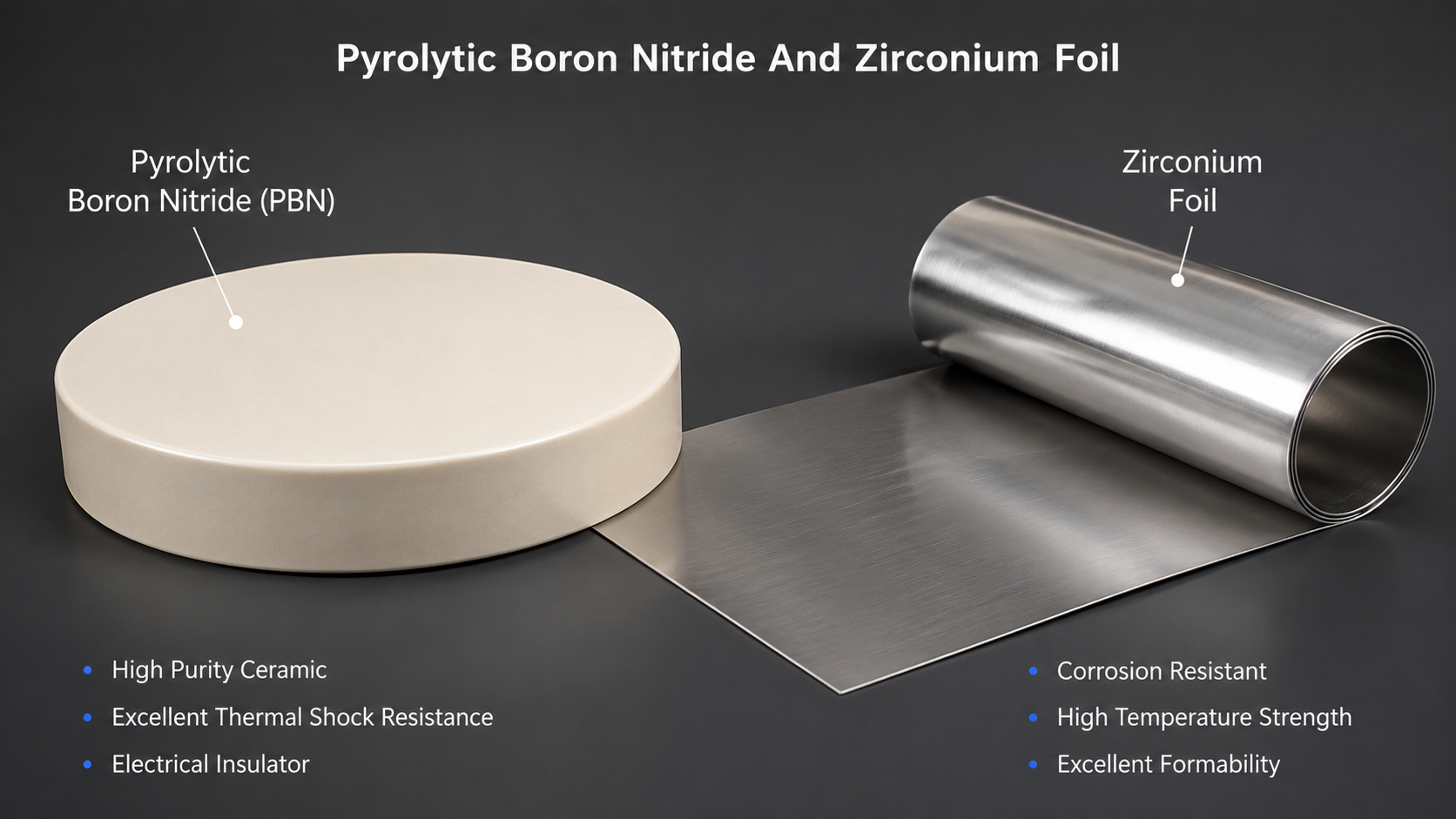
Rapid developments in semiconductor manufacturing, advanced electronics, vacuum processing, materials science and specialised research are increasing the need for materials engineered to perform under challenging operating conditions. Pyrolytic Boron Nitride and Zirconium Foil are emerging as important material options for applications where conventional solutions may not deliver the required combination of purity, thermal behaviour, corrosion resistance and electrical performance.
The development reflects a broader shift across high-technology industries. Engineers are increasingly evaluating materials according to their complete operating environment, including temperature, atmosphere, electrical requirements, chemical exposure and contamination sensitivity.
High-Technology Manufacturing Creates New Material Demands
Modern manufacturing environments are becoming more controlled and technically demanding.
Semiconductor production provides a clear example. Processing equipment may operate at elevated temperatures while components must simultaneously provide electrical insulation and minimise unwanted contamination.
Scientific research introduces different requirements. Researchers may need extremely thin metallic specimens with controlled composition and surface characteristics for studying oxidation, corrosion or other material interactions.
These contrasting challenges highlight the importance of application-specific materials.
Pyrolytic Boron Nitride addresses many requirements associated with high-purity ceramics, while Zirconium Foil provides specialised metallic properties in a thin, versatile form.
Pyrolytic Boron Nitride Strengthens Its Role in Precision Processing
PBN is an advanced boron nitride ceramic commonly produced using chemical vapour deposition.
The manufacturing approach can provide high-purity material without conventional ceramic binders, making Pyrolytic Boron Nitride particularly attractive for contamination-sensitive processes.
Another distinguishing feature is its layered structure.
PBN exhibits anisotropic behaviour, meaning certain physical properties vary according to direction. Thermal conductivity is particularly important because heat travels differently parallel and perpendicular to its layers.
For equipment designers, this characteristic can provide opportunities to manage heat while maintaining electrical insulation.
Combination of Properties Makes PBN Highly Specialised
Rather than relying on one outstanding characteristic, Pyrolytic Boron Nitride delivers a useful combination of functional properties.
These can include:
- High material purity
- Excellent electrical insulation
- Strong thermal-shock resistance
- Directional thermal conductivity
- Chemical stability
- Low contamination potential
- High-temperature capability under suitable conditions
- Compatibility with specialised vacuum environments
Such characteristics make PBN relevant to applications where thermal, chemical and electrical requirements overlap.
Potential uses include semiconductor crystal-growth crucibles, evaporation components, electrical insulators, vacuum-processing equipment, high-purity containers and specialised laboratory components.
Zirconium Foil Supports Research and Surface Engineering
While PBN addresses specialised ceramic requirements, Zirconium Foil provides an entirely different set of capabilities.
Zirconium is a metal recognised for corrosion resistance in many environments. It is also notable for relatively low neutron absorption, contributing to the established importance of zirconium-based materials within nuclear technology.
Manufacturing zirconium as thin foil creates additional opportunities in scientific and industrial research.
Researchers can use foil specimens with controlled thicknesses to investigate how zirconium responds to heat, gases, coatings, chemicals and other environmental conditions.
Surface-Focused Applications Expand Zirconium Foil Potential
Thin metallic specimens can be particularly useful when the surface of the material is central to an experiment.
Applications for Zirconium Foil can include:
- Surface-science research
- Corrosion studies
- Oxidation experiments
- Nuclear-material research
- Electrochemical investigations
- Diffusion testing
- Vacuum experiments
- Thin-film research
- High-temperature studies
- Surface modification
In these environments, simply specifying “zirconium” may not be sufficient.
Researchers may need to define exact foil thickness, purity, dimensions, surface condition and composition before beginning experimental work.
Material Comparison Highlights Different Performance Roles
Despite being discussed within the same advanced-material landscape, PBN and zirconium foil address substantially different engineering requirements.
| Performance Area | Pyrolytic Boron Nitride | Zirconium Foil |
| Material family | Technical ceramic | Metal |
| Electrical function | Insulator | Conductor |
| Key characteristic | High purity and thermal anisotropy | Corrosion-resistant metallic behaviour |
| Typical form | Crucibles and engineered parts | Thin foil and sheet |
| Semiconductor processing | Important specialised uses | Select applications |
| Surface experiments | Application specific | Particularly suitable |
| Nuclear-related research | Specialised | Significant relevance |
| Thermal behaviour | Direction dependent | Metallic heat conduction |
| Mechanical form | Rigid ceramic | Thin, formable metal |
| Main purchasing focus | Purity and component specifications | Grade, thickness and surface condition |
The distinction demonstrates why material selection should begin with performance requirements rather than material popularity.
Precision Specifications Become Increasingly Important
As applications become more sophisticated, purchasing advanced materials requires greater technical detail.
When specifying Pyrolytic Boron Nitride, engineers may need to consider:
- Purity
- Component dimensions
- Geometry
- Thermal orientation
- Surface condition
- Temperature
- Operating atmosphere
- Manufacturing tolerances
For Zirconium Foil, important factors may include thickness, grade, purity, width, length, surface finish, temper and composition.
Hafnium content may also require consideration for certain zirconium specifications.
Clear communication between engineers, researchers and material suppliers can help ensure that the supplied material aligns with the intended operating environment.
Frequently Asked Questions
1. What is Pyrolytic Boron Nitride?
It is a specialised boron nitride ceramic generally manufactured using chemical vapour deposition.
2. What industries use PBN?
PBN is associated particularly with semiconductor manufacturing, vacuum processing and specialised high-temperature applications.
3. Why is PBN useful for semiconductor processing?
Its high purity, electrical insulation and thermal characteristics are useful where contamination and process control matter.
4. Does PBN conduct electricity?
PBN is primarily an electrical insulating material.
5. What is Zirconium Foil?
It is zirconium metal produced in thin foil form for specialised engineering and research applications.
6. Why is zirconium resistant to corrosion?
A protective oxide film contributes to zirconium’s corrosion resistance in many environments.
7. Is Zirconium Foil used in nuclear research?
Yes. Zirconium-based materials have relevance to nuclear technology partly because of zirconium’s relatively low neutron absorption.
8. Can Zirconium Foil be used in high-temperature experiments?
Yes, depending on the temperature, atmosphere, material specification and experimental conditions.
9. Are Zirconium Foil and PBN alternatives?
Generally, no. One is a conductive metal and the other is an electrically insulating ceramic.
10. Why does material specification matter?
Purity, thickness, composition, dimensions and surface condition can significantly influence performance in precision applications.
Read more – https://newsgrow.blogspot.com/2026/09/boron-nitride-crucibles-and-boron.html
https://newsgrow.blogspot.com/2026/09/pyrolytic-boron-nitride-and-zirconium.html