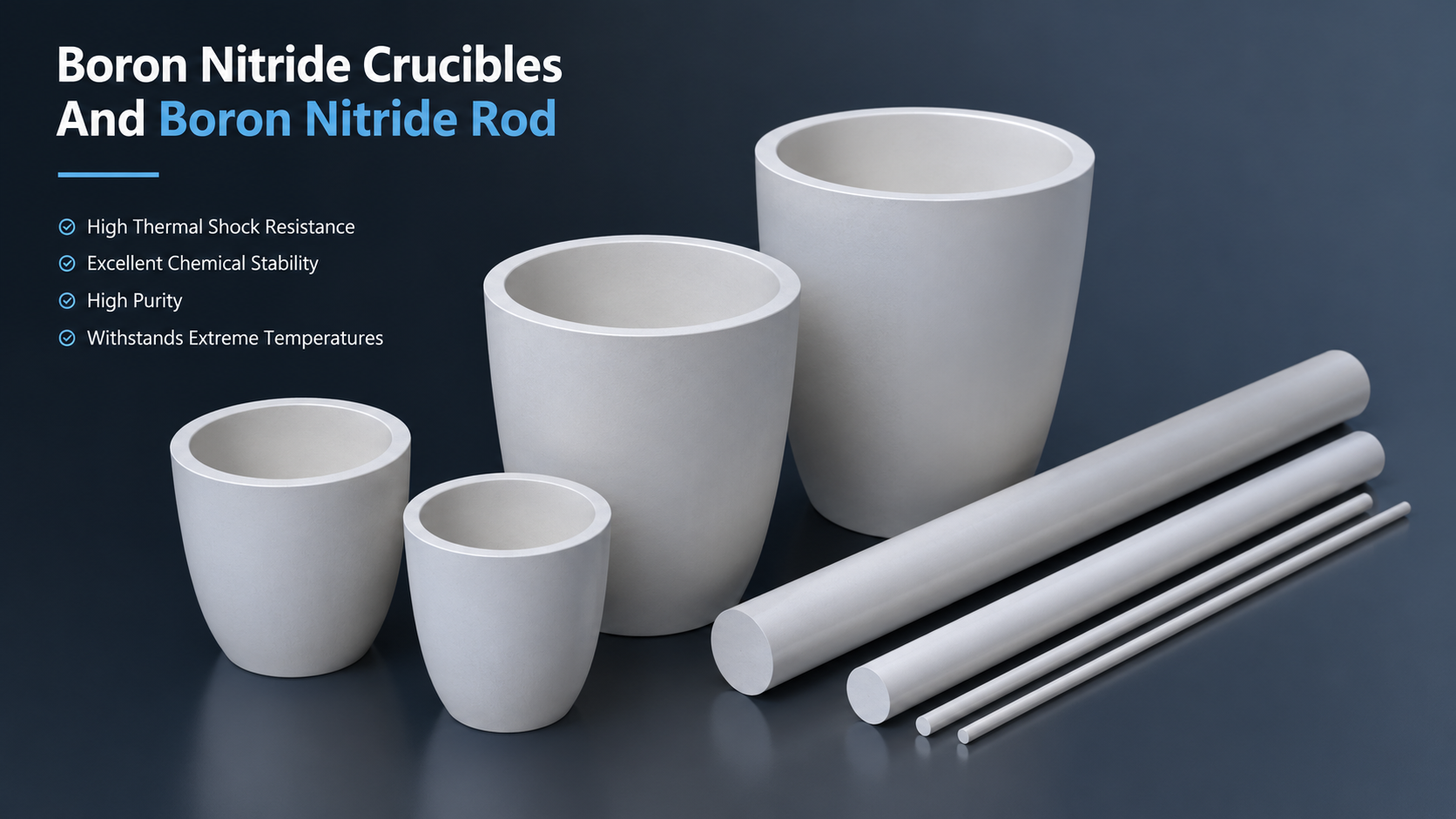
As industrial technologies move towards higher operating temperatures, cleaner processing environments and more specialised component designs, advanced ceramic materials are becoming increasingly important. Boron Nitride Crucibles and Boron Nitride Rod are emerging as noteworthy material solutions for industries requiring a combination of thermal stability, electrical insulation, thermal-shock resistance and precision machinability.
The development reflects a broader shift across semiconductor manufacturing, metallurgy, vacuum processing, electronics, laboratory research and specialised furnace technology. Instead of evaluating materials purely on their ability to tolerate heat, engineers are increasingly considering how components perform under thermal cycling, electrical requirements and contact with sensitive process materials.
Advanced Manufacturing Creates New Material Challenges
Modern industrial equipment frequently operates under conditions that place multiple demands on a single component.
High temperatures may be combined with vacuum environments, electrical isolation requirements, rapid heating and cooling, or exposure to molten substances. These conditions can restrict the suitability of conventional metals and standard ceramics.
Boron nitride offers a distinctive combination of characteristics, including:
- High-temperature capability in appropriate environments
- Excellent electrical insulation
- Good thermal-shock resistance
- Low thermal expansion
- Useful thermal conductivity
- Low-friction behaviour
- Chemical stability in many applications
- Machinability in suitable grades
These properties are helping expand interest in boron nitride for specialised industrial systems.
Boron Nitride Crucibles Address Critical Thermal Processing Needs
Boron Nitride Crucibles are designed for applications involving the containment, heating, melting or evaporation of materials at elevated temperatures.
Crucible selection can have a significant impact on process quality. In sensitive operations, unwanted reactions between the container and processed material can potentially influence purity or material recovery.
Boron nitride offers non-wetting behaviour with various compatible materials, making BN crucibles particularly interesting for specialised thermal-processing environments.
Potential applications include:
- Vacuum evaporation
- Molten-material processing
- Crystal growth
- Semiconductor manufacturing
- Laboratory research
- Advanced alloy development
- Materials science
- Controlled-atmosphere furnace systems
The suitability of a specific crucible depends on its material grade, operating temperature, furnace atmosphere and chemical environment.
Thermal-Shock Resistance Remains a Key Consideration
Repeated heating and cooling represent major challenges for components operating inside high-temperature systems.
Rapid temperature changes can generate internal stresses as materials expand and contract. Over time, these stresses may contribute to cracking or reduced component life when unsuitable materials are used.
Boron Nitride Crucibles can provide good thermal-shock performance due to the thermal characteristics of BN. This makes them relevant to applications where repeated temperature cycles are unavoidable.
Such characteristics are increasingly important as manufacturers seek reliable materials for continuous research and industrial processing environments.
Boron Nitride Rod Expands Opportunities for Custom Engineering
Alongside crucibles, Boron Nitride Rod provides another route for integrating advanced ceramics into modern equipment.
BN rod is cylindrical ceramic stock that can be machined into specialised components according to application requirements.
Common finished components can include:
- Electrical insulators
- Furnace spacers
- Ceramic sleeves
- Nozzles
- Bushings
- Thermal supports
- Positioning fixtures
- Vacuum-system components
- Laboratory equipment parts
This flexibility is particularly useful where standard ceramic components cannot provide the required dimensions or geometry.
Machinability Supports Precision Component Development
One of the challenges associated with advanced ceramics is manufacturing complex shapes.
Certain grades of Boron Nitride Rod offer comparatively good machinability, enabling manufacturers to produce customised features without some of the processing difficulties associated with harder technical ceramics.
Precision Manufacturing Requirements
When machining boron nitride, manufacturers should consider:
- Suitable tooling
- Controlled cutting pressure
- Dimensional tolerances
- Edge geometry
- Component support
- Surface finish
- Dust management
Grade-Specific Processing Is Important
Different boron nitride formulations may have different machining characteristics. Processing methods should therefore be selected according to the specific BN grade and finished-component requirements.
Boron Nitride Crucibles and Boron Nitride Rod at a Glance
| Category | Boron Nitride Crucibles | Boron Nitride Rod |
| Primary purpose | Thermal material containment | Custom component manufacturing |
| Typical form | Cup, boat or vessel | Cylindrical stock |
| Main advantage | Controlled high-temperature processing | Precision machining flexibility |
| Common use | Melting and evaporation | Insulators, sleeves and nozzles |
| Customisation | Dimensions and geometry | Extensive machining |
| Key sectors | Metallurgy, research, semiconductor | Electronics, furnaces, vacuum systems |
Semiconductor and Research Applications Drive Technical Interest
The semiconductor sector represents one area where advanced material selection is particularly important.
Processing equipment may require materials capable of handling elevated temperatures while maintaining electrical isolation. High-purity environments can also place additional restrictions on component materials.
Boron nitride’s combination of thermal and electrical characteristics makes it relevant to selected semiconductor and electronics applications.
Research institutions are similarly exploring advanced ceramics for experimental furnaces, vacuum systems, crystal growth and new-material development.
Buyers Place Greater Focus on Application-Specific BN Grades
As industrial interest increases, engineers are also recognising that boron nitride should not be treated as a single standard material.
Different grades can vary in purity, additives, density, strength, thermal performance and environmental resistance.
Important selection factors include:
- Operating and peak temperature
- Air, vacuum or inert atmosphere
- Chemical compatibility
- Purity requirements
- Electrical insulation
- Thermal cycling frequency
- Mechanical loading
- Component dimensions
- Machining requirements
- Dimensional tolerances
Technical evaluation before purchasing can help ensure that the selected material matches actual operating conditions.
Frequently Asked Questions
What are Boron Nitride Crucibles?
They are specialised ceramic containers used for demanding high-temperature material-processing applications.
What is Boron Nitride Rod?
It is cylindrical BN ceramic stock that can be machined into application-specific technical components.
Why is boron nitride receiving industrial attention?
Its combination of thermal performance, electrical insulation, thermal-shock resistance and machinability makes it useful in specialised environments.
Where are BN crucibles used?
Applications may include vacuum evaporation, molten-material processing, crystal growth, research and semiconductor manufacturing.
Can Boron Nitride Rod be customised?
Yes. Suitable BN grades can be machined into components based on specific dimensions and engineering requirements.
Is boron nitride electrically insulating?
Hexagonal boron nitride is generally valued for its electrical insulating properties.
Can BN tolerate thermal cycling?
Suitable BN grades provide good thermal-shock resistance, making them useful in applications involving repeated heating and cooling.
Are BN crucibles suitable for molten materials?
They may be suitable for selected molten-material applications, subject to chemical compatibility and operating conditions.
Are all boron nitride grades identical?
No. Their composition, purity, additives and physical properties can differ significantly.
What should buyers specify when ordering BN products?
Temperature, atmosphere, dimensions, chemical exposure, purity, tolerances and intended application should be clearly communicated.
Read more – https://newsgrow.blogspot.com/2026/09/boron-nitride-crucibles-and-boron.html