Extrusion technology has transformed the way plastics, polymers, compounds, masterbatches, profiles, pipes, sheets, and many industrial materials are manufactured. The process allows manufacturers to continuously convert raw materials into products with controlled dimensions, composition, and performance.
At the heart of this process is the extruder. Among the available technologies, the twin extruder and single extruder are the two most important configurations. While both perform melting, conveying, mixing, and shaping operations, they approach material processing differently.
Choosing between them requires more than comparing machine prices. Manufacturers must consider material characteristics, mixing requirements, production volume, energy efficiency, product quality, and long-term operating costs.
Understanding the Science Behind Extrusion
Extrusion is a continuous manufacturing process. Raw polymer or compound enters a barrel through a feeding system. A rotating screw moves the material forward while controlled heating and mechanical energy gradually transform it into a homogeneous melt.
The material then passes through a die that determines its final shape.
Successful extrusion depends on several interacting parameters:
- Screw speed
- Barrel temperature
- Feed rate
- Melt pressure
- Residence time
- Material viscosity
- Shear rate
- Cooling conditions
The screw configuration determines how effectively these variables can be controlled.
How a Single Extruder Processes Material
A single extruder operates with one rotating screw positioned inside a heated barrel. Its design is straightforward but highly effective for continuous polymer processing.
Material entering the feed section is transported forward by screw rotation. As it progresses, compression, friction, and external heating cause the polymer to melt. The final section develops stable pressure before the material reaches the extrusion die.
Processing Zones Inside a Single Extruder
The screw generally performs three primary functions.
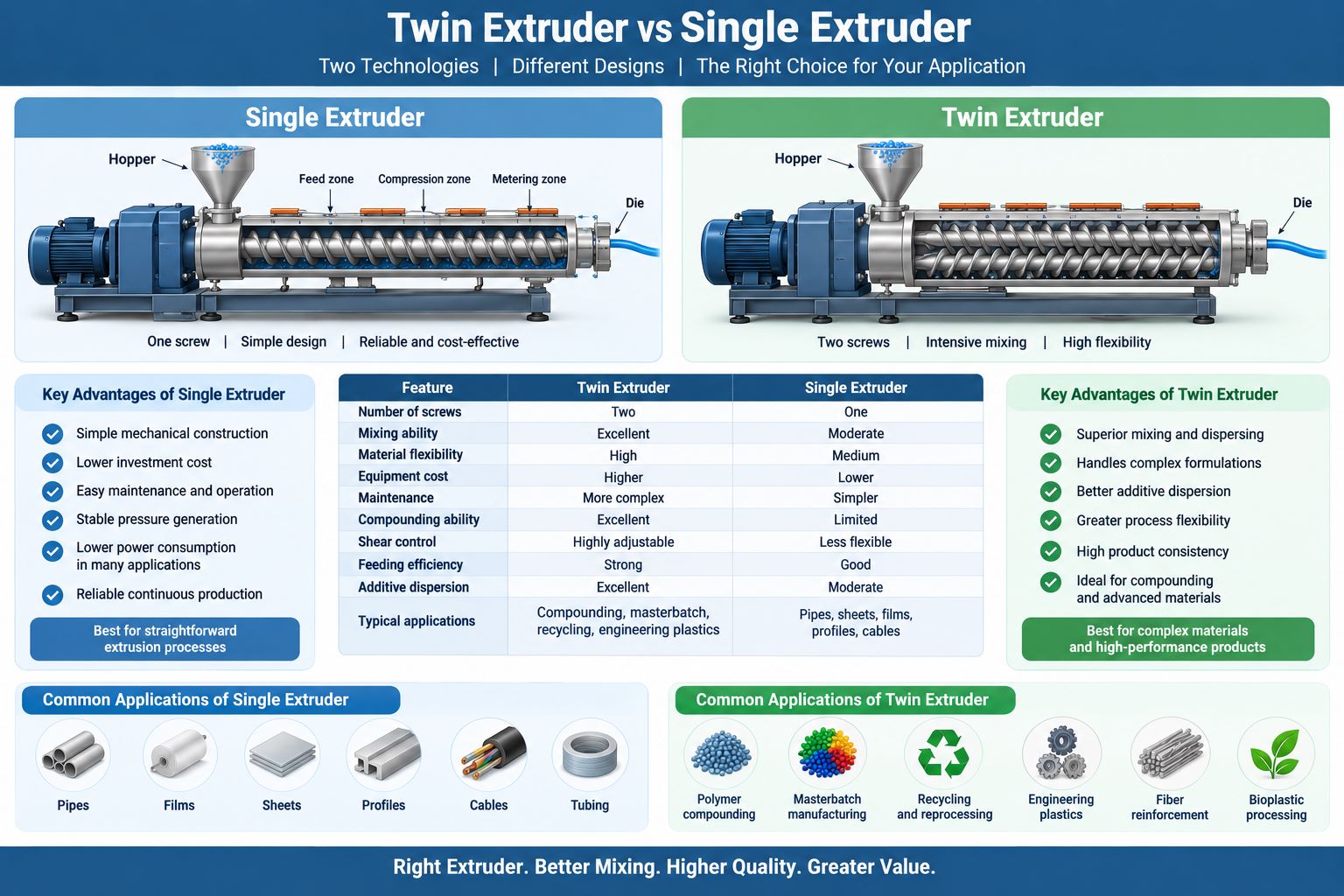
Feed zone: Receives and transports solid raw material.
Compression zone: Compresses, heats, and gradually melts the polymer.
Metering zone: Creates a more uniform melt and provides consistent output to the die.
This predictable processing sequence makes the single extruder particularly suitable for standardized production.
Where Single Extrusion Delivers the Greatest Value
Single-screw technology is highly effective when the material has already been compounded and intensive mixing is unnecessary.
Common applications include:
- PE and PP pipe production
- Plastic film extrusion
- Sheet manufacturing
- Cable insulation
- Plastic tubing
- Extruded profiles
- Coating applications
- Certain pelletizing processes
Its mechanical simplicity can translate into easier operation, lower maintenance requirements, and competitive production costs.
Understanding Twin Extruder Technology
A twin extruder contains two screws operating within a common barrel. Instead of simply transporting material forward, the screws can generate sophisticated mixing, kneading, dispersing, and conveying actions.
The interaction between the screws allows processors to handle complicated formulations that would be more challenging for conventional single-screw systems.
This is particularly valuable when different ingredients must be distributed evenly throughout a polymer.
How Twin Screws Create Better Mixing
Mixing involves more than combining ingredients visually. Fillers, pigments, additives, and reinforcing materials must be distributed at microscopic levels to achieve consistent product properties.
A twin extruder can repeatedly divide, redistribute, compress, and recombine material as it travels through the barrel.
This produces two important mixing effects.
Distributive Mixing
Distributive mixing spreads individual components throughout the material without necessarily breaking particles apart.
It helps create uniform concentration across the compound.
Dispersive Mixing
Dispersive mixing applies sufficient stress to break down agglomerates and distribute smaller particles throughout the polymer matrix.
This capability is particularly important for pigments, mineral fillers, and specialized additives.
Co-Rotating and Counter-Rotating Twin Extruders
Not every twin extruder operates in the same way.
In co-rotating equipment, both screws rotate in the same direction. This arrangement produces intensive material exchange and mixing.
Co-rotating systems are widely used for:
- Polymer compounding
- Color masterbatch
- Engineering plastics
- Filled compounds
- Polymer blends
- Reinforced materials
Counter-rotating screws move in opposite directions. Their conveying characteristics make them particularly useful for selected applications, including rigid PVC processing.
Twin Extruder vs Single Extruder
| Processing Factor | Twin Extruder | Single Extruder |
| Screw configuration | Two screws | One screw |
| Mixing intensity | High | Moderate |
| Compounding capability | Excellent | Limited |
| Machine complexity | Higher | Lower |
| Initial investment | Higher | Lower |
| Material flexibility | Excellent | Good |
| Additive dispersion | Superior | Basic to moderate |
| Maintenance | More specialized | Easier |
| Process customization | High | Moderate |
| Best suited for | Complex formulations | Standard extrusion |
The comparison shows why machine selection should depend on the actual manufacturing objective.
Material Flexibility in Twin Extrusion
A major strength of the twin extruder is its ability to process formulations containing multiple ingredients.
A compound may contain:
- Base resin
- Pigments
- Mineral fillers
- Plasticizers
- Stabilizers
- Lubricants
- Reinforcing fibers
- Performance additives
Each component may have different density, particle size, melting behavior, and thermal sensitivity.
Twin-screw processing provides greater control over how these ingredients are introduced and mixed.
Why Twin Extruders Dominate Compounding
Compounding changes the properties of a base polymer by incorporating additional materials.
For example, manufacturers may add glass fiber to increase strength, flame retardants to improve fire resistance, or mineral fillers to modify stiffness and production economics.
A twin extruder provides the mixing intensity required to distribute these ingredients consistently.
The ability to configure screw elements also allows processors to establish different conveying and mixing zones within the same barrel.
Role of Screw Configuration
Screw design directly affects extrusion performance.
The single extruder usually uses a continuous screw profile optimized for feeding, compression, melting, and metering.
Modern twin-screw machines can use modular screw elements.
These may include:
- Conveying elements
- Kneading blocks
- Mixing elements
- Reverse elements
- Specialized high-shear sections
Changing their arrangement allows engineers to customize the processing environment for specific formulations.
Temperature and Shear Management
Temperature control is essential because excessive heat can degrade polymers while insufficient heat can cause incomplete melting.
Shear creates mechanical energy that contributes to melting and mixing.
A single extruder provides stable processing for materials with relatively predictable characteristics.
A twin extruder provides greater flexibility when manufacturers need precise control over mixing intensity and residence time.
This becomes particularly important when processing heat-sensitive materials or complex polymer blends.
Feeding and Degassing Capabilities
Modern compounding processes may require multiple materials to enter at different points along the extrusion line.
Twin-screw equipment can support main feeders, side feeders, liquid injection, and venting systems.
Vacuum degassing can remove moisture, air, solvents, and volatile compounds during processing.
These capabilities make the twin extruder valuable for advanced material manufacturing and recycling applications.
Production Economics and Energy Efficiency
A single extruder generally requires a lower initial investment and has fewer components requiring maintenance.
However, purchase price alone does not determine manufacturing economics.
A twin extruder may perform mixing, blending, devolatilization, and compounding within one continuous operation. Combining several processing stages can improve overall production efficiency.
Manufacturers should therefore evaluate cost per kilogram of acceptable finished material rather than simply comparing machine prices.
Choosing the Right Extrusion System
Before investing in extrusion equipment, manufacturers should evaluate:
- Type of polymer being processed
- Number of formulation ingredients
- Required mixing quality
- Target production capacity
- Material sensitivity
- Product specifications
- Available operating expertise
- Maintenance requirements
- Energy consumption
- Future formulation requirements
If the objective is primarily melting and shaping a standardized polymer, a single extruder may be sufficient.
If intensive mixing, compounding, modification, or formulation flexibility is required, a twin extruder usually provides greater processing capability.
Frequently Asked Questions
What is a twin extruder?
A twin extruder is an extrusion machine containing two screws designed for controlled conveying, intensive mixing, compounding, and material processing.
What is a single extruder?
A single extruder uses one rotating screw to melt, convey, pressurize, and continuously process thermoplastic materials.
Which system provides stronger mixing?
The twin extruder generally provides stronger distributive and dispersive mixing because of the interaction between two screws.
Which extruder is better for masterbatch?
Twin-screw technology is generally preferred because masterbatch production requires excellent pigment and additive dispersion.
Is a single extruder suitable for pipe production?
Yes. Single-screw machines are widely used for PE and PP pipe extrusion because they provide stable and continuous output.
Can twin extrusion process fillers?
Yes. Twin-screw systems can efficiently incorporate calcium carbonate, talc, glass fiber, and numerous functional fillers into polymers.
Which machine is easier to maintain?
A single extruder normally requires simpler maintenance because its screw and drive system contains fewer mechanical components.
Can recycled materials be processed through extruders?
Yes. Both technologies can process suitable recycled polymers, although machine configuration depends on contamination, moisture, formulation, and material consistency.
Why is screw design important?
Screw geometry determines material transportation, melting behavior, mixing intensity, residence time, pressure development, and overall extrusion stability.
Which extruder should a new manufacturer choose?
The decision should depend on raw material, application, mixing requirements, capacity, product specifications, operating expertise, and available investment.
Read more – https://tandtlawassociates.com/twin-extruder-vs-single-extruder-deep-guide-to-extrusion-technology/