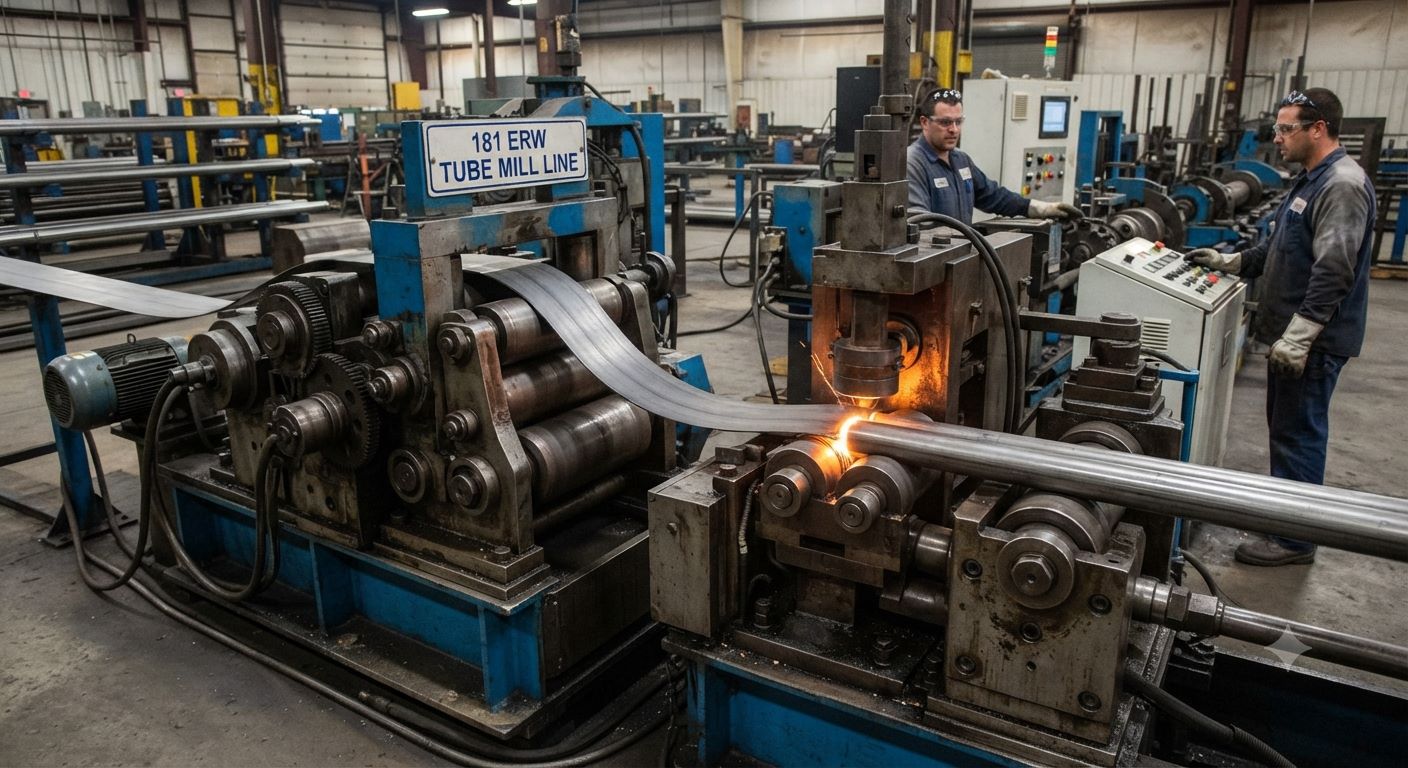
The development of the ERW Tube Mill Line and Tube Mill Line has closely followed the growth of modern steel manufacturing. From mechanically operated equipment to highly automated production systems, tube mill technology has continuously improved to meet increasing demands for speed, accuracy, product variety, and cost efficiency. Understanding its past helps explain how today’s tube manufacturing systems work and where the industry is heading next.
The Early Development of Tube Mill Production
In the early stages of industrial tube manufacturing, producing steel tubes required considerable manual involvement. Steel strips had to be formed, joined, sized, cut, and inspected through relatively simple mechanical processes. Production capacity was limited, while maintaining consistent dimensions across long production runs was challenging.
As construction, transportation, machinery, and infrastructure industries expanded, manufacturers needed a faster and more reliable method of producing steel tubes. This requirement encouraged the development of continuous tube-forming machinery.
The Introduction of ERW Technology
Electric Resistance Welding became one of the most important developments in welded tube production. Instead of relying on conventional welding consumables, ERW technology uses electrical resistance to generate heat at the strip edges. Pressure then brings the heated edges together to create a continuous longitudinal weld.
This approach offered several advantages:
- Continuous manufacturing capability
- Higher production efficiency
- Consistent weld formation
- Reduced dependence on welding filler materials
- Better suitability for automated production
These benefits helped ERW tube production become an important manufacturing method for steel tubes and profiles.
How Tube Mill Lines Evolved
The early machines were gradually improved with additional forming stands, better welding equipment, improved sizing sections, and automatic cutting systems. Each improvement reduced production interruptions and increased dimensional consistency.
From Mechanical Systems to Automated Lines
Modernization introduced electrical controls, programmable logic controllers, servo drives, sensors, and human-machine interfaces. Operators could monitor production parameters more accurately instead of depending entirely on manual adjustments.
The development of automatic flying saws was another major improvement. Tubes could be cut into predetermined lengths while the production line continued operating, reducing unnecessary stopping and restarting.
Modern ERW Tube Mill Line Technology
A contemporary Tube Mill Line is generally designed as an integrated production system. Although configurations vary according to the manufacturer and application, the manufacturing sequence normally includes material preparation, forming, welding, sizing, cutting, and collection.
Typical Production Process
- Steel coil is loaded onto the entry system.
- The strip is uncoiled and prepared for continuous processing.
- Forming stands gradually shape the strip into a tubular section.
- The edges are heated and joined through resistance welding.
- Sizing rolls establish the required final dimensions.
- Inspection equipment monitors important production parameters.
- An automatic cutting system produces predetermined tube lengths.
- Finished tubes are transferred to the collection area.
This integrated approach allows manufacturers to achieve high output while maintaining repeatability.
Past and Present: A Clear Comparison
| Area | Earlier Technology | Modern Technology |
| Production control | Manual adjustments | Automated controls |
| Welding monitoring | Limited | Advanced parameter monitoring |
| Cutting | Basic mechanical cutting | Automatic flying saw systems |
| Quality inspection | Mainly manual | Online measurement and inspection |
| Changeover | Relatively slow | Recipe-based and optimized |
| Maintenance | Mostly reactive | Increasingly predictive |
| Production data | Minimal | Digital data collection |
The Future of ERW Tube Mill Lines
The future of tube manufacturing will not simply depend on making machines faster. The major objective will be creating production systems that are smarter, more flexible, energy-efficient, and easier to monitor.
Artificial Intelligence and Smart Manufacturing
Artificial intelligence could become increasingly useful in analyzing production information. Software can compare welding conditions, motor loads, vibration, temperature, and dimensional measurements to identify unusual operating patterns.
Predictive Maintenance
Instead of waiting for a bearing, motor, drive, or other component to fail, future systems can identify warning signs before a breakdown occurs. This can help manufacturers plan maintenance and reduce unexpected production losses.
Advanced Quality Inspection
Future tube mills are expected to make greater use of cameras, laser measurement, sensors, and automated inspection systems. These technologies can continuously evaluate tube dimensions, surface conditions, weld characteristics, and other quality parameters.
This approach can reduce dependence on final-stage inspection because potential defects may be detected while production is still underway.
Greater Production Flexibility
Market requirements are becoming more diverse. Customers may require different tube diameters, wall thicknesses, lengths, profiles, and material grades in smaller production batches.
Future ERW Tube Mill Line designs will therefore focus heavily on quick changeovers and flexible tooling. Digital recipes could allow operators to recall previously tested production parameters rather than entering settings manually every time.
Energy Efficiency and Sustainable Manufacturing
Energy consumption is another major factor shaping the future. Tube manufacturers are under increasing pressure to control operating costs while improving environmental performance.
Future systems may incorporate:
- More efficient electric drives
- Intelligent power management
- Reduced production scrap
- Improved welding efficiency
- Automated process optimization
- Better monitoring of energy consumption
Reducing waste will also become increasingly important because every unnecessary piece of rejected steel represents lost material, energy, labor, and production capacity.
What the Future Means for Manufacturers
Companies investing in tube mill equipment should look beyond maximum production speed. A machine with excellent output but poor flexibility, maintenance support, or quality control may not provide the best long-term value.
Important Investment Factors
Before purchasing or upgrading equipment, manufacturers should consider:
- Required tube diameter and profile range
- Material type and thickness
- Expected production volume
- Welding requirements
- Automation level
- Changeover time
- Quality inspection capabilities
- Spare-parts availability
- Technical training
- After-sales service
- Energy consumption
- Future expansion possibilities
Frequently Asked Questions
What is an ERW Tube Mill Line?
It is a continuous manufacturing system that forms steel strip into a tubular shape and joins its edges using electric resistance welding.
When did tube mill technology become more automated?
Automation developed progressively as electrical controls, PLCs, sensors, automatic cutting, and digital monitoring became available.
What is the main advantage of ERW technology?
It enables continuous and efficient welding of formed steel strip, making it suitable for high-volume tube production.
Can tube mills produce different shapes?
Yes. Depending on tooling and machine configuration, tube mills can produce round, square, rectangular, and other profiles.
Why is forming important?
Controlled forming gradually shapes the steel strip while helping maintain the required geometry and dimensional accuracy.
What does a flying saw do?
It cuts continuously produced tubes into specified lengths without requiring the entire production line to stop.
How will AI affect tube mills?
AI can assist with process analysis, quality monitoring, fault detection, and predictive maintenance.
Why is predictive maintenance valuable?
It can help identify equipment problems before they cause unexpected breakdowns and production interruptions.
Will future tube mills require fewer operators?
Automation may reduce manual intervention, but skilled personnel will remain important for supervision, maintenance, troubleshooting, and process management.
What should buyers prioritize?
Buyers should prioritize the complete production requirement, including quality, flexibility, automation, service, maintenance, energy efficiency, and total ownership cost rather than speed alone.
Read more – https://tandtlawassociates.com/past-and-future-of-erw-tube-mill-line-and-tube-mill-line/