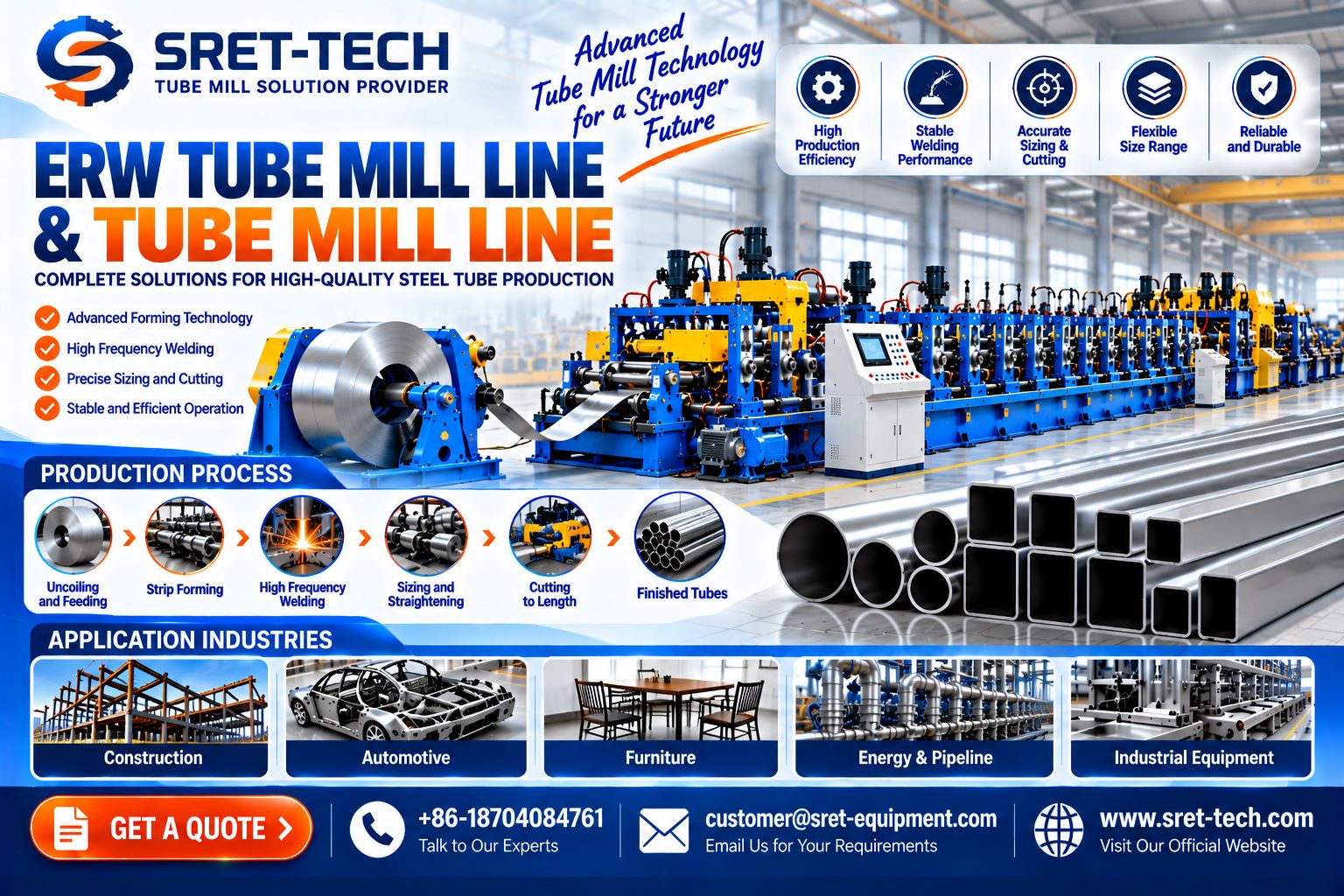
Steel tube manufacturing is becoming increasingly focused on production consistency, process efficiency, and reliable quality control. Manufacturers supplying construction, automotive, engineering, furniture, and industrial equipment sectors require production systems capable of delivering accurate dimensions and dependable welded tube quality.
An ERW Tube Mill Line plays an important role in manufacturing electric resistance welded steel tubes through a continuous forming and welding process.
Meanwhile, a modern Tube Mill Line integrates multiple production stages, including strip preparation, forming, welding where applicable, sizing, and cutting.
The growing emphasis on manufacturing efficiency is encouraging businesses to evaluate not only machine capacity but also production monitoring, material utilisation, and equipment maintenance.
For steel tube manufacturers and industrial investors, understanding these capabilities can support better machinery selection and more effective production planning.
Why Steel Tube Manufacturing Requires Greater Process Control
Steel tubes are used in applications where dimensional consistency, surface finish, and structural performance can be important.
Variations in wall thickness, weld quality, or tube dimensions may affect downstream manufacturing operations.
Consequently, tube production requires coordinated control across several manufacturing stages.
Modern production systems can incorporate monitoring equipment, adjustable forming mechanisms, and inspection technologies.
However, advanced machinery alone cannot guarantee product quality.
Appropriate operator training and quality procedures remain essential.
What Is an ERW Tube Mill Line?
An ERW Tube Mill Line is an industrial production system designed to manufacture welded tubes from steel strip using electric resistance welding technology.
The process generally begins with steel coils that are progressively formed into a tubular shape.
The strip edges are brought together and heated through an appropriate resistance welding process, commonly using high-frequency technology.
Pressure is then applied to form a longitudinal weld.
The welded tube passes through further processing stages to achieve the required dimensions and product characteristics.
Production capabilities depend on machine design, material grade, tube diameter, wall thickness, and relevant specifications.
Understanding the Main Stages of a Tube Mill Line
A typical welded tube mill line production system includes several coordinated operations.
1. Coil Preparation
Steel coils are loaded and prepared for processing. Suitable feeding equipment helps maintain consistent material supply.
2. Strip Accumulation
An accumulator may provide temporary strip storage, supporting more continuous production during coil changes.
3. Roll Forming
A series of forming rolls progressively shapes the steel strip into a tubular profile.
4. Welding
The strip edges are joined using the specified welding process, with appropriate control of welding conditions.
5. Weld Bead Processing
Excess weld material may be removed where required by the product specification.
6. Sizing and Straightening
Additional rolls help establish final dimensions and improve tube geometry.
7. Cutting and Inspection
The finished tube is cut to specified lengths and undergoes relevant quality checks.
Each stage influences the performance of the complete production line.
Why Welding Quality Is a Critical Manufacturing Factor
The longitudinal weld is an important feature of electric resistance welded tube production.
Weld quality can be influenced by strip-edge condition, forming alignment, heat input, and squeeze pressure.
Incorrect process conditions may contribute to weld defects or inconsistent joint properties.
Manufacturers should establish suitable operating parameters and inspection procedures for the material and product specification.
In-line monitoring and non-destructive testing may be used where appropriate.
However, inspection methods and acceptance criteria must match the applicable product standard.
This principle encourages manufacturers to prioritise process stability.
ERW Tube Mill Line vs Conventional Tube Production Systems
| Evaluation Factor | ERW Tube Mill Line | Other Tube Mill Configurations |
| Main Application | Longitudinally welded tube production | Depends on the forming or welding process |
| Welding Method | Electric resistance welding | May use other joining methods or none |
| Raw Material | Suitable steel strip coils | Depends on machine configuration |
| Production Control | Forming, welding, and sizing parameters | Application-specific controls |
| Quality Focus | Weld integrity and dimensional accuracy | Relevant product specifications |
| Equipment Selection | Diameter, thickness, material, output | Product and process requirements |
The appropriate system depends on manufacturing objectives and product requirements.
How Automation Supports Production Efficiency
Automation can help coordinate different operations within a tube manufacturing line.
Suitable control systems may monitor equipment speed, operating parameters, and production conditions.
Automated cutting systems can support repeatable tube lengths, while monitoring tools may help operators identify process deviations.
However, automation requirements differ between factories.
A smaller production facility may prioritise dependable operation and simple maintenance.
A larger manufacturing plant may require integrated production monitoring and detailed quality records.
The objective should be practical process improvement rather than adding unnecessary technological complexity.
Why Roll Tooling and Product Changeovers Matter
Tube manufacturers often produce different diameters, wall thicknesses, or product specifications.
Changing production requirements may involve adjustments to forming rolls, sizing equipment, and operating parameters.
Poorly managed changeovers can increase downtime and material waste.
Manufacturers should evaluate how easily a proposed production line can be adjusted for their intended product range.
Tooling design, accessibility, alignment procedures, and operator experience can influence changeover efficiency.
Standardised setup documentation can also support more consistent production.
Reducing Material Waste During Tube Production
Material utilisation is an important consideration in steel tube manufacturing.
Waste may arise from incorrect setup, dimensional errors, weld defects, or unsuitable raw material conditions.
Consistent strip quality and proper machine adjustment can help reduce avoidable losses.
Manufacturers should monitor relevant production indicators, including rejected products and material consumption.
However, increasing line speed without maintaining appropriate quality controls may create additional waste.
Effective production management requires balancing output with dimensional consistency and acceptable product quality.
Selecting the Right Tube Mill Line Manufacturer
Businesses investing in tube manufacturing equipment should evaluate suppliers against practical production requirements.
Important considerations include:
- Product Range: Confirm supported tube diameters, thicknesses, and materials.
- Production Capacity: Evaluate realistic output under specified conditions.
- Welding Technology: Review compatibility with intended product specifications.
- Equipment Configuration: Assess forming, sizing, cutting, and inspection systems.
- Automation Features: Identify monitoring and control requirements.
- Technical Support: Evaluate installation, training, maintenance, and spare parts arrangements.
A structured technical evaluation can help businesses avoid selecting equipment that does not match their operational needs.
Frequently Asked Questions (FAQs)
1. What is an ERW Tube Mill Line?
An ERW tube mill line is an industrial system that produces welded steel tubes by forming steel strip and joining its edges through electric resistance welding.
2. What is the purpose of a Tube Mill Line?
A tube mill line manufactures tubes through coordinated operations such as strip feeding, forming, welding where applicable, sizing, and cutting.
3. Which industries use ERW steel tubes?
ERW tubes are used in suitable construction, automotive, furniture, structural, and industrial engineering applications, depending on product specifications.
4. How can automation improve tube mill production?
Automation can support process monitoring, consistent equipment operation, cutting accuracy, and identification of production deviations.
5. What should buyers consider before purchasing an ERW tube mill?
Buyers should evaluate tube dimensions, material requirements, production capacity, welding technology, quality-control capabilities, maintenance needs, and supplier support.
Media Contact
Department: Tube Mill Machinery and Industrial Equipment Enquiries
Contact: +86-18704084761
Email : customer@sret-equipment.com
Official Website : https://www.sret-tech.com/