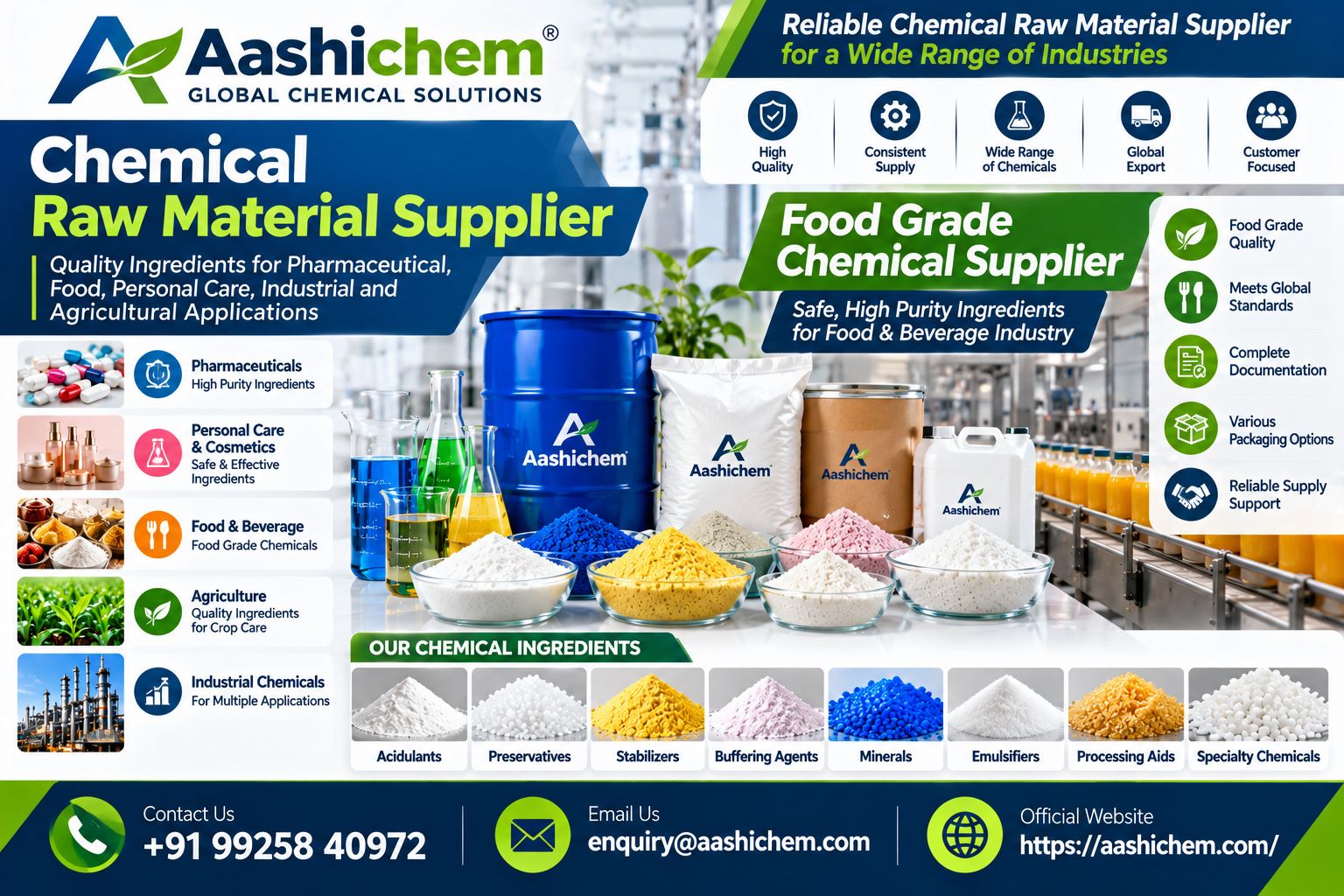
As food manufacturers develop products with increasingly specific formulation requirements, the quality of chemical raw materials has become an important consideration in production planning.
A professional Chemical Raw Material Supplier supports manufacturers by providing materials that meet defined technical specifications and application requirements.
Meanwhile, a qualified Food Grade Chemical Supplier focuses on supplying chemical ingredients suitable for food-related applications, subject to appropriate purity standards, regulatory requirements, and quality controls.
Although both supplier categories operate within the chemical industry, food-grade sourcing introduces additional considerations involving consumer safety, material handling, contamination prevention, and documentation.
For food processors, beverage manufacturers, ingredient distributors, and industrial procurement teams, understanding these differences can support safer purchasing decisions and more reliable manufacturing operations.
Why Food-Grade Chemical Sourcing Requires Special Attention
Chemical ingredients are used across many manufacturing sectors, but their quality requirements differ according to the intended application.
A chemical suitable for industrial cleaning, manufacturing, or technical processing may not be appropriate for use in food products.
Food-related materials must meet relevant identity, purity, safety, and regulatory requirements.
These expectations may include defined impurity limits, appropriate manufacturing practices, and suitable contamination controls.
A responsible sourcing strategy therefore considers the complete material supply process rather than relying exclusively on product descriptions or commercial quotations.
What Does a Chemical Raw Material Supplier Provide?
A Chemical Raw Material Supplier may provide substances used in food processing, pharmaceuticals, cosmetics, agriculture, water treatment, and industrial manufacturing.
Depending on its business model, the supplier may manufacture materials directly, distribute products from established producers, or coordinate procurement.
Its responsibilities can include providing technical specifications, product information, and relevant quality documentation.
However, the chemical name alone does not establish suitability for every application.
For example, a substance may be available in industrial, laboratory, and food grades with different specifications.
Purchasers should verify the exact grade and intended use before ordering.
Understanding the Role of a Food Grade Chemical Supplier
A Food Grade Chemical Supplier provides ingredients intended to meet relevant requirements for specified food applications.
These may include suitable acidity regulators, preservatives, buffering agents, processing aids, and other functional ingredients.
However, food-grade classification does not automatically authorise every use of a chemical in food.
Permitted applications, concentration limits, and regulatory requirements depend on the substance, product category, and destination market.
Suppliers should provide accurate specifications and appropriate documentation.
Food manufacturers remain responsible for verifying that ingredients comply with their intended applications.
Why Chemical Purity Matters in Food Manufacturing
Purity is an important consideration when evaluating food-related chemical ingredients.
Undesirable impurities may originate from raw materials, production processes, equipment, packaging, or handling.
Food manufacturers should establish acceptance criteria that reflect relevant regulatory and product-specific requirements.
Suitable analytical testing may address chemical identity, assay, and particular contaminants.
However, high assay values alone do not establish complete food suitability.
This makes comprehensive specifications more useful than relying on a single purity percentage.
Preventing Cross-Contamination During Chemical Storage
Ingredient quality can be affected after manufacturing if materials are stored or handled incorrectly.
Warehouses serving multiple chemical sectors may manage substances with different safety and purity requirements.
Inadequate segregation, damaged packaging, or unsuitable handling practices can create contamination risks.
Food-grade materials should be managed according to appropriate documented procedures.
Important practices may include:
- Material Segregation: Separating incompatible substances and controlling contamination risks.
- Packaging Integrity: Checking containers for damage or compromised seals.
- Clear Identification: Maintaining accurate product names and batch references.
- Storage Conditions: Following specified temperature, moisture, and environmental requirements.
- Handling Procedures: Using appropriate equipment and cleanliness controls.
- Traceability: Maintaining records connecting received materials with their sources.
These measures support better ingredient protection throughout distribution.
Food Grade vs Industrial Grade: Understanding the Difference
| Evaluation Factor | Food-Grade Chemicals | Industrial-Grade Chemicals |
| Intended Application | Specified food-related uses | Technical and industrial processes |
| Quality Requirements | Applicable food purity and safety specifications | Application-specific industrial standards |
| Impurity Controls | Relevant food safety limits | Limits determined by technical use |
| Documentation | Food-related specifications and compliance information | Technical specifications and safety information |
| Handling Requirements | Appropriate contamination prevention | Controls suitable for industrial applications |
| Regulatory Assessment | Food ingredient permissions and requirements | Applicable industrial regulations |
Food-grade materials must not be selected solely because their chemical composition resembles that of an industrial-grade product.
The intended application determines the necessary specifications.
Why Batch Traceability Supports Food Safety
Traceability allows manufacturers to connect purchased ingredients with their production records.
A suitable system records material identity, batch numbers, supplier information, and relevant quality documentation.
If a quality concern occurs, these records can support an investigation and help identify affected materials.
Traceability also improves communication between ingredient suppliers and food manufacturers.
However, documentation should be accurate, complete, and appropriate for the particular material.
Reliable recordkeeping is an important part of responsible ingredient management.
Supplier Qualification Beyond Product Pricing
Choosing a supplier involves evaluating the company’s ability to provide consistent materials and dependable technical support.
A structured qualification process should consider:
- Product Specifications: Confirm grade, identity, purity, and intended application.
- Supplier Capabilities: Understand manufacturing and distribution arrangements.
- Quality Documentation: Review relevant certificates and analytical information.
- Storage Controls: Evaluate contamination prevention and material handling.
- Regulatory Suitability: Confirm requirements for the intended food application.
- Change Communication: Establish procedures for reporting significant product changes.
This approach helps buyers recognise quality concerns before materials enter production.
Building Responsible Food Ingredient Supply Partnerships
Long-term supplier relationships work best when technical expectations are clearly documented.
Food manufacturers should communicate the intended application, quality requirements, packaging preferences, and relevant compliance obligations.
Suppliers should accurately describe available materials and communicate significant specification changes.
Where necessary, buyers may conduct additional testing or supplier assessments.
The objective is not simply to establish continuous material availability but to support consistent ingredient quality.
Clear cooperation between procurement, quality assurance, and production departments strengthens this process.
Frequently Asked Questions (FAQs)
1. What is a Chemical Raw Material Supplier?
A chemical raw material supplier provides substances used in manufacturing, formulation, processing, and other industrial applications according to specified technical requirements.
2. What does a Food Grade Chemical Supplier provide?
A food-grade chemical supplier provides ingredients intended for suitable food-related applications, supported by relevant quality specifications and documentation.
3. Are food-grade and industrial-grade chemicals interchangeable?
No. Even when their chemical identities are similar, their purity requirements, permitted applications, and regulatory specifications may differ.
4. Why is traceability important when purchasing food-grade chemicals?
Traceability helps identify material origins, manufacturing batches, and related documentation, supporting investigations and quality management.
5. How can food manufacturers select reliable chemical suppliers?
They should assess product specifications, supplier quality systems, contamination controls, batch documentation, regulatory suitability, and technical communication.
Media Contact
Department: Chemical Raw Materials and Food Ingredient Supply Enquiries
Contact: +91 99258 40972
Email: enquiry@aashichem.com
Official Website: https://aashichem.com/
Read More:-